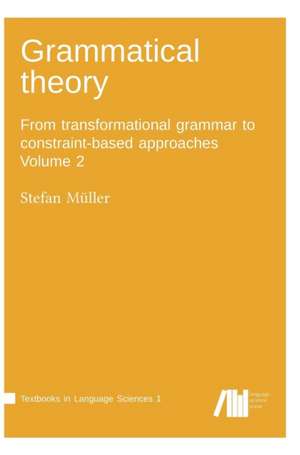
Grammatical theory Vol. 2: Textbooks in Language Sciences 1
Autor Stefan Müllerde Limba Germană Hardback – 22 mai 2017
Preț: 273.25 lei
Puncte Express: 410
Carte disponibilă
Livrare economică 07-21 noiembrie
Livrare prin curier în România Termenul estimat este afișat lângă disponibilitate.
Transport gratuit de la 400.00 lei Plată online sau ramburs, în funcție de opțiunile comenzii.
Retur gratuit în 14 zile Comandă securizată și suport în română.
Specificații
ISBN-13: 9783946234401
ISBN-10: 3946234402
Pagini: 394
Dimensiuni: 175 x 246 x 30 mm
Greutate: 0.87 kg
Ediția:1. Auflage
Editura: Language Science Press
Colecția Textbooks in Language Sciences 1
Seria Textbooks in Language Sciences 1
ISBN-10: 3946234402
Pagini: 394
Dimensiuni: 175 x 246 x 30 mm
Greutate: 0.87 kg
Ediția:1. Auflage
Editura: Language Science Press
Colecția Textbooks in Language Sciences 1
Seria Textbooks in Language Sciences 1
Notă biografică
Stefan Müller hat an der Humboldt-Universität zu Berlin und in Edinburgh Informatik, Computerlinguistik und Linguistik studiert. Danach arbeitete er am Deutschen Forschungszentrum für Künstliche Intelligenz (DFKI) in Saarbrücken und bei der Firma Interprice. Er hat in Jena eine Professur für Germanistische Linguistik und Computerlinguistik und in Potsdam eine für Theoretische Computerlinguistik vertreten. Er hatte eine Juniorprofessur in Bremen für Theoretische Linguistik und Computerlinguistik, eine W3-Professur für Deutsch und Allgemeine Sprachwissenschaft an der Freien Universität Berlin und ist jetzt Professor für Deutsche Sprache mit Schwerpunkt Syntax an der Humboldt-Universität zu Berlin.
Sein Forschungsschwerpunkt ist die deutsche Grammatik. Er arbeitet sowohl empirisch als auch theoretisch. Seine Interessengebiete sind Morphologie, Syntax, Semantik und Informationsstruktur. Er hat vor allem über das Deutsche publiziert, arbeitet aber auch an anderen Sprachen, wie z.B. Mandarin-Chinesisch, Maltesisch und Persisch, sowie den germanischen Sprachen, hier mit Schwerpunkt Dänisch. Die theoretische Arbeit wird im Rahmen der Head-Driven Phrase Structure Grammar (HPSG) durchgeführt und die theoretischen Analysen werden als computerverarbeitbare Grammatikfragmente implementiert. Die Grammatikfragmente, die im CoreGram Projekt implementiert sind, verwenden einen gemeinsamen Kern. Ein Ziel seiner Forschung ist es, Sprache zu verstehen und herauszufinden, was Sprachen im Allgemeinen und bestimmte Sprachklassen im Besonderen gemeinsam haben.