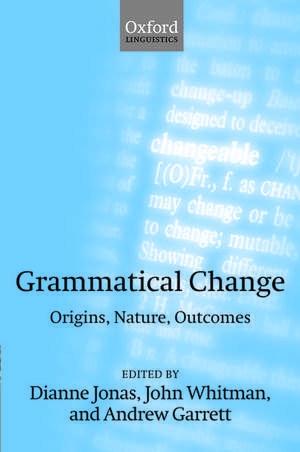
Grammatical Change: Origins, Nature, Outcomes
Editat de Dianne Jonas, John Whitman, Andrew Garretten Limba Engleză Hardback – 24 noi 2011
Preț: 998.54 lei
Preț vechi: 1454.75 lei
-31%
Puncte Express: 1498
Carte tipărită la comandă
Livrare economică 20-25 noiembrie
Livrare prin curier în România Termenul estimat este afișat lângă disponibilitate.
Transport gratuit pentru acest produs Plată online sau ramburs, în funcție de opțiunile comenzii.
Retur gratuit în 14 zile Comandă securizată și suport în română.
Specificații
ISBN-13: 9780199582624
ISBN-10: 0199582629
Pagini: 400
Ilustrații: 38 Tables, 17 Figures
Dimensiuni: 163 x 240 x 27 mm
Greutate: 0.73 kg
Editura: OUP OXFORD
Colecția OUP Oxford
Locul publicării:Oxford, United Kingdom
ISBN-10: 0199582629
Pagini: 400
Ilustrații: 38 Tables, 17 Figures
Dimensiuni: 163 x 240 x 27 mm
Greutate: 0.73 kg
Editura: OUP OXFORD
Colecția OUP Oxford
Locul publicării:Oxford, United Kingdom
V-ar putea interesa
-
 Sinitic Grammar: Synchronic and Diachronic PerspectivesHilary Chappell-30%Preț: 529.81 lei753.11 lei
 -
 DegrammaticalizationMuriel Norde-11%Preț: 338.67 lei381.14 lei
 -
 Grammaticalization and Parametric VariationMontserrat Batllori-33%Preț: 1279.26 lei1906.58 lei
 -
 Lexical Plurals: A Morphosemantic ApproachPaolo Acquaviva-21%Preț: 374.29 lei474.37 lei
 -
 Lexical Semantics, Syntax, and Event StructureMalka Rappaport Hovav-32%Preț: 550.14 lei810.09 lei
 -
 -21%Preț: 475.95 lei602.75 lei
 -
 Dissolving Binding TheoryJohan Rooryck-21%Preț: 446.71 lei567.25 lei
 -
 Comparisons and ContrastsRichard Kayne-28%Preț: 486.30 lei678.61 lei
 -
 -21%Preț: 400.09 lei507.81 lei
 -
 Essentials of Cognitive GrammarRonald W. Langacker-13%Preț: 292.88 lei335.44 lei
 -
 KoreanSungdai Cho-14%Preț: 828.88 lei963.81 lei
 -
 -15%Preț: 425.72 lei500.84 lei
 -
 Preț: 232.30 lei
 -
 Preț: 464.26 lei
 -
 Preț: 464.26 lei
 -
 Category Neutrality: A Type-Logical InvestigationNeil Whitman-15%Preț: 422.92 lei497.56 lei
 -
 Plains Cree MorphosyntaxAmy DahlstromPreț: 473.96 lei
 -
 Preț: 467.54 lei
 -
 -23%Preț: 162.35 lei210.44 lei
 -
 Handbook of Historical Japanese LinguisticsBjarke Frellesvig-23%Preț: 2422.53 lei3146.15 lei
 -
 Let God AriseJohn WhitmanPreț: 90.13 lei
 -
 Krav Maga für EinsteigerDarren LevinePreț: 133.54 lei
 -
 Krav MagaDarren LevinePreț: 174.79 lei
 -
 Affixation and Auxiliaries in IgboVirginia Chinwe OnumajuruPreț: 273.76 lei
Notă biografică
Dianne Jonas (PhD Harvard University 1997) is currently replacement professor of English Linguistics at Goethe University, Frankfurt. Her main research interests are comparative Scandinavian syntax, Icelandic and Faroese in particular, syntactic variation and change, and dialect syntax (Shetland Dialect and Norfuk English).John Whitman (PhD Harvard 1984) is Professor of Linguistics at Cornell University. He works on structural variation among languages, with a focus on the languages of East Asia: Japanese, Korean, and Chinese, in that order, in addition to a more recent interest in Burmese and Karen languages. Recent projects have been on the syntactic alignment of Old Japanese (with Yuko Yanagida), the structure of applicatives, and the long-vexed question of the word order typology of Old Chinese and proto-Sino-Tibetan (with Redouane Djamouri and Waltraud Paul). Andrew Garrett (PhD Harvard 1990) is Professor of Linguistics at the University of California, Berkeley, where he also serves as Director of the Survey of California and Other Indian Languages. In historical linguistics he has published on general topics in sound change and morphological change as well as the dialectology, diversification, and prehistory of Yurok (an Algic language of California) and Western Numic (Uto-Aztecan), the dialectology and diachronic syntax of English, and the syntax and morphology of Anatolian, Greek, and Latin.
Cuprins
- 1: John Whitman, Dianne Jonas, and Andrew Garrett: Introduction
- Part 1: Grammaticalization and Directionality of Change
- 2: Paul Kiparsky: Grammaticalization as Optimization
- 3: Andrew Garrett: The Historical Syntax Problem: Reanalysis and Directionality
- 4: Montse Batllori and Francesc Roca: Grammaticalization of ser and estar in Romance
- 5: David Willis: A Minimalist Approach to Jespersen's Cycle in Welsh
- Part 2: Change in the Nominal Domain: Internal and External Factors
- 6: Uffe Bergeton and Roumyana Pancheva: A New Perspective on the Historical Development of English Intensifiers and Reflexives
- 7: Gertjan Postma: Language Contact and Linguistic Complexity - The Rise of the Reflexive Pronoun zich in a 15th Century netherlands' Border Dialect
- 8: Mila Dimitrova-Vulchanova and Valentin Vulchanov: An Article Evolving: The Case of Old Bulgarian
- 9: Christina Guardiano: Parametric Changes in the History of the Greek Article
- 10: Paola Chrisma: Triggering Syntactic Change: Inertia and Local Causes in the History of English Genitives
- Part 3: Change in the Clausal Domain: Cues, Triggers, and Articulation
- 11: Eric Haeberli and Susan Pintzuk: Revisting Verb (Projection) Raising in Old English
- 12: Ans van Kemenade and Tanja Milicev: Syntax and Discourse in Old English and Middle Word Order
- 13: Brady Clark: Subjects in Early English: Syntactic Change as Gradual Constraint Reranking
- 14: Ana Maria Martins: Coordination, Gapping, and the Portuguese Inflected Infinitive: The Role of Structural Ambiguity in Syntactic Change
- 15: John Sundquist: Neg Movement in the History of Norwegian: The Evolution of a Grammatical Virus
- Part 4: Morphosyntactic Change and Language Type
- 16: Jason Haugen: On the Gradual Development of Polysynthesis in Nahuatl
- 17: Edith Aldridge: Antipassive in Austronesian Alignment Changeg
- References
- Acknowledgements
- Index