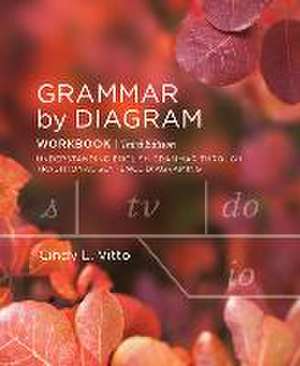
Grammar by Diagram: Workbook - Third Edition
Autor Cindy L. Vittoen Limba Engleză Spirală – 3 mai 2022
The Grammar by Diagram Workbook provides practice exercises to accompany each chapter, including cumulative exercises with which students can check their progress at key points, a summary of concepts for each chapter, and a complete answer key.
Preț: 308.75 lei
Preț vechi: 344.21 lei
-10%
Puncte Express: 463
Carte disponibilă
Livrare economică 27 octombrie-10 noiembrie
Livrare prin curier în România Termenul estimat este afișat lângă disponibilitate.
Transport gratuit de la 400.00 lei Plată online sau ramburs, în funcție de opțiunile comenzii.
Retur gratuit în 14 zile Comandă securizată și suport în română.
Specificații
ISBN-13: 9781554814541
ISBN-10: 1554814545
Pagini: 240
Dimensiuni: 197 x 238 x 18 mm
Greutate: 0.45 kg
Ediția:3rd edition
Editura: BROADVIEW PR
Colecția Broadview Press
Locul publicării:Peterborough, Canada
ISBN-10: 1554814545
Pagini: 240
Dimensiuni: 197 x 238 x 18 mm
Greutate: 0.45 kg
Ediția:3rd edition
Editura: BROADVIEW PR
Colecția Broadview Press
Locul publicării:Peterborough, Canada
V-ar putea interesa
-
 Everyday GrammarJohn Seely-21%Preț: 77.90 lei98.08 lei
 -
 Essential English GrammarPhilip GuckerPreț: 61.62 lei
 -
 -19%Preț: 127.16 lei156.94 lei
 -
 The Blue Book of Grammar and PunctuationLester KaufmanPreț: 111.82 lei
 -
 Preț: 431.35 lei
 -
 Preț: 301.91 lei
 -
![Grammar Dimensions, Book 4: Form, Meaning, and Use [With Access Code]](https://i2.books-express.ro/bt/9781413027525/grammar-dimensions-book-4.jpg) Preț: 225.76 lei
Preț: 225.76 lei -
 Templates: Models of Style and Usage for WritersStephen Lewis-23%Preț: 263.85 lei340.96 lei
 -
 Grammar by Diagram - Third EditionCindy L. Vitto-15%Preț: 471.66 lei554.89 lei
 -
 The English Grammar Workbook for Grades 6, 7, and 8Lauralee MossPreț: 134.73 lei
 -
 Grammar 1 Pupil BookSara WernhamPreț: 58.46 lei
 -
 The Grammar 3 HandbookSara WernhamPreț: 348.85 lei
 -
 The Grammar 4 HandbookSara WernhamPreț: 349.59 lei
 -
 Grammar 3 Pupil BookSara WernhamPreț: 58.59 lei
 -
 Grammar 1 Workbooks 1-6Sara WernhamPreț: 150.23 lei
 -
 Preț: 348.52 lei
Recenzii
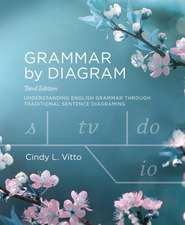
Grammar by Diagram is a book designed for anyone who wishes to improve grammatical understanding and skill. Using traditional sentence diagraming as a visual tool, the book explains how to expand ten basic patterns for simple sentences into compound, complex, and compound-complex sentences, and how to employ verbals (infinitives, gerunds, and participles), other specialized structures, and even punctuation for additional versatility.
The Grammar by Diagram Workbook provides practice exercises to accompany each chapter, including cumulative exercises with which students can check their progress at key points, a summary of concepts for each chapter, and a complete answer key.
“Grammar for English majors is as important as mathematics for physics majors; it is the invisible structure that determines how language works. Unlike math, however, almost everyone learns to speak a language well without studying it in school. Grammar is unconscious logical structure we know without knowing it. Cindy Vitto’s Grammar by Diagram makes it conscious and comprehensible and will improve students’ writing and analytical skills, no matter their majors.” — Gordon Sayre, University of Oregon
Priase for the second edition:
“Rejoice! After years of neglect, sentence diagraming can unapologetically return to college courses. Cindy Vitto’s Grammar by Diagram makes this a fruitful return by using diagraming first to lay bare the structural bones of English and then to demonstrate ways in which writers use these components to create effective sentences. Through diagraming, students see that a strong sentence is a purposefully structured unit and not a set of words aimlessly strung together. Thus Grammar by Diagram gives students not only skills for crafting better sentences but also tools for examining language with greater care.” — Candace Barrington, Central Connecticut State University
“Grammar by Diagram is a dream come true for me. I grew up academically on diagraming, and I have always thought it is one of the best ways for students to visualize the structure of the language.” — George Edward Stanley, Cameron University
The Grammar by Diagram Workbook provides practice exercises to accompany each chapter, including cumulative exercises with which students can check their progress at key points, a summary of concepts for each chapter, and a complete answer key.
“Grammar for English majors is as important as mathematics for physics majors; it is the invisible structure that determines how language works. Unlike math, however, almost everyone learns to speak a language well without studying it in school. Grammar is unconscious logical structure we know without knowing it. Cindy Vitto’s Grammar by Diagram makes it conscious and comprehensible and will improve students’ writing and analytical skills, no matter their majors.” — Gordon Sayre, University of Oregon
Priase for the second edition:
“Rejoice! After years of neglect, sentence diagraming can unapologetically return to college courses. Cindy Vitto’s Grammar by Diagram makes this a fruitful return by using diagraming first to lay bare the structural bones of English and then to demonstrate ways in which writers use these components to create effective sentences. Through diagraming, students see that a strong sentence is a purposefully structured unit and not a set of words aimlessly strung together. Thus Grammar by Diagram gives students not only skills for crafting better sentences but also tools for examining language with greater care.” — Candace Barrington, Central Connecticut State University
“Grammar by Diagram is a dream come true for me. I grew up academically on diagraming, and I have always thought it is one of the best ways for students to visualize the structure of the language.” — George Edward Stanley, Cameron University
Cuprins
Introduction
CHAPTER 1: Preliminaries
CHAPTER 2: Building a Sentence with Noun/Pronoun and Verb
CHAPTER 3: Adjectives, Adverbs, Prepositions, Conjunctions, Interjections
CHAPTER 4: Basic Sentence Patterns for Be and Linking Verbs
CHAPTER 5: Basic Sentence Patterns for Intransitive and Transitive Verbs
CHECK YOUR PROGRESS: Chapters 1–5
CHAPTER 6: Combining and Expanding Patterns: Compound Structures
CHAPTER 7: Combining and Expanding Patterns: Complex Sentences with Adverb and Relative Clauses
CHAPTER 8: Complex Sentences with Noun Clauses
CHAPTER 9: Verbals
CHAPTER 10: Crafting Better Sentences
CHECK YOUR PROGRESS: Chapters 6–10
CHAPTER 11: Verbs
CHAPTER 12: Pronouns
CHAPTER 13: Usage Problems Associated with Adjectives and Adverbs
CHAPTER 14: Punctuation and Capitalization
Answer Key
CHAPTER 1: Preliminaries
CHAPTER 2: Building a Sentence with Noun/Pronoun and Verb
CHAPTER 3: Adjectives, Adverbs, Prepositions, Conjunctions, Interjections
CHAPTER 4: Basic Sentence Patterns for Be and Linking Verbs
CHAPTER 5: Basic Sentence Patterns for Intransitive and Transitive Verbs
CHECK YOUR PROGRESS: Chapters 1–5
CHAPTER 6: Combining and Expanding Patterns: Compound Structures
CHAPTER 7: Combining and Expanding Patterns: Complex Sentences with Adverb and Relative Clauses
CHAPTER 8: Complex Sentences with Noun Clauses
CHAPTER 9: Verbals
CHAPTER 10: Crafting Better Sentences
CHECK YOUR PROGRESS: Chapters 6–10
CHAPTER 11: Verbs
CHAPTER 12: Pronouns
CHAPTER 13: Usage Problems Associated with Adjectives and Adverbs
CHAPTER 14: Punctuation and Capitalization
Answer Key