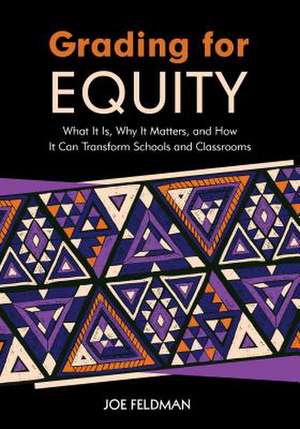
Grading for Equity: What It Is, Why It Matters, and How It Can Transform Schools and Classrooms
Autor Joe Feldmanen Limba Engleză Electronic book text – 19 sep 2018
Preț: 191.12 lei
Puncte Express: 287
Preț estimativ în valută:
31.00€ • 35.83$ • 26.78£
31.00€ • 35.83$ • 26.78£
Indisponibil temporar
Doresc să fiu notificat când acest titlu va fi disponibil:
Se trimite...
Specificații
ISBN-13: 9781506391601
ISBN-10: 1506391605
Pagini: 296
Dimensiuni: 178 x 254 mm
Ediția:1
Editura: SAGE Publications
Colecția Corwin
Locul publicării:Thousand Oaks, United States
ISBN-10: 1506391605
Pagini: 296
Dimensiuni: 178 x 254 mm
Ediția:1
Editura: SAGE Publications
Colecția Corwin
Locul publicării:Thousand Oaks, United States
Recenzii
“This
book
will
stop
educators
who
want
to
improve
their
practices
with
underserved
students
right
in
their
tracks.
Feldman
offers
an
insightful
invitation
to
teachers
who
dare
change
the
ways
in
which
we
have
been
taught
to
grade
students’
products.
He
demonstrates
how
our
grading
practices
are
grossly
under-substantiated
and
too
often
unquestioned,
and
he
challenges
educators
to
build
equitable
assessment
tools
and
mechanisms
to
support
learning
and
development
of
all
students. Grading
for
Equitypenetrates
macro-level
grading
policies
to
transform
micro-level
teaching
practices
that
embrace
the
cultural
and
the
contextual.
A
must
read
for
justice-centered
educators.”
"Wow, Wow Wow!!! This book hooked me as a not-to-be-missed read right from the Prologue. Joe Feldman makes a strong case for shared grading practices to overcome the inequity of traditional grading, with solid reasoning, well-chosen research evidence, and perhaps most significantly, the powerful and frequent use of teacher voice. The chapters’ organizing structure encourages thoughtful and reflective reading, and will be particularly beneficial for book study within PLCs. . . . The main message of the book for me is summed up in this quote, 'We teachers cannot continue to sacrifice the integrity and reliability of our grades at the altar of professional autonomy.'"
"There is growing awareness within the industry of education that traditional grading practices have become a barrier to meaningful student learning. One dilemma is that there is a lack of resources to support educators who want to adopt new grading practices that are both accurate and equitable. Joe Feldman addresses this need with his book, Grading for Equity. Joe skillfully makes a compelling argument for change and offers specific ways educators can make profound differences to their grading practices. Students become intrinsically motivated to learn when their grades accurately measure where they are in the learning process. Students who typically give up any hope of success can now approach learning with a positive growth mindset. Grading for Equitywill provide clarity and tools for an individual instructor or as a book study for an entire organization."
"Joe Feldman peels back the curtain and shows the many flaws of our traditional grading system. His arguments are convincing - and the alternatives he proposes are both practical and powerful. Reading this book will make you re-think the way you assess students and will inspire you to enact a system that encourages revision and redemption instead of compliance and corruption. "
"We don’t usually think of grading when talking about equity, but inGrading for Equity: What It Is, Why It Matters, and How It Can Transform Schools and Classrooms, Joe Feldman helps us see why grading is an integral part of an equity agenda. He shows us how we can use grading to help students become the leaders of their own learning and lift the veil on how to succeed. He reminds us that authentic assessment and transparent grading are essential parts of a culturally responsive classroom. This must-have book will help teachers learn to implement improved, equity-focused grading for impact."
"Wow, Wow Wow!!! This book hooked me as a not-to-be-missed read right from the Prologue. Joe Feldman makes a strong case for shared grading practices to overcome the inequity of traditional grading, with solid reasoning, well-chosen research evidence, and perhaps most significantly, the powerful and frequent use of teacher voice. The chapters’ organizing structure encourages thoughtful and reflective reading, and will be particularly beneficial for book study within PLCs. . . . The main message of the book for me is summed up in this quote, 'We teachers cannot continue to sacrifice the integrity and reliability of our grades at the altar of professional autonomy.'"
"There is growing awareness within the industry of education that traditional grading practices have become a barrier to meaningful student learning. One dilemma is that there is a lack of resources to support educators who want to adopt new grading practices that are both accurate and equitable. Joe Feldman addresses this need with his book, Grading for Equity. Joe skillfully makes a compelling argument for change and offers specific ways educators can make profound differences to their grading practices. Students become intrinsically motivated to learn when their grades accurately measure where they are in the learning process. Students who typically give up any hope of success can now approach learning with a positive growth mindset. Grading for Equitywill provide clarity and tools for an individual instructor or as a book study for an entire organization."
"Joe Feldman peels back the curtain and shows the many flaws of our traditional grading system. His arguments are convincing - and the alternatives he proposes are both practical and powerful. Reading this book will make you re-think the way you assess students and will inspire you to enact a system that encourages revision and redemption instead of compliance and corruption. "
"We don’t usually think of grading when talking about equity, but inGrading for Equity: What It Is, Why It Matters, and How It Can Transform Schools and Classrooms, Joe Feldman helps us see why grading is an integral part of an equity agenda. He shows us how we can use grading to help students become the leaders of their own learning and lift the veil on how to succeed. He reminds us that authentic assessment and transparent grading are essential parts of a culturally responsive classroom. This must-have book will help teachers learn to implement improved, equity-focused grading for impact."
Cuprins
ACKNOWLEDGMENTS
ABOUT THE AUTHOR
PROLOGUE: MALLORY’S DILEMMA
PART I: FOUNDATIONS
CHAPTER 1. WHAT MAKES GRADING SO DIFFICULT TO TALK ABOUT (AND EVEN HARDER TO CHANGE)?
Grading as Identity
Grading and Our “Web of Belief”
Who Is This Book For?
Blending the Technical and Theoretical
How Is This Book Organized?
A Final Word
Summary of Concepts / Questions to Consider
CHAPTER 2. A BRIEF HISTORY OF GRADING
The Twentieth Century Context
Impact on Schools
Grading in the Twentieth Century
Summary of Concepts / Questions to Consider
PART II: THE CASE FOR CHANGE: HOW TRADITIONAL GRADING THWARTS EFFECTIVE AND EQUITABLE TEACHING AND LEARNING
CHAPTER 3. HOW TRADITIONAL GRADING STIFLES RISK-TAKING AND SUPPORTS THE “COMMODITY OF GRADES”
Risk-Taking, Trust, and the Teacher–Student Relationship
The “Commodity of Grades” and Extrinsic Motivation
Summary of Concepts / Questions to Consider
CHAPTER 4. TRADITIONAL GRADING HIDES INFORMATION, INVITES BIASES, AND PROVIDES MISLEADING INFORMATION
Traditional Grading Evaluates Both a Student’s Content Knowledge as Well as Their Behaviors, and Invites Subjectivity and Bias
Implicit Bias and Traditional Grading
The “Omnibus” Grade: A Barrel-ful of Information in a Thimble-Size Container
A Tale of Two Students: Tangela and Isabel
Grade Hacks
The Impact of Variable and Unreliable Grading
Summary of Concepts / Questions to Consider
CHAPTER 5. TRADITIONAL GRADING DEMOTIVATES AND DISEMPOWERS
Disengagement and Disempowerment
Motivating Students to Do the Wrong Thing
So Where Do We Go From Here?
Summary of Concepts / Questions to Consider
CHAPTER 6. A NEW VISION OF GRADING
Supporting the Pillars: Coherence
A Measured Vision
Summary of Concepts / Questions to Consider
PART III: EQUITABLE GRADING PRACTICES
CHAPTER 7. PRACTICES THAT ARE MATHEMATICALLY ACCURATE
The Zero
The 0-100-Percentage Scale: Early Use and Enduring Flaws
The 0–100 Scale’s Orientation Toward Failure
Minimum Grading
The 0–4 Grading Scale
Summary of Concepts / Questions to Consider
CHAPTER 8. PRACTICES THAT ARE MATHEMATICALLY ACCURATE (CONTINUED)
The Problems With Averaging
Weighting More Recent Performance
Examining the Group Grade
Encouraging Productive Group Work Without a Group Grade
Our Accuracy Pillar: A Final Thought
Summary of Concepts / Questions to Consider
CHAPTER 9. PRACTICES THAT VALUE KNOWLEDGE, NOT ENVIRONMENT OR BEHAVIOR
Examining Extra Credit
If the Work Is Important, Require It; If It’s Not, Don’t Include It in the Grade
Grading the Work, Not the Timing of the Work
What’s the Alternative to Lowering Grades for Late Work?
Alternative (Non-Grade) Consequences for Cheating
Excluding “Participation” and “Effort” From the Grade
Summary of Concepts / Questions to Consider
CHAPTER 10. PRACTICES THAT VALUE KNOWLEDGE, NOT ENVIRONMENT OR BEHAVIOR (CONTINUED)
Homework
The Impact of Including Homework in the Grade: Student Voices and Copying
Reframing Homework
Grades Based Entirely on Summative Assessment Performance
Grades to Teach Students, Not to Control Them
Summary of Concepts / Questions to Consider
CHAPTER 11. PRACTICES THAT SUPPORT HOPE AND A GROWTH MINDSET
Our Understanding of Motivation
Grades and Their Impact on Student Motivation
The Role of Mistakes in Learning
Minimum Grading (A Revisit)
Renaming Grades
Retakes and Redos
Retakes: Frequent Approaches
Retakes: Common Concerns
Summary of Concepts / Questions to Consider
CHAPTER 12. PRACTICES THAT “LIFT THE VEIL”
The Veils in Our Schools, and “Hostile Attributional Bias”
Rubrics: What Are They, and Why?
Scoring Rubrics and Grade Book Entries
Using Rubrics to Empower Students
“Lifting the Veil” for Tests: The Opacity of Points
Beyond Points: Standards Scales
The Effects of Standards Transparency
Standards-Based Grade Books
Veils, Rubrics, and the “Real World”
Summary of Concepts / Questions to Consider
CHAPTER 13. PRACTICES THAT BUILD “SOFT SKILLS” WITHOUT INCLUDING THEM IN THE GRADE
“Soft Skills”
Grading as Feedback
Preparation for the “Real World”
Whose “Real World” Are We Talking About?
Connecting Soft Skills to Academic Success
Two Grades: Academic and “Soft Skills”
The Twenty-First Century’s Soft Skill: Self-Regulation
Creating a Community of Feedback
Student Trackers and Goal-Setting
Summary of Concepts / Questions to Consider
CHAPTER 14. PUTTING IT ALL TOGETHER: NICK AND CATHY
Nick: Rethinking Assessments: Getting Away From the Games, and Focusing on Learning
Cathy: A Clearer Vision of Excellence
Summary of Concepts / Questions to Consider
EPILOGUE: A RETURN TO MALLORY’S SCHOOL
BIBLIOGRAPHY
INDEX
ABOUT THE AUTHOR
PROLOGUE: MALLORY’S DILEMMA
PART I: FOUNDATIONS
CHAPTER 1. WHAT MAKES GRADING SO DIFFICULT TO TALK ABOUT (AND EVEN HARDER TO CHANGE)?
Grading as Identity
Grading and Our “Web of Belief”
Who Is This Book For?
Blending the Technical and Theoretical
How Is This Book Organized?
A Final Word
Summary of Concepts / Questions to Consider
CHAPTER 2. A BRIEF HISTORY OF GRADING
The Twentieth Century Context
Impact on Schools
Grading in the Twentieth Century
Summary of Concepts / Questions to Consider
PART II: THE CASE FOR CHANGE: HOW TRADITIONAL GRADING THWARTS EFFECTIVE AND EQUITABLE TEACHING AND LEARNING
CHAPTER 3. HOW TRADITIONAL GRADING STIFLES RISK-TAKING AND SUPPORTS THE “COMMODITY OF GRADES”
Risk-Taking, Trust, and the Teacher–Student Relationship
The “Commodity of Grades” and Extrinsic Motivation
Summary of Concepts / Questions to Consider
CHAPTER 4. TRADITIONAL GRADING HIDES INFORMATION, INVITES BIASES, AND PROVIDES MISLEADING INFORMATION
Traditional Grading Evaluates Both a Student’s Content Knowledge as Well as Their Behaviors, and Invites Subjectivity and Bias
Implicit Bias and Traditional Grading
The “Omnibus” Grade: A Barrel-ful of Information in a Thimble-Size Container
A Tale of Two Students: Tangela and Isabel
Grade Hacks
The Impact of Variable and Unreliable Grading
Summary of Concepts / Questions to Consider
CHAPTER 5. TRADITIONAL GRADING DEMOTIVATES AND DISEMPOWERS
Disengagement and Disempowerment
Motivating Students to Do the Wrong Thing
So Where Do We Go From Here?
Summary of Concepts / Questions to Consider
CHAPTER 6. A NEW VISION OF GRADING
Supporting the Pillars: Coherence
A Measured Vision
Summary of Concepts / Questions to Consider
PART III: EQUITABLE GRADING PRACTICES
CHAPTER 7. PRACTICES THAT ARE MATHEMATICALLY ACCURATE
The Zero
The 0-100-Percentage Scale: Early Use and Enduring Flaws
The 0–100 Scale’s Orientation Toward Failure
Minimum Grading
The 0–4 Grading Scale
Summary of Concepts / Questions to Consider
CHAPTER 8. PRACTICES THAT ARE MATHEMATICALLY ACCURATE (CONTINUED)
The Problems With Averaging
Weighting More Recent Performance
Examining the Group Grade
Encouraging Productive Group Work Without a Group Grade
Our Accuracy Pillar: A Final Thought
Summary of Concepts / Questions to Consider
CHAPTER 9. PRACTICES THAT VALUE KNOWLEDGE, NOT ENVIRONMENT OR BEHAVIOR
Examining Extra Credit
If the Work Is Important, Require It; If It’s Not, Don’t Include It in the Grade
Grading the Work, Not the Timing of the Work
What’s the Alternative to Lowering Grades for Late Work?
Alternative (Non-Grade) Consequences for Cheating
Excluding “Participation” and “Effort” From the Grade
Summary of Concepts / Questions to Consider
CHAPTER 10. PRACTICES THAT VALUE KNOWLEDGE, NOT ENVIRONMENT OR BEHAVIOR (CONTINUED)
Homework
The Impact of Including Homework in the Grade: Student Voices and Copying
Reframing Homework
Grades Based Entirely on Summative Assessment Performance
Grades to Teach Students, Not to Control Them
Summary of Concepts / Questions to Consider
CHAPTER 11. PRACTICES THAT SUPPORT HOPE AND A GROWTH MINDSET
Our Understanding of Motivation
Grades and Their Impact on Student Motivation
The Role of Mistakes in Learning
Minimum Grading (A Revisit)
Renaming Grades
Retakes and Redos
Retakes: Frequent Approaches
Retakes: Common Concerns
Summary of Concepts / Questions to Consider
CHAPTER 12. PRACTICES THAT “LIFT THE VEIL”
The Veils in Our Schools, and “Hostile Attributional Bias”
Rubrics: What Are They, and Why?
Scoring Rubrics and Grade Book Entries
Using Rubrics to Empower Students
“Lifting the Veil” for Tests: The Opacity of Points
Beyond Points: Standards Scales
The Effects of Standards Transparency
Standards-Based Grade Books
Veils, Rubrics, and the “Real World”
Summary of Concepts / Questions to Consider
CHAPTER 13. PRACTICES THAT BUILD “SOFT SKILLS” WITHOUT INCLUDING THEM IN THE GRADE
“Soft Skills”
Grading as Feedback
Preparation for the “Real World”
Whose “Real World” Are We Talking About?
Connecting Soft Skills to Academic Success
Two Grades: Academic and “Soft Skills”
The Twenty-First Century’s Soft Skill: Self-Regulation
Creating a Community of Feedback
Student Trackers and Goal-Setting
Summary of Concepts / Questions to Consider
CHAPTER 14. PUTTING IT ALL TOGETHER: NICK AND CATHY
Nick: Rethinking Assessments: Getting Away From the Games, and Focusing on Learning
Cathy: A Clearer Vision of Excellence
Summary of Concepts / Questions to Consider
EPILOGUE: A RETURN TO MALLORY’S SCHOOL
BIBLIOGRAPHY
INDEX
Descriere
This
book delivers
the
research
base,
tools,
and
courage
to
tackle
one
of
the
most
challenging
and
emotionally
charged
conversations
in
today's
schools:
our
inconsistent
grading
practices
and
the
ways
they
can
inadvertently
perpetuate
the
achievement
and
opportunity
gaps
among
our
students.