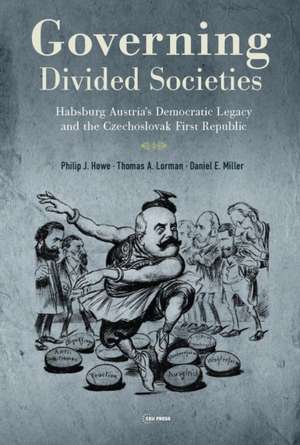
Governing Divided Societies
Autor Philip J Howe, Thomas A Lorman, Daniel E. Milleren Limba Engleză Hardback – 31 aug 2026
Consociationalism has proven its worth as a model for describing contemporary democracies and diagnosing their ills. By exploring the institutions and practices of the Habsburg Monarchy before 1918 and the Czechoslovak First Republic, Howe, Lorman, and Miller prove the value of the consociational theory in analyzing the past. They hold that a multitude of parties, frequent cabinet changes, and reliance on cabinets of experts do not necessarily signal flawed democracies. In fact, they are features of consociationalism. This volume challenges historians and social scientists to view the Austrian half of the Habsburg Monarchy before 1918 as evolving toward consociational democracy and the Czechoslovak First Republic as a fully consociational state.
Preț: 967.75 lei
Preț vechi: 1180.19 lei
-18% Nou
Puncte Express: 1452
Carte tipărită la comandă
Livrare economică 05-19 decembrie
Livrare prin curier în România Termenul estimat este afișat lângă disponibilitate.
Transport gratuit pentru acest produs Plată online sau ramburs, în funcție de opțiunile comenzii.
Retur gratuit în 14 zile Comandă securizată și suport în română.
Specificații
ISBN-13: 9789633865859
ISBN-10: 9633865859
Pagini: 16
Dimensiuni: 156 x 234 x 25 mm
Greutate: 0.8 kg
Editura: Amsterdam University Press
ISBN-10: 9633865859
Pagini: 16
Dimensiuni: 156 x 234 x 25 mm
Greutate: 0.8 kg
Editura: Amsterdam University Press
Notă biografică
Philip J. Howe is a professor of political science at Adrian College in Adrian, MI. Thomas A. Lorman is a teaching fellow in the School of Slavonic and East European Studies at the University College London. Daniel E. Miller is a professor of history at the University of West Florida in Pensacola.
Cuprins
List of Tables List of Illustrations List of Abbreviations Foreword Preface Introduction Chapter 1 -Consociationalism and Consensus Democracy in Theory and Practice Chapter 2 - Imperial Austria's Proto-consociational Legacy Chapter 3 - Czechoslovakia as a Consociational Democracy Chapter 4 - The Consociational Model and Interwar Slovakia Conclusion Bibliography About the Authors