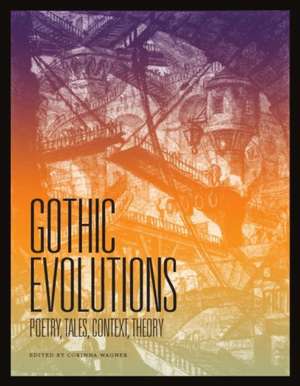
Gothic Evolutions: Poetry, Tales, Context, Theory
Editat de Corinna Wagneren Limba Engleză Paperback – 23 iun 2014
In addition to a wide selection of classic and lesser-known texts from the eighteenth and nineteenth centuries, Gothic Evolutions includes key examples of the aesthetic, scientific, and cultural theory related to the Gothic, from John Locke and David Hume to Sigmund Freud and Julia Kristeva.
Preț: 412.04 lei
Preț vechi: 544.87 lei
-24%
Puncte Express: 618
Carte disponibilă
Livrare economică 09-23 noiembrie
Livrare express 23-29 octombrie pentru 100.46 lei
Livrare prin curier în România Termenul estimat este afișat lângă disponibilitate.
Transport gratuit pentru acest produs Plată online sau ramburs, în funcție de opțiunile comenzii.
Retur gratuit în 14 zile Comandă securizată și suport în română.
Specificații
ISBN-13: 9781551119816
ISBN-10: 1551119811
Pagini: 525
Dimensiuni: 178 x 229 x 24 mm
Greutate: 0.83 kg
Editura: BROADVIEW PR
Colecția Broadview Press
Locul publicării:Peterborough, Canada
ISBN-10: 1551119811
Pagini: 525
Dimensiuni: 178 x 229 x 24 mm
Greutate: 0.83 kg
Editura: BROADVIEW PR
Colecția Broadview Press
Locul publicării:Peterborough, Canada
V-ar putea interesa
-
 The Oxford Handbook of Victorian MedievalismJoanne Parker-32%Preț: 1026.98 lei1513.81 lei
 -
 Pathological BodiesCorinna WagnerPreț: 295.16 lei
 -
 -18%Preț: 761.97 lei929.24 lei
 -
 -18%Preț: 768.94 lei937.74 lei
 -
 -18%Preț: 1252.37 lei1527.28 lei
 -
 -18%Preț: 763.72 lei931.37 lei
 -
 Robert Henry HendershotWilliam Sumner DodgePreț: 116.68 lei
 -
 The History of Butler County, Alabama, from 1815 to 1885Little, John BucknerPreț: 128.30 lei
 -
 Commodore John Barry, the Father of the American NavyMeany, William BarryPreț: 73.07 lei
 -
 Business PsychologyMunsterberg, HugoPreț: 138.23 lei
 -
 Characteristics of Men, Manners, Opinions, Times, Etc; Volume 1Anthony Ashley Cooper ShaftesburyPreț: 153.14 lei
 -
 Main-StreetNathaniel HawthornePreț: 77.71 lei
 -
 Characteristics of Men, Manners, Opinions, Times, Etc; Volume 2Anthony Ashley Cooper ShaftesburyPreț: 151.81 lei
 -
 The Letters and Journals of Robert Baillie, 1637-1662; Volume 2Baillie, RobertPreț: 193.77 lei
 -
 The Lady with the CameliasAlexandre DumasPreț: 103.88 lei
 -
 ArtaxerxesThomas Augustine ArnePreț: 66.09 lei
 -
 Andy GordonHoratio AlgerPreț: 93.17 lei
 -
 Bright CagesChristopher Morley-11%Preț: 656.53 lei737.67 lei
 -
 Walt Whitman's Backward GlancesSculley Bradley-11%Preț: 655.11 lei736.09 lei
 -
 The Broadview Anthology of Victorian Prose, 1832-1901Mary Elizabeth Leighton-24%Preț: 362.67 lei474.23 lei
 -
 -24%Preț: 355.09 lei468.29 lei
 -
 -24%Preț: 475.07 lei625.39 lei
 -
 -8%Preț: 477.92 lei519.48 lei
Recenzii
The texts in this unique collection range from the Gothic Revival of the late eighteenth century through to the late Victorian gothic, and from the poetry of Wordsworth and Coleridge to the short fiction of H.G. Wells and Henry James. Genres represented include medievalist poetry, psychological thrillers, dark political dystopias, sinister tales of social corruption, and popular ghost tales.
In addition to a wide selection of classic and lesser-known texts from the eighteenth and nineteenth centuries, Gothic Evolutions includes key examples of the aesthetic, scientific, and cultural theory related to the Gothic, from John Locke and David Hume to Sigmund Freud and Julia Kristeva.
“Corinna Wagner’s capacious anthology brings together, like no other competing volume, a fresh and truly invigorating selection of Gothic tales, poetry, short stories, fragments, and dramas. Across its exciting range of primary texts, the anthology attests to the richness, diversity, longevity, and adaptability of the Gothic mode. Each of the collection’s featured writers is carefully introduced, glossed, and contextualized, while the anthology as a whole is supported by a rigorous and scholarly editorial framework, including a thematic guide, a detailed chronology, illustrations, suggestions for further reading, and several invaluable appendices of relevant historical and theoretical material. Wagner’s anthology contributes powerfully to existing scholarly debates while also providing an accessible introduction to Gothic studies. As important a resource for the student as for the established researcher, Gothic Evolutions is set to become a benchmark volume in the field.” — Dale Townshend, University of Stirling
“Corinna Wagner’s wonderfully rich compendium of poems and tales could easily serve as the single textbook for a survey of the Gothic. Familiar poems and tales are freshly contextualized, both historically and thematically, and the collection also includes a number of unexpected pleasures from lesser-known authors. The appendices provide generous excerpts from the later-modern political philosophy, aesthetic theory, and social medicine that influenced the Gothic, as well as more recent theoretical approaches to the genre. Wagner’s lucid introduction examines the origins of Gothic literature in medievalism and faux-medievalism, and tracks its evolving but always ambivalent relationship to its own times. Gothic Evolutions is an exciting new resource for teachers and scholars of the eighteenth- and nineteenth-century Gothic, and indeed for all who love the genre.” — Kelly Hurley, University of Colorado at Boulder
In addition to a wide selection of classic and lesser-known texts from the eighteenth and nineteenth centuries, Gothic Evolutions includes key examples of the aesthetic, scientific, and cultural theory related to the Gothic, from John Locke and David Hume to Sigmund Freud and Julia Kristeva.
“Corinna Wagner’s capacious anthology brings together, like no other competing volume, a fresh and truly invigorating selection of Gothic tales, poetry, short stories, fragments, and dramas. Across its exciting range of primary texts, the anthology attests to the richness, diversity, longevity, and adaptability of the Gothic mode. Each of the collection’s featured writers is carefully introduced, glossed, and contextualized, while the anthology as a whole is supported by a rigorous and scholarly editorial framework, including a thematic guide, a detailed chronology, illustrations, suggestions for further reading, and several invaluable appendices of relevant historical and theoretical material. Wagner’s anthology contributes powerfully to existing scholarly debates while also providing an accessible introduction to Gothic studies. As important a resource for the student as for the established researcher, Gothic Evolutions is set to become a benchmark volume in the field.” — Dale Townshend, University of Stirling
“Corinna Wagner’s wonderfully rich compendium of poems and tales could easily serve as the single textbook for a survey of the Gothic. Familiar poems and tales are freshly contextualized, both historically and thematically, and the collection also includes a number of unexpected pleasures from lesser-known authors. The appendices provide generous excerpts from the later-modern political philosophy, aesthetic theory, and social medicine that influenced the Gothic, as well as more recent theoretical approaches to the genre. Wagner’s lucid introduction examines the origins of Gothic literature in medievalism and faux-medievalism, and tracks its evolving but always ambivalent relationship to its own times. Gothic Evolutions is an exciting new resource for teachers and scholars of the eighteenth- and nineteenth-century Gothic, and indeed for all who love the genre.” — Kelly Hurley, University of Colorado at Boulder
Cuprins
Illustrations
A Thematic Guide to the Anthology
Acknowledgements
Introduction
A Chronology of Major Social, Political, Literary, and Cultural Events, 1742–1918
A Note on the Texts
Thomas Gray
A Thematic Guide to the Anthology
Acknowledgements
Introduction
A Chronology of Major Social, Political, Literary, and Cultural Events, 1742–1918
A Note on the Texts
Thomas Gray
- “Elegy Written in a Country Churchyard” (1751)
- “Sonnet XII” (1784)
“Sonnet XLIV” (1784–97)
“Sonnet LXVII” (1784–97)
“Sonnet LXX” (1784–97)
- “The Pimp Well Served” (c. 1787)
- “The Thorn” (1798)
- “The Rime of the Ancient Mariner” (1798; 1800 version)
“Christabel” (1816)
- “The Fire-King” (1801)
“Ancient Gaelic Melody” (1819)
- “The Giaour: A Fragment of a Turkish Tale” (1813)
- “The Sandman” (1816)
- “The Vampyre” (1819)
- The Cenci (1819)
- “La Belle Dame Sans Merci” (original 1819 version)
“Lamia” (1820)
“The Eve of St. Agnes” (1820)
- “The Ghost of Fadon” (1821)
- “Grave Doings” (1831)
- “The Victim” (1831)
- “Post-Mortem Recollections of a Medical Lecturer” (1836)
- “Ligeia” (1838; 1840 version)
“The Pit and the Pendulum” (1842; 1845 version)
- “The Lady of Shalott” (1833; 1842 version)
- “My Last Duchess” (1842)
“Porphyria’s Lover” (1842)
- “The Birthmark” (1843)
- “The Paradise of Bachelors and the Tartarus of Maids” (1855)
- “Goblin Market” (1862)
- “Of nearness to her sundered things” (1862, 337)
“I felt a funeral in my brain” (1862, 340)
“’Tis so appalling it exhilarates” (1862, 341)
“It was not death for I stood up” (1862, 355)
“I felt my life with both my hands” (1862, 357)
“After great pain a formal feeling comes” (1862, 372)
“One need not be a chamber to be haunted” (1862, 407, copy B)
“It knew no medicine” (1862, 567)
“I heard a fly buzz when I died” (1863, 591)
“Much madness is divinest sense” (1863, 620)
“I felt a cleaving in my mind” (1863, 867, copy B)
- “To Be Taken with a Grain of Salt” (1865)
- “The Case of George Dedlow” (1866)
- “The Evil Monk” (1861)
“The Punishment of Pride” (1861)
“The Mask” (1861)
“More Than Night’s Vault, It’s You That I Adore” (1861)
“The Carcase” (1861)
“The Vampire” (1861)
“The Wine of the Rag Pickers” (1861)
“The Wine of the Murderer” (1861)
“The Metamorphoses of the Vampire” (1866)
- “Green Tea” (1872)
- “The Dream” (1876)
“The Dog” (1878)
“My Adversary” (1878)
“Necessitas—Vis—Libertas!” (1878)
- “Olalla” (1885)
- “Beyond the Pale” (1888)
- “The Yellow Wallpaper” (1892)
- “Désirée’s Baby” (1893)
“The Story of an Hour” (1894)
- “The Inmost Light” (1894)
- “The Stolen Bacillus” (1895)
“The Triumphs of a Taxidermist” (1895)
- “The Surgery Room” (1895)
- “Good Lady Ducayne” (1896)
- “The Way It Came” (“The Friends of the Friends”) (1896)
- “The Adventure of Lady Wishaw’s Hand” (1898)
- “The Fête” (1914)
“In Nunhead Cemetery” (1916)
“Madeleine in Church” (1916)
- From Thomas Hobbes, Leviathan (1651)
- From John Locke, An Essay Concerning Human Understanding (1690)
- From David Hume, Essays Moral, Political, and Literary (1742–54)
- From Immanuel Kant, “An Answer to the Question: What Is Enlightenment?”(1784)
- From Edmund Burke, Reflections on the Revolution in France (1790)
- From Jeremy Bentham, Panopticon; Or, The Inspection-House (1791)
- From William Godwin, Enquiry Concerning Political Justice (1793)
- From Thomas Malthus, An Essay on the Principle of Population (1798)
- From Thomas Carlyle, The French Revolution (1837)
- From Karl Marx and Friedrich Engels, The Communist Manifesto (1848)
- From John Stuart Mill, On Liberty (1859)
- From Edmund Burke, A Philosophical Enquiry into the Origin of Our Ideas of the Sublime and Beautiful (1757)
- From Richard Hurd, Letters on Chivalry and Romance (1762)
- From Immanuel Kant, Critique of Judgment (1790)
- From A.W.N. Pugin, Contrasts (1836)
- From John Ruskin, The Stones of Venice (1851–53)
- From Johann Caspar Lavater, Essays on Physiognomy (1789)
- From M.D.T. de Bienville, Nymphomania (1775)
- From Eliza Farnham, Rationale of Crime and Its Appropriate Treatment (1846)
- From Charles Darwin, The Origin of Species (1859)
- From Charles Darwin, The Expression of the Emotions in Man and Animals (1872)
- From Thomas Laycock, Mind and Brain (1860)
- From Sir Francis Galton, Inquiries into Human Faculty and Its Development (1883)
- From Henry M. Boies, Prisoners and Paupers (1893)
- From Cesare Lombroso and Gina Lombroso-Ferrero, Criminal Man (1911)
- From Cesare Lombroso and William Ferrero, The Female Offender (1895)
- From Max Nordau, Degeneration (1895)
- From Sigmund Freud, “The Uncanny” (1919)
- From Michel Foucault, “Of Other Spaces: Heterotopias” (1967)
- From Michel Foucault, Discipline and Punish (1975)
- From Julia Kristeva, The Powers of Horror: An Essay on Abjection (1982)