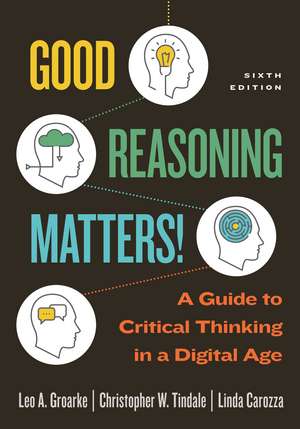
Good Reasoning Matters!: A Guide to Critical Thinking in a Digital Age, Sixth Edition
Autor Leo Groarke, Christopher W. Tindale, Linda Carozzaen Limba Engleză Paperback – 14 oct 2025
The instruction in the book is rooted in traditional philosophical understandings of argument, but is expanded to account for the complexities that characterize real-life arguments. This includes an examination of the role that images, sounds, and other non-verbal components play in attempts to convince us of some point of view—in advertising, television, YouTube, film, interpersonal exchange, and elsewhere. Numerous and varied exercises—formative within the chapters and summative at their end—help students improve their reading, reasoning, and writing skills.
Instructors will find the text is informed by research in digital pedagogy and works well in a variety of course formats: in-person, remote, hybrid, and synchronous or asynchronous delivery. The authors’ expertise in argumentation theory and decades of teaching experience ensure that this book prepares students for the complexities of arguing in the 21st century.
Preț: 478.80 lei
Preț vechi: 563.29 lei
-15%
Puncte Express: 718
Carte disponibilă
Livrare economică 06-20 noiembrie
Livrare express 23-29 octombrie pentru 137.47 lei
Livrare prin curier în România Termenul estimat este afișat lângă disponibilitate.
Transport gratuit pentru acest produs Plată online sau ramburs, în funcție de opțiunile comenzii.
Retur gratuit în 14 zile Comandă securizată și suport în română.
Specificații
ISBN-13: 9781554816842
ISBN-10: 155481684X
Pagini: 520
Dimensiuni: 178 x 229 x 22 mm
Greutate: 0.94 kg
Editura: BROADVIEW PR
Colecția Broadview Press
Locul publicării:Peterborough, Canada
ISBN-10: 155481684X
Pagini: 520
Dimensiuni: 178 x 229 x 22 mm
Greutate: 0.94 kg
Editura: BROADVIEW PR
Colecția Broadview Press
Locul publicării:Peterborough, Canada
Recenzii
Good Reasoning Matters! teaches students how to decipher, evaluate, analyze, construct, and engage in argument. This sixth edition incorporates many timely topics, including the impact of artificial intelligence and social media on how we propose and respond to arguments.
The instruction in the book is rooted in traditional philosophical understandings of argument, but is expanded to account for the complexities that characterize real-life arguments. This includes an examination of the role that images, sounds, and other non-verbal components play in attempts to convince us of some point of view—in advertising, television, YouTube, film, interpersonal exchange, and elsewhere. Numerous and varied exercises—formative within the chapters and summative at their end—help students improve their reading, reasoning, and writing skills.
Instructors will find the text is informed by research in digital pedagogy and works well in a variety of course formats: in-person, remote, hybrid, and synchronous or asynchronous delivery. The authors’ expertise in argumentation theory and decades of teaching experience ensure that this book prepares students for the complexities of arguing in the 21st century.
“This is the book I wish we’d used in my undergraduate critical thinking class! It provides a comprehensive overview of reasoning skills and argument, along with a wealth of examples taken from social media, the internet, newspapers, magazines, and philosophy. More than any other text, it’s up to date on developments in informal logic and the study of argumentation, addressing an impressive array of related topics. It includes unique discussions of arguments and audiences, argumentation schemes, emotional arguments, and the use of images and multimedia in arguing. The graduated exercises will leave students well prepared for further studies in logic, philosophy, communications, rhetoric, and any other subject. I highly recommend the sixth edition of Good Reasoning Matters! ” — David Godden, Michigan State University
“The sixth edition of Good Reasoning Matters! is a clear leader among critical reasoning textbooks. Written by experts in argumentation theory, informal logic, and mediation, this edition blends cutting-edge instruction on the fundamentals of reasoning with highly relevant new content on deep disagreement, reasoning and artificial intelligence, non-linguistic modes of argument, and alternative dispute resolution. Additionally, Good Reasoning Matters! offers a rich selection of contemporary examples and well-designed exercises to help students gain the skills they need to thrive as reasoners. All-round, a terrific text!” — Moira Howes, Trent University
“This updated and streamlined sixth edition of a tried-and-tested critical thinking textbook will be enthusiastically welcomed by students and instructors alike. It follows a clear progression of concept and skill development through each chapter and includes many new exercises that apply the ideas and techniques under discussion. I look forward to using this book in my own teaching.” — Paul Simard Smith, University of Regina
The instruction in the book is rooted in traditional philosophical understandings of argument, but is expanded to account for the complexities that characterize real-life arguments. This includes an examination of the role that images, sounds, and other non-verbal components play in attempts to convince us of some point of view—in advertising, television, YouTube, film, interpersonal exchange, and elsewhere. Numerous and varied exercises—formative within the chapters and summative at their end—help students improve their reading, reasoning, and writing skills.
Instructors will find the text is informed by research in digital pedagogy and works well in a variety of course formats: in-person, remote, hybrid, and synchronous or asynchronous delivery. The authors’ expertise in argumentation theory and decades of teaching experience ensure that this book prepares students for the complexities of arguing in the 21st century.
“This is the book I wish we’d used in my undergraduate critical thinking class! It provides a comprehensive overview of reasoning skills and argument, along with a wealth of examples taken from social media, the internet, newspapers, magazines, and philosophy. More than any other text, it’s up to date on developments in informal logic and the study of argumentation, addressing an impressive array of related topics. It includes unique discussions of arguments and audiences, argumentation schemes, emotional arguments, and the use of images and multimedia in arguing. The graduated exercises will leave students well prepared for further studies in logic, philosophy, communications, rhetoric, and any other subject. I highly recommend the sixth edition of Good Reasoning Matters! ” — David Godden, Michigan State University
“The sixth edition of Good Reasoning Matters! is a clear leader among critical reasoning textbooks. Written by experts in argumentation theory, informal logic, and mediation, this edition blends cutting-edge instruction on the fundamentals of reasoning with highly relevant new content on deep disagreement, reasoning and artificial intelligence, non-linguistic modes of argument, and alternative dispute resolution. Additionally, Good Reasoning Matters! offers a rich selection of contemporary examples and well-designed exercises to help students gain the skills they need to thrive as reasoners. All-round, a terrific text!” — Moira Howes, Trent University
“This updated and streamlined sixth edition of a tried-and-tested critical thinking textbook will be enthusiastically welcomed by students and instructors alike. It follows a clear progression of concept and skill development through each chapter and includes many new exercises that apply the ideas and techniques under discussion. I look forward to using this book in my own teaching.” — Paul Simard Smith, University of Regina
Cuprins
Preface
Credits
Index
PART ONE: INTRODUCING ARGUMENTS
1 MAKING ROOM FOR ARGUMENT
- Critical Thinking
- Acts of Arguing
- Identifying Argument Components
- Audiences
- Opponents and Proponents
- Arguments in a Digital Age
2 ARGUMENTS, WEAK AND STRONG
- Burden of Proof
- Premise Acceptability
- Validity
- Assessing Arguments
- Applying the Criteria: Conditional Arguments
3 STANDARDIZING ARGUMENTS
- Inference Indicators
- Arguments without Indicator Words
- Hidden Conclusions
- Hidden Premises
- Arguments and Explanations
4 ARGUMENT DIAGRAMS
- Simple and Extended Arguments
- Argument Diagrams: Simple Arguments
- Diagramming Extended Arguments
- Linked and Convergent Premises
- Diagramming Your Own Arguments
PART TWO: JUDGING ARGUMENTS
5 DEFINITIONS: SAYING WHAT YOU MEAN
- Making Meanings Clear
- Vagueness and Ambiguity
- Equivocation and Verbal Disputes
- Formulating Definitions
- Rules for Good Definitions
6 PREMISES: CONSISTENT, TRUE, ACCEPTABLE
- Premise Acceptability and Its Complexities
- Consistency and Inconsistency
- Truth and Acceptability
- Questionable Premises
- Conditions of Acceptability
- Fallacies of Unacceptability
7 LINKING PREMISES TO CONCLUSIONS
- Relevance
- Fallacies of Relevance
- Sufficiency
- Putting It All Together
PART THREE: REAL LIFE COMPLICATIONS
8 MODES OF ARGUING
- Argument Flags
- Modes of Presentation
- Modes of Feeling
- Symbols and Metaphors
- Alternative Dispute Resolution
- A Complex Example
9 READING BEYOND THE LINES
- Belief Systems
- Cognitive Bias
- Illegitimate Bias
- Audiences and Deep Disagreement
- Supplemented Diagrams
PART FOUR: SCHEMING IN ALL ITS FORMS
10 SCHEMES AND COUNTER-SCHEMES
- What’s a Scheme?
- Categorical Syllogisms
- Venn Diagrams
- Argument by Showing
11 LOOKING FOR THE FACTS
- Generalizations
- Polling
- General Causal Reasoning
12 THINKING LIKE A SCIENTIST
- Particular Causal Reasoning
- Arguments from Ignorance
- Scientific Reasoning
- The Scientific Method
- Summary
13 SCHEMES OF VALUE
- Slippery Slope Arguments
- Arguments by Analogy
- Appeals to Precedent
- Two-Wrongs Reasoning
14 PEOPLE SCHEMES
- Appeal to the Person
- Ad Populum Arguments
- Arguments from Authority
- Ad Hominem
- Arguments against Authority
- Appeal to Eyewitness Testimony
- Guilt (and Honour) by Association
- Other Cases
PART FIVE: PUTTING IT ALL TOGETHER
15 ESSAYING ARGUMENTS
- The Good Evaluative Critique
- The Good Argumentative Essay
- A Student’s Paper
- Conclusion
Credits
Index