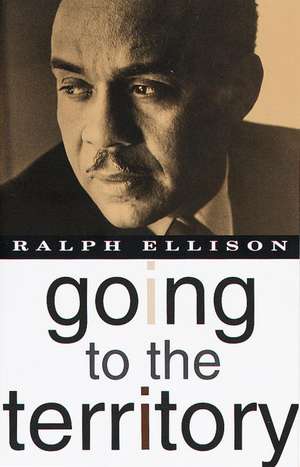
Going to the Territory
Autor Ralph Ellisonen Limba Engleză Paperback – 14 mar 1995
-- Washington Post Book World
The seventeen essays collected in this volume prove that Ralph Ellison was not only one of America's most dazzlingly innovative novelists but perhaps also our most perceptive and iconoclastic commentator on matters of literature, culture, and race. In Going to the Territory, Ellison provides us with dramatically fresh readings of William Faulkner and Richard Wright, along with new perspectives on the music of Duke Ellington and the art of Romare Bearden. He analyzes the subversive quality of black laughter, the mythic underpinnings of his masterpiece Invisible Man, and the extent to which America's national identity rests on the contributions of African Americans. Erudite, humane, and resounding with humor and common sense, the result is essential Ellison.
Preț: 91.54 lei
Puncte Express: 137
Carte indisponibilă temporar
Doresc să fiu notificat când acest titlu va fi disponibil:
Se trimite...
Specificații
ISBN-13: 9780679760016
ISBN-10: 0679760016
Pagini: 352
Dimensiuni: 134 x 203 x 20 mm
Greutate: 0.27 kg
Ediția:Vintage Intl.
Editura: Knopf Doubleday Publishing Group
ISBN-10: 0679760016
Pagini: 352
Dimensiuni: 134 x 203 x 20 mm
Greutate: 0.27 kg
Ediția:Vintage Intl.
Editura: Knopf Doubleday Publishing Group
Textul de pe ultima copertă
The seventeen essays collected in this volume prove that Ralph Ellison was not only one of America's most dazzlingly innovative novelists but perhaps also our most perceptive and iconoclastic commentator on matters of literature, culture, and race.
Notă biografică
Ralph Ellison (1914–1994) was born in Oklahoma and trained as a musician at Tuskegee Institute from 1933 to 1936, at which time a visit to New York and a meeting with Richard Wright led to his first attempts at fiction.Invisible Man won the National Book Award. Appointed to the Academy of American Arts and Letters in 1964, Ellison taught at several institutions, including Bard College, the University of Chicago, and New York University, where he was Albert Schweitzer Professor of Humanities.