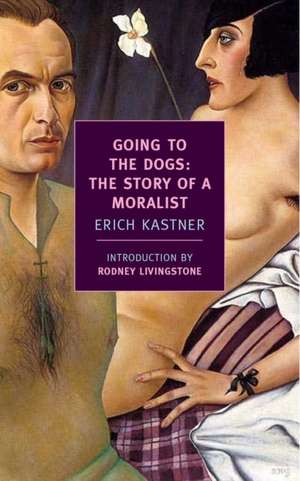
Going to the Dogs
Autor Erich Kästneren Limba Engleză Paperback – 6 noi 2012
Ne-a atras atenția, încă din primele pagini, aerul de „timpuri tulburi” care devin tot mai agitate pe măsură ce Jakob Fabian, un moralist rătăcit într-o lume în derivă, traversează Berlinul anilor '30. „Going to the Dogs” nu este doar o cronică a unui colaps economic, ci o radiografie a unei prăbușiri spirituale colective, surprinsă între crahul de pe Wall Street și umbra tot mai lungă a regimului nazist. Suntem de părere că forța acestui roman rezidă în capacitatea lui Erich Kästner de a folosi satira nu pentru a amuza, ci pentru a evidenția absurdul unei societăți care își pierde busola morală sub presiunea foamei și a ideologiilor extreme. Cititorul care a apreciat atmosfera de decadență și disperare din Goodbye to Berlin de Christopher Isherwood va găsi aici o explorare similară a vulnerabilității umane în fața istoriei — dar filtrată printr-un cinism intelectual mai pronunțat și o structură narativă ce amintește de realismul tăios al epocii. Deși Kästner este adesea celebrat pentru spiritul ludic din The Flying Classroom sau pentru aventurile din Emil und die drei Zwillinge, în acest roman el își dezvăluie latura cea mai profundă și critică. Cartea se distanțează de optimismul operelor sale pentru copii, poziționându-se ca o lucrare fundamentală despre rezistența individuală într-o epocă a capitulării etice.
Preț: 86.09 lei
Carte disponibilă
Livrare economică 10-24 noiembrie
Livrare express 24-30 octombrie pentru 20.40 lei
Specificații
ISBN-10: 1590175840
Pagini: 280
Dimensiuni: 128 x 203 x 19 mm
Greutate: 0.22 kg
Editura: Random House LLC US
Colecția NYRB Classics
V-ar putea interesa
-
 Mary CoinMarisa SilverPreț: 133.12 lei
 -
 Flimsy Little Plastic MiraclesRon CurriePreț: 122.98 lei
 -
 The AntiquarianGustavo Faverón PatriauPreț: 89.04 lei
 -
 Billy Wahoo: Devours the Snake GodGeorge Van NoyPreț: 116.76 lei
 -
 Second SecondLynn GrayPreț: 79.82 lei
 -
 Make/BelieveLynn GrayPreț: 92.15 lei
 -
 Mary Magdalene Moi-PweepsJ. David WoodendPreț: 107.36 lei
 -
 Isla VerdeGarry HoytPreț: 108.89 lei
 -
 The SyndicateJeriel NgPreț: 67.21 lei
 -
 Lydia's LivesMR John a. RickardPreț: 71.91 lei
 -
 Drop of a HatMilton Louis SteinbergPreț: 70.80 lei
 -
 ZalPaul EricsonPreț: 100.63 lei
 -
 Woke Up LonelyFiona MaazelPreț: 91.97 lei
 -
 Dieses Na ja!, wenn man das nicht hätte!Sven HanuschekPreț: 171.72 lei
 -
 Der kleine Grenzverkehr oder Georg und die ZwischenfälleErich KästnerPreț: 88.96 lei
 -
 Preț: 126.21 lei
De ce să citești această carte
Recomandăm această carte celor care caută o perspectivă autentică asupra Germaniei interbelice, dincolo de clișeele istorice. Cititorul va câștiga o înțelegere profundă a modului în care criza economică macină psihologia unei națiuni. Este o lectură esențială pentru fanii literaturii europene clasice care apreciază umorul negru, observația socială fină și personajele care încearcă să rămână integre într-o lume care se destramă.
Despre autor
Erich Kästner (1899–1974) a fost un scriitor, poet și satirist german de o importanță colosală, fiind nominalizat de patru ori la Premiul Nobel pentru Literatură. Deși a atins faima internațională prin literatura pentru copii, fiind distins cu medalia Hans Christian Andersen, opera sa pentru adulți reflectă o viziune critică și profund umanistă asupra societății germane. Stilul său se caracterizează printr-o simplitate înșelătoare și o ironie fină, instrumente folosite pentru a naviga perioadele întunecate ale istoriei secolului XX, pe care le-a observat direct din inima Berlinului.
Notă biografică
works for adults and children, including Lottie and Lisa, the basis for the popular Disney film The Parent Trap. In 1933 the pacifist Kästner was banned from German publication and subsequently found employment as a film scriptwriter. After World War II, he worked as a literary editor and continued to write, mainly for children.
Cyrus Brooks translated works by Alfred Neumann, Friedrich Dürrenmatt, and Leonhard Frank as well as Kästner’s Emil and the Detectives, Emil and the Three Twins, and Lottie and Lisa.
Rodney Livingstone is a professor emeritus in German studies at the University of Southampton and a translator of books by Theodor W. Adorno, Max Weber, and Walter Benjamin, among others. In 2009 he was awarded the Ungar German Translation Prize of the American Translators Association.
Descriere scurtă
What’s to be done? Fabian and friends make the best of it—they go to work though they may be laid off at any time, and in the evenings they go to the cabarets and try to make it with girls on the make, all the while making a lot of sharp-sighted and sharp-witted observations about politics, life, and love, or what may be. Not that it makes a difference. Workers keep losing work to new technologies while businessmen keep busy making money, and everyone who can goes out to dance clubs and sex clubs or engages in marathon bicycle events, since so long as there’s hope of running into the right person or (even) doing the right thing, well—why stop?
Going to the Dogs, in the words of introducer Rodney Livingstone, “brilliantly renders with tangible immediacy the last frenetic years [in Germany] before 1933.” It is a book for our time too.
Recenzii
“Like his hero Fabian, Kästner was not a cynic as a saddened idealist; the two conditions look much the same, but the latter is more painful….Fabian is a "key novel" of the Weimar Republic in its last years. It is a notably efficient novel, with little of the metaphysical resonance of [Thomas Mann’s] Doctor Faustus or that book’s soul-searching, but offering instead a series of moral tableaux, rendered the cooler by the chapter titles, in the form of newspaper headings.” —The Times Literary Supplement
“Graceful, vivid and distinguished…a little masterpiece of pathos and calamity.” —Michael Sadleir
“Damned for its improper subject-matter, [Going to the Dogs] showed the crumbling Berlin of Christopher Isherwood’s stories with something of Isherwood’s sharp intelligence, but a far more tragic sense of implication.” —The Times Literary Supplement
“I am a great admirer of Fabian [original title] and have read it at least twice.” —Graham Greene