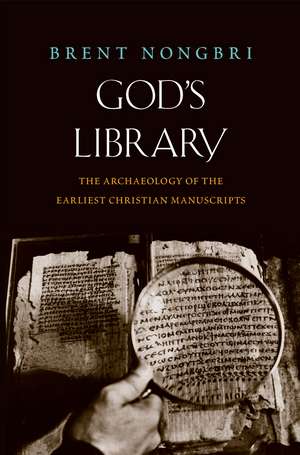
God's Library: The Archaeology of the Earliest Christian Manuscripts
Autor Brent Nongbrien Limba Engleză Paperback – 28 ian 2020
“[Nongbri] sets out to demystify the ‘discovery’ of ancient writings, advancing a more sober and realistic framework for assessing the breathless claims and counterclaims that appear in the media. . . . For those wanting to know something of the material basis for the world’s most published (and possibly, read) book, Nongbri’s own book is a gift.”—Luke Timothy Johnson, Commonweal
In this bold and groundbreaking book, Brent Nongbri provides an up-to-date introduction to the major collections of early Christian manuscripts and demonstrates that much of what we thought we knew about these books and fragments is mistaken. While biblical scholars have expended much effort in their study of the texts contained within the earliest Christian manuscripts, there has been a surprising lack of interest in thinking about these books as material objects with individual, unique histories. We have too often ignored the ways that the antiquities market obscures our knowledge of the origins of these manuscripts.
Through painstaking archival research and detailed studies of the most important collections of early Christian manuscripts, Nongbri vividly shows that the earliest Christian books are more than just carriers of texts or samples of handwriting. They are three-dimensional archaeological artifacts with fascinating stories to tell, if we’re willing to listen.
Preț: 149.45 lei
Puncte Express: 224
Carte disponibilă
Livrare economică 07-21 noiembrie
Livrare express 24-30 octombrie pentru 33.33 lei
Livrare prin curier în România Termenul estimat este afișat lângă disponibilitate.
Transport gratuit de la 400.00 lei Plată online sau ramburs, în funcție de opțiunile comenzii.
Retur gratuit în 14 zile Comandă securizată și suport în română.
Specificații
ISBN-13: 9780300248609
ISBN-10: 0300248601
Pagini: 416
Ilustrații: 73 b-w illus.
Dimensiuni: 156 x 235 x 23 mm
Greutate: 0.54 kg
Editura: Yale University Press
Colecția Yale University Press
ISBN-10: 0300248601
Pagini: 416
Ilustrații: 73 b-w illus.
Dimensiuni: 156 x 235 x 23 mm
Greutate: 0.54 kg
Editura: Yale University Press
Colecția Yale University Press
V-ar putea interesa
-
 -19%Preț: 98.21 lei121.23 lei
 -
 -12%Preț: 308.99 lei350.21 lei
 -
 Culture and Power: The Sociology of Pierre BourdieuDavid SwartzPreț: 293.45 lei
 -
 Selling Jerusalem: Relics, Replicas, Theme ParksAnnabel Jane WhartonPreț: 373.84 lei
 -
 Psellos and the PatriarchsMichael PsellosPreț: 257.86 lei
 -
 The Virus in the Age of MadnessBernard Henri-LevyPreț: 89.77 lei
 -
 Time and Temporality in Transitional and Post-Conflict SocietiesNatascha Mueller-HirthPreț: 459.36 lei
 -
 Images of Women in AntiquityAveril CameronPreț: 424.63 lei
 -
 Power in the Global Information Age: From Realism to GlobalizationJoseph S. Nye Jr.-15%Preț: 454.05 lei534.17 lei
 -
 Preț: 288.26 lei
 -
 Unrivalled InfluenceJudith HerrinPreț: 237.04 lei
 -
 The Patient Ferment of the Early ChurchAlan KreiderPreț: 172.14 lei
 -
 Ethnography After AntiquityAnthony Kaldellis-11%Preț: 559.88 lei629.08 lei
 -
 By the Emperor's HandGraham SumnerPreț: 236.02 lei
 -
 The Cyprus Tribute and Geopolitics in the Levant, 1875-1960Diana Markides-15%Preț: 606.36 lei713.36 lei
 -
 Konflikt und BewältigungThomas Pratsch-23%Preț: 1598.13 lei2075.50 lei
Recenzii
“Captivating and clearly written book about, among other things, ancient manuscript production with focus on the Chester Beatty and Bodmer Papyri, but also discussing the Nag Hammadi and Medinet Madi codices and a recent find such as Codex Tchacos. With many illustrations and excellent indices.”—Johannes van Oort, Brill journal Vigiliae Christianae
“A stimulating introduction to working with early Christian manuscripts.”—Thomas Johann Bauer, Zeitschrift für Antikes Christentum
“Nongbri challenges beliefs about ancient Christian papyri in this readable account. . . . [His] lucid arguments, free from any rancor, will give researchers and lay readers a greater appreciation for the complex problems involved in working with ancient writings.”—Publishers Weekly
“[Nongbri] sets out to demystify the ‘discovery’ of ancient writings, advancing a more sober and realistic framework for assessing the breathless claims and counterclaims that appear in the media. . . . For those wanting to know something of the material basis for the world’s most published (and possibly, read) book, Nongbri’s own book is a gift.”—Luke Timothy Johnson, Commonweal
“Brent Nongbri has written an outstanding book that gives needed context to early Christian manuscripts.”—Elijah Hixson, Journal of the Evangelical Theological Society
“Brent Nongbri presents an interesting argument . . . both advanced scholars and young scholars and students will find much of interest in this monograph.”—Claire Clivaz, Journal of Early Christian Studies
“Nongbri has produced a ‘must read’ for all those interested in early Christian manuscripts. . . . [An] impressively researched book.”—Larry Hurtado (blog review)
“Few recent works provide such extensive information. . . . Nongbri’s careful and even-handed study . . . makes a compelling case that many longstanding assumptions about the dating and provenance of some important witnesses to the New Testament may be misguided.”—Benjamin Laird, Southeastern Theological Review
“[This book] is an extraordinary example of scholarly humility intermixed with immense learning, and it deserves a prominent space on the bookshelf of any reader interested in ancient Christianity.”—Mark Letteney, Journal of Late Antiquity
“God’s Library is mandatory reading for anyone interested in early Christian manuscripts and the problems—as well as the benefits—involved in studying them.”—Peter Malik, Journal of Theological Studies
“An excellent and necessary book.”—Steven M. Stannish, American Journal of Archaeology
“This fascinating book explores a seldom-researched aspect of biblical archaeology. . . . Written in a clear and engaging style, here is a special brand of historical detective work of interest to Bible buffs.”—Donald Senior, Bible Today
“This is a deeply researched, well-written, and highly informative book—a must-read for anyone with an interest in early Christian manuscripts.”—Harry Gamble, Church History
“An exemplary study. . . . God’s Library arguably contains the best description of the material properties of the early Christian books (Chapter 1) in such a clear, detailed and nuanced manner that could make the book a standalone tool for teaching. . . . A brilliant piece of scholarly work, which deserves its place in university, public, and private libraries alike.”—Alexandros Tsakos, Journal of Egyptian Archaeology
“This is an important book that will benefit different fields: biblical studies, history, papyrology,classics, archaeology, cultural heritage studies, and so on. . . . The monograph is both a gripping read and a dense academic publication on early Christian books from Egypt.”—Roberta Mazza, Review of Biblical Literature
“All readers will benefit from [Nongbri’s] careful analysis and the transparency by which he arrives at his conclusions.”—David M. Wyman, Religious Studies Review
“[A] marvelous book. . . . Indispensable reading for both the guild and the interested public.”—Robyn Faith Walsh, Journal of the American Academy of Religion
“A sobering and meticulous reevaluation of what we think we know about early Christian manuscripts.”—Nathan L. Shedd, Religious Studies Review
“Nongbri is to be congratulated for his ability to synthensize large amounts of data and present a clear and cogent picture of the issues in manuscript study.”—Sean A. Adams, Journal for the Study of the New Testament
“There is much to commend in this wonderful rich and informative book about books. Nongbri’s discussion should be of interest for all scholars of the New Testament writings.”—Paul Foster, Expository Times
Finalist for the 2019 PROSE awards, Theology and Religious Studies category
Winner of the 2019 Ramirez Family Award for Most Significant Scholarly Book, presented by the Texas Institute of Letters
Winner of the 2019 George A. and Jean S. DeLong History Book Prize sponsored by the Society for the History of Authorship, Reading and Publishing (SHARP)
Winner of the 2019 Best Book Relating to the New Testament Award, sponsored by the Biblical Archaeology Society
“With a skeptical eye, a large amount of original archival research, a comprehensive command of the bibliography, and fine critical judgment, this essential book takes apart most of what has been claimed for generations about early Christian manuscripts. This is the best available broad treatment of its subject and is certain to have a wide audience.”—Roger S. Bagnall, New York University;
“Breath-taking. . . . With its spectacular archival research and clear, level-headed thinking, this book is a model of scholarship. As a result of Nongbri’s research, we know both more and less about these important early Christian books.”—AnneMarie Luijendijk, Princeton University
“Nongbri offers an engaging account of early Christian manuscripts and their modern discoverers, interpreters, and publicists. His lucid narrative offers useful guidance about what can and cannot be known about these important relics.”—Harold W. Attridge, Yale University
“In a study that is erudite, persuasive, and massively documented, Brent Nongbri explodes many of the dominant assumptions of early Christian textual scholars. This is a must read for anyone interested in the ‘archaeology’ of Christian manuscripts.”—Bart D. Ehrman, University of North Carolina at Chapel Hill
“A stimulating introduction to working with early Christian manuscripts.”—Thomas Johann Bauer, Zeitschrift für Antikes Christentum
“Nongbri challenges beliefs about ancient Christian papyri in this readable account. . . . [His] lucid arguments, free from any rancor, will give researchers and lay readers a greater appreciation for the complex problems involved in working with ancient writings.”—Publishers Weekly
“[Nongbri] sets out to demystify the ‘discovery’ of ancient writings, advancing a more sober and realistic framework for assessing the breathless claims and counterclaims that appear in the media. . . . For those wanting to know something of the material basis for the world’s most published (and possibly, read) book, Nongbri’s own book is a gift.”—Luke Timothy Johnson, Commonweal
“Brent Nongbri has written an outstanding book that gives needed context to early Christian manuscripts.”—Elijah Hixson, Journal of the Evangelical Theological Society
“Brent Nongbri presents an interesting argument . . . both advanced scholars and young scholars and students will find much of interest in this monograph.”—Claire Clivaz, Journal of Early Christian Studies
“Nongbri has produced a ‘must read’ for all those interested in early Christian manuscripts. . . . [An] impressively researched book.”—Larry Hurtado (blog review)
“Few recent works provide such extensive information. . . . Nongbri’s careful and even-handed study . . . makes a compelling case that many longstanding assumptions about the dating and provenance of some important witnesses to the New Testament may be misguided.”—Benjamin Laird, Southeastern Theological Review
“[This book] is an extraordinary example of scholarly humility intermixed with immense learning, and it deserves a prominent space on the bookshelf of any reader interested in ancient Christianity.”—Mark Letteney, Journal of Late Antiquity
“God’s Library is mandatory reading for anyone interested in early Christian manuscripts and the problems—as well as the benefits—involved in studying them.”—Peter Malik, Journal of Theological Studies
“An excellent and necessary book.”—Steven M. Stannish, American Journal of Archaeology
“This fascinating book explores a seldom-researched aspect of biblical archaeology. . . . Written in a clear and engaging style, here is a special brand of historical detective work of interest to Bible buffs.”—Donald Senior, Bible Today
“This is a deeply researched, well-written, and highly informative book—a must-read for anyone with an interest in early Christian manuscripts.”—Harry Gamble, Church History
“An exemplary study. . . . God’s Library arguably contains the best description of the material properties of the early Christian books (Chapter 1) in such a clear, detailed and nuanced manner that could make the book a standalone tool for teaching. . . . A brilliant piece of scholarly work, which deserves its place in university, public, and private libraries alike.”—Alexandros Tsakos, Journal of Egyptian Archaeology
“This is an important book that will benefit different fields: biblical studies, history, papyrology,classics, archaeology, cultural heritage studies, and so on. . . . The monograph is both a gripping read and a dense academic publication on early Christian books from Egypt.”—Roberta Mazza, Review of Biblical Literature
“All readers will benefit from [Nongbri’s] careful analysis and the transparency by which he arrives at his conclusions.”—David M. Wyman, Religious Studies Review
“[A] marvelous book. . . . Indispensable reading for both the guild and the interested public.”—Robyn Faith Walsh, Journal of the American Academy of Religion
“A sobering and meticulous reevaluation of what we think we know about early Christian manuscripts.”—Nathan L. Shedd, Religious Studies Review
“Nongbri is to be congratulated for his ability to synthensize large amounts of data and present a clear and cogent picture of the issues in manuscript study.”—Sean A. Adams, Journal for the Study of the New Testament
“There is much to commend in this wonderful rich and informative book about books. Nongbri’s discussion should be of interest for all scholars of the New Testament writings.”—Paul Foster, Expository Times
Finalist for the 2019 PROSE awards, Theology and Religious Studies category
Winner of the 2019 Ramirez Family Award for Most Significant Scholarly Book, presented by the Texas Institute of Letters
Winner of the 2019 George A. and Jean S. DeLong History Book Prize sponsored by the Society for the History of Authorship, Reading and Publishing (SHARP)
Winner of the 2019 Best Book Relating to the New Testament Award, sponsored by the Biblical Archaeology Society
“With a skeptical eye, a large amount of original archival research, a comprehensive command of the bibliography, and fine critical judgment, this essential book takes apart most of what has been claimed for generations about early Christian manuscripts. This is the best available broad treatment of its subject and is certain to have a wide audience.”—Roger S. Bagnall, New York University;
“Breath-taking. . . . With its spectacular archival research and clear, level-headed thinking, this book is a model of scholarship. As a result of Nongbri’s research, we know both more and less about these important early Christian books.”—AnneMarie Luijendijk, Princeton University
“Nongbri offers an engaging account of early Christian manuscripts and their modern discoverers, interpreters, and publicists. His lucid narrative offers useful guidance about what can and cannot be known about these important relics.”—Harold W. Attridge, Yale University
“In a study that is erudite, persuasive, and massively documented, Brent Nongbri explodes many of the dominant assumptions of early Christian textual scholars. This is a must read for anyone interested in the ‘archaeology’ of Christian manuscripts.”—Bart D. Ehrman, University of North Carolina at Chapel Hill
Notă biografică
Brent Nongbri is an Honorary Research Fellow at Macquarie University in Sydney, Australia, and the author of Before Religion: A History of a Modern Concept and numerous articles on the paleography and codicology of early Christian manuscripts.