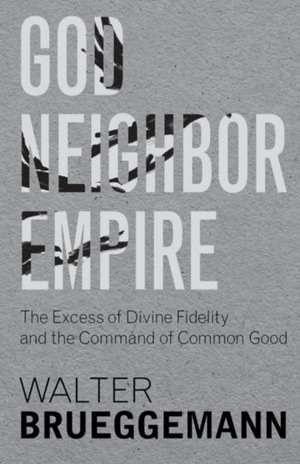
God, Neighbor, Empire: The Excess of Divine Fidelity and the Command of Common Good
Autor Walter Brueggemann Cuvânt înainte de Tim A. Dearbornen Limba Engleză Hardback – 30 sep 2016
Recomandăm God, Neighbor, Empire ca o resursă esențială pentru studenții la teologie și practicienii care doresc să ancoreze acțiunea socială în rigoarea exegezei Vechiului Testament. Într-o perioadă în care discursul public este adesea fragmentat, Walter Brueggemann demonstrează relevanța hermeneutică a textului biblic pentru structurile politice și comunitare actuale. Premisa centrală a cărții nu este doar analiza istorică, ci modul în care „excesul de fidelitate divină” obligă la o reevaluare a binelui comun.
Observăm o structură narativă și teologică precisă: autorul pornește în primul capitol de la natura intrinsec relațională a lui Dumnezeu, pentru ca ulterior să recalibreze conceptele de dreptate (Zion versus Sinai), har și lege. Această progresie indică faptul că legea nu este văzută ca o constrângere, ci ca o convocare la ascultare activă în cadrul unei comunități. Cartea acoperă aceeași arie tematică precum Old Testament Theology de John Kessler, dar cu o abordare mult mai axată pe imaginația sociopolitică și pe rezistența în fața ideologiilor dominante.
În contextul operei sale, God, Neighbor, Empire continuă linia critică stabilită în The Prophetic Imagination, însă aplică acele intuiții teoretice la mecanismele specifice ale „imperiului” modern. Dacă în Materiality as Resistance autorul se concentra pe aspectele fizice ale credinței, aici accentul cade pe relația de legământ ca antidot la marfă și individualism. Tonul este academic, dar păstrează acea urgență profetică specifică lui Brueggemann, reușind să transforme studiul biblic într-un manifest pentru dragostea radicală față de aproape.
Preț: 237.34 lei
Carte disponibilă
Livrare economică 11-25 noiembrie
Specificații
ISBN-10: 1481305425
Pagini: 179
Dimensiuni: 139 x 215 x 20 mm
Greutate: 0.36 kg
Editura: Baylor University Press
Colecția Baylor University Press (US)
V-ar putea interesa
-
 A New English Translation of the SeptuagintAlbert PietersmaPreț: 311.84 lei
 -
 The Theology of the Book of GenesisR. W. L. MoberlyPreț: 245.57 lei
 -
 An Introduction to the Old Testament: The Canon and Christian ImaginationWalter BrueggemannPreț: 169.42 lei
 -
 Psalms and Life of FaithWalter BrueggemannPreț: 228.01 lei
 -
 Inspiration and IncarnationPeter EnnsPreț: 140.79 lei
 -
 Reality, Grief, HopeWalter BrueggemannPreț: 128.82 lei
 -
 An Other KingdomPeter BlockPreț: 90.92 lei
 -
 Out of BabylonWalter BrueggemannPreț: 106.42 lei
 -
 Life in the Psalms: Contemporary Meaning in Ancient Texts: The Mowbray Lent Book 2016(The Revd Canon) Patrick Woodhouse-40%Preț: 84.83 lei140.93 lei
 -
 Esther: A Handbook on the Hebrew TextJohn ScrenockPreț: 351.97 lei
 -
 Truth-Telling as Subversive ObedienceWalter BrueggemannPreț: 98.09 lei
De ce să citești această carte
Reținem această lucrare pentru capacitatea sa de a transforma teologia Vechiului Testament într-un instrument critic modern. Cititorul va câștiga o înțelegere profundă a modului în care conceptele de dreptate și milă pot submina individualismul contemporan. Este o lectură necesară pentru cei care caută o bază biblică solidă pentru implicarea socială, oferind o perspectivă clară asupra modului în care fidelitatea față de divinitate se traduce în politici de bunăstare comunitară.
Despre autor
Walter Brueggemann (născut în 1933) este un reputat cercetător american al Vechiului Testament și un teolog influent în cadrul creștinismului progresist modern. Opera sa vastă se concentrează pe tradiția profetică ebraică, argumentând constant că Biserica trebuie să ofere o contra-narațiune la forțele consumerismului și naționalismului. De-a lungul deceniilor, Brueggemann a redefinit studiul biblic prin integrarea dimensiunii etice și politice, fiind considerat o voce de referință pentru modul în care textele antice pot modela imaginația socială și rezistența în fața puterii hegemonice.