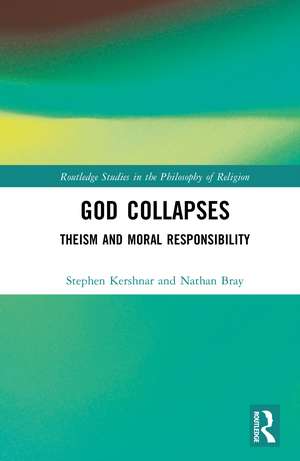
God Collapses: Theism and Moral Responsibility: Routledge Studies in the Philosophy of Religion
Autor Stephen Kershnar, Nathan Brayen Limba Engleză Hardback – 10 noi 2026
Impossibility: God is not responsible because responsibility itself is impossible. No one—including God—can satisfy the conditions necessary for moral responsibility.
Compulsion: God is not responsible because his perfect nature compels his choices. A being whose psychology necessarily determines his actions cannot be responsible for them.
Arbitrariness: God is not responsible because his choices would be arbitrary. No one is responsible for making arbitrary choices, even if those choices are between good options.
Maximal Greatness: If God lacks responsibility, then his greatness depends on being uniquely and maximally benevolent, but no one can satisfy this requirement.There is no other book that argues against God's existence by systematically examining whether God can be morally responsible and showing how these arguments undermine the greatest possible being thesis. The book's arguments connecting divine psychology, foreknowledge, and responsibility are new to the literature. Ultimately, the book's conclusions challenge our understanding of God, morality, and the metaphysical structure of the universe.
God Collapses: Theism and Moral Responsibility is essential reading for scholars and graduate students in philosophy, religious studies, and theology who are interested in debates about divine attributes, moral responsibility, and arguments for atheism.
Din seria Routledge Studies in the Philosophy of Religion
- 18%
 Preț: 1110.28 lei
 - 18%
 Preț: 1004.68 lei
 -
 Preț: 452.47 lei
 -
 Preț: 452.47 lei
 -
 Preț: 450.95 lei
 - 18%
 Preț: 1112.48 lei
 - 15%
 Preț: 462.09 lei
 -
 Preț: 440.77 lei
 - 15%
 Preț: 437.28 lei
 - 15%
 Preț: 471.41 lei
 -
 Preț: 484.14 lei
 - 15%
 Preț: 472.37 lei
 -
 Preț: 438.69 lei
 -
 Preț: 465.41 lei
 - 18%
 Preț: 1057.86 lei
 -
 Preț: 442.18 lei
 -
 Preț: 459.25 lei
 - 18%
 Preț: 1114.85 lei
 -
 Preț: 466.24 lei
 - 18%
 Preț: 1254.12 lei
 - 15%
 Preț: 423.54 lei
 -
 Preț: 487.72 lei
 -
 Preț: 435.80 lei
 - 15%
 Preț: 468.12 lei
 -
 Preț: 420.57 lei
 -
 Preț: 379.51 lei
 -
 Preț: 460.54 lei
 - 18%
 Preț: 1009.08 lei
 - 18%
 Preț: 1150.52 lei
 -
 Preț: 424.92 lei
Preț: 1352.85 lei
Preț vechi: 1649.82 lei
-18% Precomandă
Puncte Express: 2029
Carte nepublicată încă
Livrare prin curier în România Precomanda se expediază când titlul devine disponibil.
Transport gratuit pentru acest produs Plată online sau ramburs, în funcție de opțiunile comenzii.
Retur gratuit în 14 zile Comandă securizată și suport în română.
Doresc să fiu notificat când acest titlu va fi disponibil:
Se trimite...
Specificații
ISBN-13: 9781041412984
ISBN-10: 1041412983
Pagini: 312
Ilustrații: 16
Dimensiuni: 152 x 229 mm
Greutate: 0.74 kg
Ediția:1
Editura: Taylor & Francis
Colecția Routledge
Seria Routledge Studies in the Philosophy of Religion
Locul publicării:Oxford, United Kingdom
ISBN-10: 1041412983
Pagini: 312
Ilustrații: 16
Dimensiuni: 152 x 229 mm
Greutate: 0.74 kg
Ediția:1
Editura: Taylor & Francis
Colecția Routledge
Seria Routledge Studies in the Philosophy of Religion
Locul publicării:Oxford, United Kingdom
Public țintă
Postgraduate and Undergraduate AdvancedCuprins
Table of Contents
Introduction
Part One. If God exists, then he is the greatest possible being
Chapter One: Greatness
Chapter Two: Greatest Possible Being
Chapter Three: Maximal Greatness and Responsibility
Chapter Four: Greatness and Self-Explanation
Part Two. The greatest possible being is not significantly responsible
Chapter Five: Basic Responsibility-Maker
Chapter Six: Blameworthiness
Chapter Seven: Responsibility and Value
Chapter Eight: God and Responsibility
Chapter Nine: Divine Foreknowledge
Chapter Ten: The Benevolence-Responsibility Tradeoff
Part Three. The greatest possible being is not insignificantly responsible
Chapter Eleven: Insignificant Responsibility
Chapter Twelve: Universe Creation
Part Four. The greatest possible being does not lack responsibility
Chapter Thirteen: Arbitrary Benevolence
Part Five: Conclusion
Chapter Fourteen: Conclusion
Part Six: Appendix: On the Best Possible World
Index
Bibliography
Introduction
Part One. If God exists, then he is the greatest possible being
Chapter One: Greatness
Chapter Two: Greatest Possible Being
Chapter Three: Maximal Greatness and Responsibility
Chapter Four: Greatness and Self-Explanation
Part Two. The greatest possible being is not significantly responsible
Chapter Five: Basic Responsibility-Maker
Chapter Six: Blameworthiness
Chapter Seven: Responsibility and Value
Chapter Eight: God and Responsibility
Chapter Nine: Divine Foreknowledge
Chapter Ten: The Benevolence-Responsibility Tradeoff
Part Three. The greatest possible being is not insignificantly responsible
Chapter Eleven: Insignificant Responsibility
Chapter Twelve: Universe Creation
Part Four. The greatest possible being does not lack responsibility
Chapter Thirteen: Arbitrary Benevolence
Part Five: Conclusion
Chapter Fourteen: Conclusion
Part Six: Appendix: On the Best Possible World
Index
Bibliography
Recenzii
“Stephen Kershnar and Nathan Bray join their mind and produce an exciting discussion about God’s existence. The book is a tour de force of relentless, careful argumentation.”
Carlo Alvaro, St. John’s University, USA
Carlo Alvaro, St. John’s University, USA
Notă biografică
Stephen Kershnar is a distinguished teaching professor in the philosophy department at the State University of New York at Fredonia. He is also an attorney. Kershnar focuses on applied ethics and political philosophy. He has written more than one hundred articles and book chapters on such diverse topics as abortion, desert, moral responsibility, punishment, and religion. He is the author of twelve books, including Morality Collapses: Against the Right and the Good (New York: Routledge, 2025), Responsibility Collapses: Why Moral Responsibility is Impossible (New York: Routledge, 2023), and Desert Collapses: Why No One Deserves Anything (New York: Routledge, 2022).
Nathan Bray is a doctoral candidate at the University of St Andrews. He works mainly in Philosophy of Religion and Ethics. Within these fields, his favorite topics, in no particular order, are the cosmological argument, divine freedom, and animal ethics. His works have appeared in Public Affairs Quarterly and Between the Species.
Nathan Bray is a doctoral candidate at the University of St Andrews. He works mainly in Philosophy of Religion and Ethics. Within these fields, his favorite topics, in no particular order, are the cosmological argument, divine freedom, and animal ethics. His works have appeared in Public Affairs Quarterly and Between the Species.
Descriere
This book argues against God's existence by examining whether God can be morally responsible. The book's arguments connect divine psychology, foreknowledge, and responsibility. Ultimately, the book's conclusions challenge our understanding of God, morality, and the metaphysical structure of the universe.