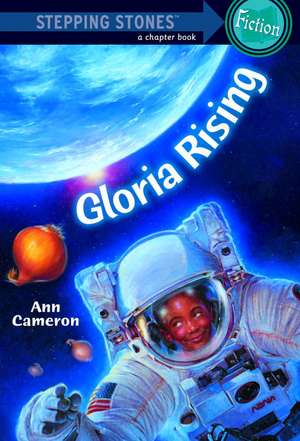
Gloria Rising
Autor Ann Cameron Ilustrat de Lis Toften Limba Engleză Paperback – 8 iun 2004 – vârsta până la 9 ani
Considerăm că valoarea fundamentală a acestui volum rezidă în modul cald și onest în care abordează integritatea personală și gestionarea neînțelegerilor cu autoritatea. Gloria Rising îi introduce pe micii cititori într-o situație de viață extrem de recognoscibilă: momentul în care adevărul tău este pus la îndoială de un adult. Totul începe cu o întâlnire întâmplătoare la magazin între Gloria și Dr. Grace Street, o femeie astronaut care îi transmite un mesaj crucial despre curaj și perspectivă: lucrurile mari nu sunt întotdeauna atât de intimidante pe cât par. Totuși, când Gloria încearcă să împărtășească această experiență printr-un referat la școală, învățătoarea ei, Mrs. Yardley, refuză să o creadă, forțând-o pe fetiță să găsească o cale de a-și demonstra onestitatea.
Stilul autoarei Ann Cameron păstrează simplitatea și profunzimea observată în lucrări precum More Stories Huey Tells sau The Stories Julian Tells. Dacă în acele volume accentul cădea pe dinamica fraternă și micile aventuri domestice, în Gloria Rising vedem o evoluție spre teme de validare externă și încredere în sine în afara cercului familial. Pe același raft cu The Book Star, această carte se adresează copiilor de 7-10 ani care caută povești despre pasiunea pentru explorare și curajul de a rămâne fideli propriei versiuni a faptelor. Structura narativă, susținută de ilustrațiile semnate de Lis Toft, menține un ritm accesibil, transformând dilema Gloriei într-o lecție despre demnitate. Este o lectură care nu doar dezvoltă empatia, dar oferă și un model de comportament în fața scepticismului, încurajând curiozitatea față de știință și spațiul cosmic.
Preț: 35.95 lei
Carte disponibilă
Livrare economică 16-30 octombrie
Specificații
ISBN-10: 0440419980
Pagini: 112
Dimensiuni: 131 x 193 x 8 mm
Greutate: 0.08 kg
Editura: RANDOM HOUSE CHILDREN'S BOOKS
V-ar putea interesa
-
 PaxSara PennypackerPreț: 108.19 lei
 -
 Fish in a TreeLynda Mullaly HuntPreț: 51.08 lei
 -
 The Kidnapped PrinceAnn CameronPreț: 47.90 lei
 -
 How to Grow a FriendSara GillinghamPreț: 106.96 lei
 -
 The Rule of Thoughts (The Mortality Doctrine, Book Two)James DashnerPreț: 79.98 lei
 -
 Best FriendsMargery CuylerPreț: 31.59 lei
 -
 ColibriAnn CameronPreț: 43.57 lei
 -
 Eva and the New Owl: A Branches Book (Owl Diaries #4)Rebecca ElliottPreț: 43.19 lei
 -
 The Innovator's MindsetGeorge CourosPreț: 143.69 lei
 -
 Preț: 310.12 lei
 -
 Ivy and Bean What's the Big Idea? (Book 7)Annie BarrowsPreț: 36.36 lei
 -
 We Are the AntsShaun David HutchinsonPreț: 119.06 lei
 -
 Little Elliot, Big CityMike CuratoPreț: 64.27 lei
 -
 This Adventure EndsEmma MillsPreț: 104.12 lei
 -
 The Julian StoriesAnn Cameron-22%Preț: 37.92 lei48.61 lei
 -
 Tiger Tells AllAnn Cameron-21%Preț: 44.12 lei55.59 lei
 -
 Learning by DoingRichard DufourPreț: 290.81 lei
De ce să citești această carte
Recomandăm această carte părinților care doresc să cultive încrederea în sine a copiilor de vârstă școlară. Prin povestea Gloriei, cititorii învață că adevărul merită apărat, chiar și atunci când adulții greșesc. Este un instrument excelent pentru a discuta despre onestitate, autoritate și aspirații profesionale, oferind în același timp informații fascinante despre explorarea spațială într-o formă accesibilă și caldă.
Despre autor
Ann Cameron este o autoare de renume, cu peste cincisprezece titluri publicate, cunoscută pentru capacitatea de a surprinde vocea autentică a copilăriei. Cariera sa este marcată de distincții importante, fiind finalistă la National Book Award pentru The Secret Life of Amanda K. Woods. Născută în Wisconsin, ea a trăit timp de două decenii în Guatemala, experiență care i-a îmbogățit perspectiva narativă și atenția pentru detalii culturale. În seria dedicată lui Julian, Huey și Gloriei, Cameron reușește să transforme întâmplările cotidiene în lecții de viață memorabile, ancorate în realitatea emoțională a tinerilor cititori.
Notă biografică
Extras
My mother was making spaghetti sauce. She said, "Gloria, honey, would you go buy me an onion?"
"Sure," I said. She gave me some money, and I went.
The store was crowded with old people holding tightly to their shopping carts, little kids hollering to their parents for candy, and lots of people staring at shopping lists and blocking the aisles.
I ducked around all the carts and went to the back where the vegetables are. From all the onions in the bin, I took the prettiest--a big round one, light tan and shiny, with a silvery glow to its skin.
I carried it to the express checkout and stood at the end of a very long line.
Next to me there was a giant Berkbee's Baby Food display. It was like a wall of glass, and taller than I am. All the little jars were stacked up to look like a castle, with pennants that said "Baby Power" sticking out above the castle doorways and windows. At the top there was a high tower with a red-and-white flag that said "Berkbee's Builds Better Babies!" I started counting the jars, but when I got to 346, I gave up. There must have been at least a thousand.
The checkout line didn't move. To pass the time, I started tossing my onion from hand to hand. I tried to improve and make my throws harder to catch.
A woman wearing a sky-blue jogging suit got in line behind me. She was holding a cereal box. She smiled at me, and I smiled back.
I decided to show her what a really good catcher I am. I made a wild and daring onion throw.
I missed the catch. The onion kept going, straight for the middle of the baby food castle. The castle was going to fall!
My folks would have to pay for every broken jar! The store manager would kill me. After that, my folks would bring me back to life to tell me things that would be much worse than death.
I was paralyzed. I shut my eyes.
I didn't hear a crash. Maybe I had gone deaf from fright. Or maybe I was in a time warp because of my fear. In fifty years the onion would land, and that would be the end of me.
I felt a tap on my shoulder. If I opened my eyes, I would see the store manager and all the broken jars.
I didn't want to see him. I didn't want to know how bad it was.
There came a tap again, right on the top of my head.
I heard a woman's voice. "I have your onion."
I opened my eyes. The woman in the jogging suit handed the onion to me.
"Lucky I used to play baseball," she said.
"O-o-o-h," I said. I clutched the onion.
"O-o-o-h," I moaned again.
"You're welcome," was all she said.
She had brown eyes with a sparkle in them, and her hair was in shiny black ringlets. She wore blue-green earrings that hung on tiny gold chains. When she tilted her head, her earrings spun around, and I saw they were the Earth--I mean, made to look like the Earth, jeweled with green continents and blue oceans.
"Your earrings are beautiful," I said.
She smiled. "Some friends got them for me," she said, "to remind me of a trip we made."
When she said "trip," her face started to look familiar, but I didn't know why. Then I remembered.
"I've seen you!" I said. "I saw you on TV!"
She smiled. "Could be."
"And you come from right here in town, but you don't live here anymore," I said.
"That's right," she said.
"And you are--aren't you?--Dr. Grace Street, the astronaut!"
She tilted her head, and the little Earths on both her ears spun round. "That's me," she said.
I was amazed, because I never thought I would meet a famous person in my life, and yet one was right beside me in the supermarket, and I myself, Gloria Jones, was talking to her, all because of my onion throw.
"We learned about the space station in school last year," I said. "You were up there, orbiting the Earth."
"My team and I were there," Dr. Street said.
"What is space like?"
"You know," she said.
"How could I know?" I said.
"We're always in space," Dr. Street said. "We're in space right now."
"Yes," I said, "but what was it like out there, where you went? Out there it must seem different."
"Do you really want to know?" she asked, and I said yes.
"The most awesome part was when we had to fix things on the outside of the station. We got our jobs done and floated in our space suits, staring out into the universe. There were zillions of stars--and space, deep and black, but it didn't seem exactly empty. It seemed to be calling to us, calling us to go on an endless journey. And that was very scary.
"So we turned and looked at Earth. We were two hundred miles above it. We saw enormous swirls of clouds and the glow of snowfields at the poles. We saw water like a giant blue cradle for the land. One big ocean, not 'oceans.' The Earth isn't really chopped up into countries, either. Up there you see it is one great big powerful living being that knows a lot, lot more than we do."
"What does it know?" I said.
"It knows how to be Earth," Dr. Street said. "And that's a lot."
I tried to imagine everything she had seen. It gave me a shiver.
"I wish I could see what you saw," I said. "I'd like to be an astronaut. Of course, probably I couldn't."
Dr. Street frowned. "Why do you say 'Probably I couldn't?' "
"Practically nobody gets to do that," I said.
"You might be one of the people who do," she said. "But you'll never do anything you want to do if you keep saying 'Probably I couldn't.' "
"But maybe I can't!" I protested. I looked down at my onion. I didn't think a very poor onion thrower had a chance to be an astronaut.
Dr. Street looked at my onion, too. "It was a good throw--just a bad catch," she said. "Anyhow--saying 'Maybe I can't' is different. It's okay. It's realistic.
"Even 'I can't' can be a good, sensible thing to say. It makes life simpler. When you really know you can't do one thing, that leaves you time to try some of the rest. But when you don't even know what you can do, telling yourself 'Probably I couldn't' will stop you before you even start. It's paralyzing. You don't want to be paralyzed, do you?"
"I just was paralyzed," I said. "A minute ago, when I threw my onion. I didn't enjoy it one bit."
Descriere scurtă
Recenzii
“Kids will be thrilled by the possibility of running into an astronaut in the checkout line.”—The Bulletin, Recommended