Cantitate/Preț
Produs

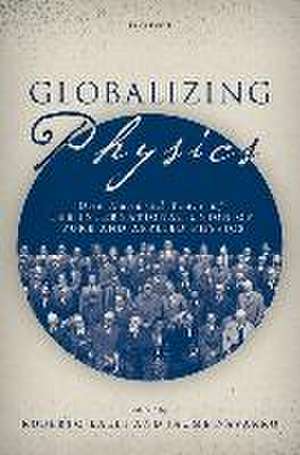
Globalizing Physics: One Hundred Years of the International Union of Pure and Applied Physics

Editat de Roberto Lalli, Jaume Navarro
en Limba Engleză Hardback – 9 iul 2024

Observăm că Globalizing Physics funcționează ca un instrument analitic esențial pentru înțelegerea modului în care infrastructura cercetării științifice se întrepătrunde cu geopolitica. Aplicabilitatea sa practică rezidă în capacitatea de a oferi studenților și cercetătorilor din domeniul relațiilor internaționale și istoriei științei un studiu de caz detaliat despre modul în care instituțiile academice pot naviga perioade de criză globală. Structurat în trei secțiuni cronologice clare, volumul documentează tranziția IUPAP de la o entitate ineficientă în perioada interbelică — marcată de excluderea Puterilor Centrale — la un pilon al diplomației științifice în timpul Războiului Rece.

Credem că forța acestui volum editat de Roberto Lalli și Jaume Navarro stă în explorarea modului în care agenda științifică este modelată de imperative politice. Autorii demonstrează cum urmărirea „liberei circulații a cercetătorilor” nu a fost doar un ideal academic, ci o strategie de diplomație culturală într-o lume divizată. Ca alternativă la Science International de Frank Greenaway pentru cursurile de Istoria Științei, acest volum aduce avantajul unei focalizări specifice pe fizică, oferind o perspectivă mult mai granulată asupra modului în care o singură disciplină a influențat standardele globale de metrologie și educație.

Această lucrare continuă preocupările lui Roberto Lalli din The Renaissance of General Relativity in Context și Building the General Relativity and Gravitation Community During the Cold War, unde acesta a analizat formarea comunităților științifice sub presiune politică. Dacă în lucrările anterioare accentul cădea pe o sub-disciplină teoretică, Globalizing Physics extinde analiza la nivelul întregii instituții internaționale, oferind o viziune de ansamblu asupra instituționalizării fizicii la scară mondială.

Citește tot Restrânge

Preț: 36203 lei

Preț vechi: 45978 lei
-21%

Puncte Express: 543

Carte disponibilă

Livrare economică 07-12 august
Livrare express 23-29 iulie pentru 14393 lei

Livrare prin curier în România Termenul estimat este afișat lângă disponibilitate.
Transport gratuit de la 40000 lei Plată online sau ramburs, în funcție de opțiunile comenzii.
Retur gratuit în 14 zile Comandă securizată și suport în română.

Specificații

ISBN-13: 9780198878681
ISBN-10: 0198878680
Pagini: 336
Ilustrații: 24 B&W figures
Dimensiuni: 160 x 240 x 23 mm
Greutate: 0.71 kg
Editura: OUP OXFORD
Colecția OUP Oxford
Locul publicării:Oxford, United Kingdom

De ce să citești această carte

Recomandăm această carte istoricilor și specialiștilor în politici publice care doresc să înțeleagă mecanismele diplomației științifice. Cititorul câștigă o perspectivă rară asupra modului în care IUPAP a facilitat dialogul între Est și Vest în momente de tensiune maximă. Este un studiu documentat riguros despre cum știința devine un limbaj universal în diplomația globală, fiind esențial pentru oricine studiază impactul societății asupra progresului tehnic.


Despre autor

Roberto Lalli și Jaume Navarro sunt istorici ai științei recunoscuți pentru cercetările lor asupra intersecției dintre fizică și contextul politic al secolului XX. Roberto Lalli s-a specializat în istoria relativității generale și a comunităților științifice din timpul Războiului Rece, publicând lucrări de referință despre renașterea teoriilor fizice sub influența factorilor instituționali. Jaume Navarro aduce o expertiză vastă în istoria fizicii și a relației dintre știință și religie sau diplomație. Împreună, aceștia coordonează contribuțiile unor experți internaționali pentru a oferi o viziune coerentă asupra evoluției IUPAP la centenarul său.


Descriere

This is an open access book available under the terms of a CC BY-NC-ND 4.0 International licence. It is free to read on the Oxford Academic platform and offered as a free PDF download from OUP and selected open access locations.Following the centenary of the International Union of Pure and Applied Physics, this volume features contributions from leading science historians from around the world on the changing roles of the institution in international affairs from its foundation in 1922 to the present. The case studies presented in this volume show the multitude of functions that IUPAP had and how these were related to the changing international political contexts. The book is divided into three parts. The first discusses the interwar period demonstrating how the exclusion of communities of the Central Powers from international scientific institutions imposed by victorious allied countries made IUPAP ineffective until the end of World War II. The second part analyzes the changing roles assumed by IUPAP starting from its complete renovation after World War II. Case studies covering the role of IUPAP in physics education, in metrology, in joint commissions with other unions and in defining the complex relations between pure and applied physics provide examples of IUPAP's impact on the world of science. Part III squarely addresses the science diplomacy aspects of IUPAP during the Cold War highlighting the importance of IUPAP in furthering diplomatic goals and explaining the origin of the pursuit of the free circulation of scientists as the activity that characterized the main function of international unions during the Cold War.Highlighting how often scientific agendas and political imperatives were entangled in the activities of IUPAP, the book analyzes the work of the Union as exercises of science diplomacy, thus contributing to the current debate on the use of science and technology in international relations.

Recenzii

An important piece of heritage that also offers some cutting-edge history of science, written by leading figures in the field.
Well-conceived, important, unique, and valuable not only for the field of history of science and technology, but also for physics and readers beyond academia.
The innovation inherent in this volume comes from the novelty of the subject matter and the historical sources. It represents an opportunity for a new analysis of physics in the framework of twentieth century geopolitics and international affairs.

Notă biografică

Roberto Lalli is an Assistant Professor in the History of Science and Technology at the Polytechnic University of Turin. He specializes in the history of physics from the second half of the nineteenth century to the present. After a MSc degree in physics, he earned a PhD in International History at the University of Milan in 2011. From 2011 to 2013, he was a post-doctoral fellowship at MIT, and from 2013 to 2022, he was a Research Scholar at the Max Planck Institute for the History of Science in Berlin. He has been developing quantitative methodologies for the investigation of historical developments of scientific fields and has published extensively on the interplay between science and diplomacy in the history of international scientific organizations during the Cold War.Jaume Navarro is Ikerbasque Research Professor at the University of the Basque Country. A historian of science, he has previously held research positions at the University of Cambridge, Imperial College, the University of Exeter and the Max Planck Institute for the History of Science. His research interests lie in the history of physics and in the historiography of science and religion. He is the author of, among others, A History of the Electron. J.J. and G.P. Thomson (CUP 2012) and the editor of Ether and Modernity (OUP 2018).