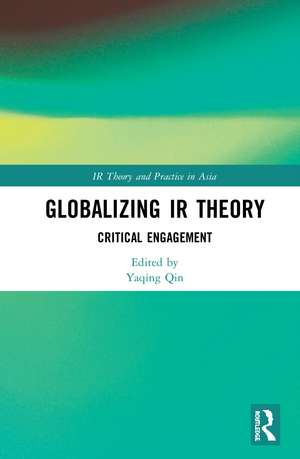
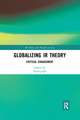
Globalizing IR Theory: Critical Engagement: IR Theory and Practice in Asia
Editat de Yaqing Qinen Limba Engleză Hardback – 7 apr 2020
Drawing on scholars with backgrounds in the United States, Europe, Asia and South America, this volume attempts to critically engage with and reflect upon existing traditions of IR theory to produce a deeply pluralist approach. Traditions, cultures, histories and practices from around the world influence their respective theoretical understanding and in turn explain why the Western tradition of IR is insufficient.
This book provides great insight for scholars of IR from around the world, looking for more diversity in IR theory.




Preț: 1101.34 lei
Preț vechi: 1465.17 lei
-25%
Puncte Express: 1652
Carte indisponibilă temporar
Doresc să fiu notificat când acest titlu va fi disponibil:
Se trimite...
Specificații
ISBN-13: 9780367404710
ISBN-10: 0367404710
Pagini: 204
Dimensiuni: 156 x 234 x 19 mm
Greutate: 0.54 kg
Ediția:1
Editura: Taylor & Francis
Colecția Routledge
Seria IR Theory and Practice in Asia
Locul publicării:Oxford, United Kingdom
ISBN-10: 0367404710
Pagini: 204
Dimensiuni: 156 x 234 x 19 mm
Greutate: 0.54 kg
Ediția:1
Editura: Taylor & Francis
Colecția Routledge
Seria IR Theory and Practice in Asia
Locul publicării:Oxford, United Kingdom
Public țintă
Postgraduate and UndergraduateCuprins
List of contributors Acknowledgements 1 Introduction: the global turn in IR and development of non-Western IRT (Yaqing Qin) 2 The second coming? reflections on a global theory of International Relations (Peter J. Katzenstein)
3 How and how not to develop IR theory: lessons from core and periphery (Barry Buzan) 4 Towards a pluralist International Relations theory: a European Union perspective (Mario Telò) 5 Beyond ‘the West/non-West divide’ in IR: how to ensure dialogues as mutual learning (Yong-Soo Eun) 6 Chinese values vs. liberalism: what ideology will shape the international normative order? (Xuetong Yan) 7 Towards a ‘global IR’? A view from Brazil (Oliver Stuenkel) 8 A multiverse of knowledge: cultures and IR theory (Yaqing Qin) 9 Conclusion: From Heaven to Earth — ‘Cultural Idealism’ and ‘Moral Realism’ as Chinese Contributions to Global International Relations (GIR)(Amitav Acharya) Index
3 How and how not to develop IR theory: lessons from core and periphery (Barry Buzan) 4 Towards a pluralist International Relations theory: a European Union perspective (Mario Telò) 5 Beyond ‘the West/non-West divide’ in IR: how to ensure dialogues as mutual learning (Yong-Soo Eun) 6 Chinese values vs. liberalism: what ideology will shape the international normative order? (Xuetong Yan) 7 Towards a ‘global IR’? A view from Brazil (Oliver Stuenkel) 8 A multiverse of knowledge: cultures and IR theory (Yaqing Qin) 9 Conclusion: From Heaven to Earth — ‘Cultural Idealism’ and ‘Moral Realism’ as Chinese Contributions to Global International Relations (GIR)(Amitav Acharya) Index
Notă biografică
Yaqing Qin is Professor of International Studies at China Foreign Affairs University. He is interested in IR theory, culture and social theory, and global governance. He is Executive Vice President of China National Association for International Studies, Associate Member of the Royal Academy of Belgium and Global Fellow at Oslo Peace Research Institute. His work has appeared in many academic journals, including International Studies Review, The Chinese Journal of International Politics and International Relations of the Asia-Pacific. His has published over 100 journal articles and 40 books, including Global Governance: Rebuilding of Order in a Multiplex World (2019), A Relational Theory of World Politics (2018); Future in Retrospect: China’s Diplomatic History Revisited (2016) and Power, Institutions, and Cultures (2005).
Descriere
This book explore the challenges of constructing an alternative, with a dialogue between global and local approaches. Drawing on scholars with backgrounds in the US, Europe, Asia and South America, this volume attempts to critically engage with and reflect upon existing traditions of IR theory, to produce a deeply pluralist approach.