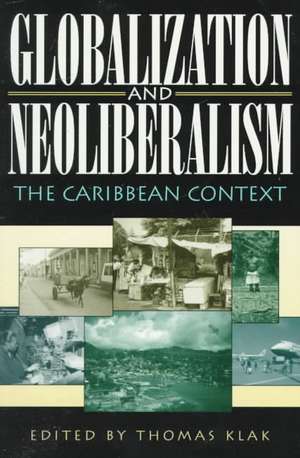
Globalization and Neoliberalism: The Caribbean Context
Editat de Thomas Klak Contribuţii de Dennis Conway, Roger-Mark De Souza, Dennis J. Gayle, Janet Henshall Momsen, Beverley Mullings, Garth Myers, Aaron Segal, Paul Susman, James Wileyen Limba Engleză Paperback – 11 dec 1997
Preț: 422.23 lei
Preț vechi: 599.06 lei
-30%
Puncte Express: 633
Carte tipărită la comandă
Livrare economică 03-17 decembrie
Livrare prin curier în România Termenul estimat este afișat lângă disponibilitate.
Transport gratuit pentru acest produs Plată online sau ramburs, în funcție de opțiunile comenzii.
Retur gratuit în 14 zile Comandă securizată și suport în română.
Specificații
ISBN-13: 9780847685370
ISBN-10: 0847685373
Pagini: 352
Dimensiuni: 163 x 227 x 26 mm
Greutate: 0.46 kg
Ediția:New.
Editura: Bloomsbury Publishing
Colecția Rowman & Littlefield
Locul publicării:New York, United States
ISBN-10: 0847685373
Pagini: 352
Dimensiuni: 163 x 227 x 26 mm
Greutate: 0.46 kg
Ediția:New.
Editura: Bloomsbury Publishing
Colecția Rowman & Littlefield
Locul publicării:New York, United States
V-ar putea interesa
-
 Cluster Genesis: Technology-Based Industrial DevelopmentPontus Braunerhjelm-28%Preț: 349.10 lei484.17 lei
 -
 The Oxford Handbook of Economic GeographyGordon L. Clark-29%Preț: 510.51 lei721.89 lei
 -
 A Guide to Countries of the WorldPeter Stalker-19%Preț: 93.65 lei115.10 lei
 -
 The Economics of Clusters: Lessons from the French ExperienceGilles Duranton-31%Preț: 646.84 lei933.59 lei
 -
 -28%Preț: 439.74 lei613.31 lei
 -
 By All Means Necessary: How China's Resource Quest is Changing the WorldElizabeth Economy-24%Preț: 143.38 lei189.57 lei
 -
 Economic Geography: Places, Networks and FlowsAndrew Wood-15%Preț: 486.50 lei572.35 lei
 -
 Geographies of ConsumptionJuliana Mansvelt-15%Preț: 597.99 lei703.52 lei
 -
 Innovation, Entrepreneurship, Geography and GrowthPhilip MccannPreț: 218.56 lei
 -
 The Geography of the World EconomyPaul Knox-15%Preț: 611.47 lei719.37 lei
 -
 Global ShiftPeter Dicken-18%Preț: 588.84 lei718.10 lei
 -
 Key Concepts in Economic GeographyYuko AoyamaPreț: 437.87 lei
 -
 Creative Industry DistrictsJinliao He-15%Preț: 665.01 lei782.36 lei
 -
 -18%Preț: 5736.76 lei6996.04 lei
Cuprins
Chapter 1 Introduction
Chapter 2 Thirteen Theses on Globalization and Neoliberalism
Part 3 Development Models and Neoliberal Policies
Chapter 4 Editor's Introduction
Chapter 5 Misguided Directions, Mismanaged Models, or Missed Paths?
Chapter 6 Microstates in a Macroworld
Chapter 7 Trade Policies and the Hemispheric Integration Process
Chapter 8 How States Sell Their Countries and People
Part 9 Caribbean Development Policies in a Neoliberal Era: Case Studies
Chapter 10 Editor's Introduction
Chapter 11 Caribbean Tourism and Agriculture: New Linkages in the Global Era?
Chapter 12 Jamaica's Export Information Processing Services: Neoliberal Niche or Structural Limitation?
Chapter 13 Dominica's Economic Diversification: Microstates in a Neoliberal Era?
Chapter 14 Cuban Socialism in Crisis: A Neoliberal Solution?
Part 15 Contemporary Caribbean Adaptation Through Migration
Chapter 16 Editor's Introduction
Chapter 17 The Political Economy of Contemporary Migration
Chapter 18 The Spell of the Cascadura: West Indian Return Migration
Part 19 Future Prospects
Chapter 20 Editor's Introduction
Chapter 21 From Neoliberalism to Sustainable Development?
Chapter 2 Thirteen Theses on Globalization and Neoliberalism
Part 3 Development Models and Neoliberal Policies
Chapter 4 Editor's Introduction
Chapter 5 Misguided Directions, Mismanaged Models, or Missed Paths?
Chapter 6 Microstates in a Macroworld
Chapter 7 Trade Policies and the Hemispheric Integration Process
Chapter 8 How States Sell Their Countries and People
Part 9 Caribbean Development Policies in a Neoliberal Era: Case Studies
Chapter 10 Editor's Introduction
Chapter 11 Caribbean Tourism and Agriculture: New Linkages in the Global Era?
Chapter 12 Jamaica's Export Information Processing Services: Neoliberal Niche or Structural Limitation?
Chapter 13 Dominica's Economic Diversification: Microstates in a Neoliberal Era?
Chapter 14 Cuban Socialism in Crisis: A Neoliberal Solution?
Part 15 Contemporary Caribbean Adaptation Through Migration
Chapter 16 Editor's Introduction
Chapter 17 The Political Economy of Contemporary Migration
Chapter 18 The Spell of the Cascadura: West Indian Return Migration
Part 19 Future Prospects
Chapter 20 Editor's Introduction
Chapter 21 From Neoliberalism to Sustainable Development?
Recenzii
A thorough, serious, and scholarly analysis of the impact of recent global economic tendencies on the Caribbean. . . . For those wishing intelligent and well-documented research and commentary on the micro- and macro-consequences of unfettered economic globalization, including those who support such processes but are willing to consider fair criticism, this collection will be extremely useful.
Klak's thinking is original and refreshing. . . . [His] first chapter ['Thirteen theses on globalization and neoliberalism'] is worth the price of the book. . . . Whether one teaches or studies suburban U.S. communities, historic preservation in the Islamic realm, or housing markets in China, each thought-provoking thesis lends itself to other important issues related to our shrinking world. Scholars will welcome these insights and instructors will easily be able to draw a lecture out of each thesis. . . . [The book] has a master bibliography that will serve as a benchmark in development and Caribbean studies readings for years to come. . . . Human geography and development studies are all the richer because of this stellar work.
This volume examines the ways political, economic, and social geographic factors are affecting the development of the region. The book's original approach should be of great interest to geographers, economists, and other scholars who are interested in the Caribbean or postmodern processes.
...the case study chapters assemble a lot of new information and will certainly be cited in other studies.
This volume provides a thorough, serious, and scholarly analysis of the impact of the recent global economic tendencies on the Carribean.
A wide-ranging critique of the neoliberal agenda. The authors generate an imaginative argument for renewing a core-periphery framework in order to understand the economic, political, social and cultural position of small countries in the developing world.
The merit of the essays is that they raise many valid questions...
Klak has put together a great book about the economic development of Caribban states. It respects the diversity of the people and their policies as they respond, both individually and collectively, to their economic challenges and adversities.
A well-organized and well-written assessment of linkages between states and societies in the Caribbean and the internaional political economy. . . . There is a good balance between description and analysis, and the discussion is both thematic and country-specific. . . . This is an academic text with considerable policy relevance. . . . I, therefore, commend it not just to students and scholars interested in Caribbean economics and political economy, but to policy makers and managers both within and outside the Caribbean.
This book is a valuable addition to the discourse on the place of the Caribbean in the globalization process.
The writing styles of the chapter authors are remarkably clear, and the editor has obviously done his job well in organizing the book's presentation of chapters and editing its contents. It should be considered a must reading for anyone interested in the Caribbean or in problems of economic development elsewhere in the world.
Klak's thinking is original and refreshing. . . . [His] first chapter ['Thirteen theses on globalization and neoliberalism'] is worth the price of the book. . . . Whether one teaches or studies suburban U.S. communities, historic preservation in the Islamic realm, or housing markets in China, each thought-provoking thesis lends itself to other important issues related to our shrinking world. Scholars will welcome these insights and instructors will easily be able to draw a lecture out of each thesis. . . . [The book] has a master bibliography that will serve as a benchmark in development and Caribbean studies readings for years to come. . . . Human geography and development studies are all the richer because of this stellar work.
This volume examines the ways political, economic, and social geographic factors are affecting the development of the region. The book's original approach should be of great interest to geographers, economists, and other scholars who are interested in the Caribbean or postmodern processes.
...the case study chapters assemble a lot of new information and will certainly be cited in other studies.
This volume provides a thorough, serious, and scholarly analysis of the impact of the recent global economic tendencies on the Carribean.
A wide-ranging critique of the neoliberal agenda. The authors generate an imaginative argument for renewing a core-periphery framework in order to understand the economic, political, social and cultural position of small countries in the developing world.
The merit of the essays is that they raise many valid questions...
Klak has put together a great book about the economic development of Caribban states. It respects the diversity of the people and their policies as they respond, both individually and collectively, to their economic challenges and adversities.
A well-organized and well-written assessment of linkages between states and societies in the Caribbean and the internaional political economy. . . . There is a good balance between description and analysis, and the discussion is both thematic and country-specific. . . . This is an academic text with considerable policy relevance. . . . I, therefore, commend it not just to students and scholars interested in Caribbean economics and political economy, but to policy makers and managers both within and outside the Caribbean.
This book is a valuable addition to the discourse on the place of the Caribbean in the globalization process.
The writing styles of the chapter authors are remarkably clear, and the editor has obviously done his job well in organizing the book's presentation of chapters and editing its contents. It should be considered a must reading for anyone interested in the Caribbean or in problems of economic development elsewhere in the world.