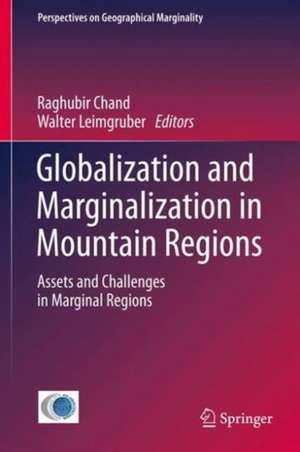
Globalization and Marginalization in Mountain Regions: Perspectives on Geographical Marginality, cartea 1
Editat de Raghubir Chand, Walter Leimgruberen Limba Engleză Hardback – 23 iun 2016
În cadrul programelor de studiu dedicate geografiei umane și dezvoltării durabile, Globalization and Marginalization in Mountain Regions ocupă un loc central prin modul în care redefinește statutul zonelor montane în contextul globalizării. Această lucrare, care deschide seria Perspectives on Geographical Marginality, propune o schimbare de paradigmă: privirea munților nu doar ca periferii geografice, ci ca bunuri comune globale esențiale pentru supraviețuirea a peste jumătate din populația planetei. Descoperim aici o analiză riguroasă a modului în care procesele economice globale și schimbările climatice tind să marginalizeze comunitățile montane, în ciuda rolului lor crucial în furnizarea serviciilor ecosistemice. Structura volumului este echilibrată între fundamentarea teoretică și studiile de caz empirice. Prima parte examinează potențialul de dezvoltare în era globalizării, în timp ce secțiunile ulterioare explorează impactul încălzirii globale asupra resurselor de apă și a biodiversității în regiuni diverse, de la Himalaya și Anzi până la Arctica și zonele de frontieră europene. Această abordare completează perspectiva oferită de Impact of Global Changes on Mountains de Velma I. Grover, adăugând o dimensiune socială și politică profundă asupra marginalizării, nu doar o trecere în revistă a schimbărilor de mediu. Subliniem faptul că Raghubir Chand continuă și extinde aici preocupările sale anterioare din lucrări precum Landschaftsökologie und Landnutzung im höheren Himalaya, trecând de la ecologia peisajului la o analiză socio-economică integrată. Față de Global Mountain Regions de Ann Kingsolver, care se concentrează pe identitatea culturală a comunităților montane, volumul de față adoptă un ton mai tehnic și bazat pe date geografice, fiind o resursă academică indispensabilă pentru înțelegerea vulnerabilității acestor ecosisteme.

Preț: 666.97 lei
Preț vechi: 784.67 lei
-15%
Carte disponibilă
Livrare economică 31 octombrie-14 noiembrie
Specificații
ISBN-10: 3319326481
Pagini: 256
Ilustrații: XVI, 240 p. 45 illus., 36 illus. in color.
Dimensiuni: 160 x 241 x 19 mm
Greutate: 0.6 kg
Ediția:1st ed. 2016
Editura: Springer
Colecția Perspectives on Geographical Marginality
Seria Perspectives on Geographical Marginality
Locul publicării:Cham, Switzerland
V-ar putea interesa
-
 -34%Preț: 714.29 lei1078.01 lei
 -
 -15%Preț: 486.91 lei572.84 lei
 -
 Preț: 504.78 lei
 -
 Space, Knowledge and Power: Foucault and GeographyStuart EldenPreț: 430.58 lei
 -
 Geographies of ConsumptionJuliana Mansvelt-15%Preț: 597.99 lei703.52 lei
 -
 Preț: 156.72 lei
 -
 The Wiley-Blackwell Companion to Human GeographyJohn A. AgnewPreț: 361.70 lei
 -
 Preț: 410.61 lei
 -
 TraceLauret SavoyPreț: 94.55 lei
 -
 80:20: Development in an Unequal WorldCiara Regan-27%Preț: 122.23 lei167.58 lei
 -
 Creative Industry DistrictsJinliao He-15%Preț: 665.01 lei782.36 lei
 -
 -18%Preț: 5736.76 lei6996.04 lei
De ce să citești această carte
Recomandăm această carte cercetătorilor și studenților de la geografie și ecologie care doresc să înțeleagă mecanismele prin care regiunile montane devin marginale în economia globală. Cititorul câștigă o perspectivă documentată asupra modului în care schimbările climatice afectează resursele de apă și stabilitatea socială, primind instrumente analitice pentru a evalua sustenabilitatea în zone critice precum Himalaya sau Alpii.
Despre autor
Raghubir Chand este un reputat specialist în geografie umană și marginalitate, fiind editorul seriei Perspectives on Geographical Marginality. Opera sa se concentrează pe intersecția dintre ecologia peisajului și utilizarea terenurilor, cu o expertiză vastă în regiunea Himalaya, reflectată în lucrări precum Landschaftsökologie und Landnutzung im höheren Himalaya. Alături de Walter Leimgruber, Chand a coordonat numeroase studii care analizează inegalitățile sociale și economice din regiunile izolate, fiind o voce autoritară în cadrul comunității academice internaționale preocupate de dezvoltarea zonelor montane.
Descriere scurtă
Cuprins
Recenzii
Notă biografică
Raghubir Chand: His research interest is the mountain geography in the fields of Himalayan environment and land use planning, socio-economic and demographic transformation of Himalayan societies besides his involvement in migration studies, agricultural productivity, cultural geography, environmental and livelihood support systems of tribal communities of Bhutan and other parts of western Himalaya. He has published two books including Brokpas: The Hidden Highlanders of Bhutan (2004). He has published 70 papers in various national and international journals. He is in the editorial board and one of the founder members of PAHAR - a research journal of people’s Association for Himalayan Area Research based at Nainital.