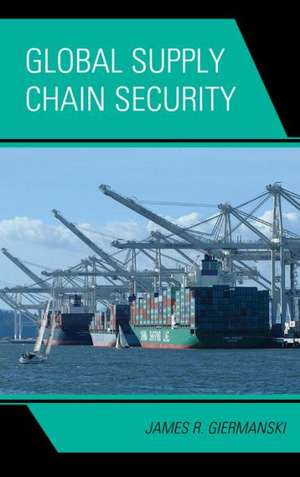
Global Supply Chain Security
Autor James Giermanskien Limba Engleză Hardback – 27 dec 2012
Offering insights on deficiencies in U.S. policies, Giermanski underscores the vulnerabilities in the supply chain that U.S. government agencies have ignored, avoided, and even denied. Global Supply Chain Security treats both the terrestrial and maritime borders of the United States, reserving for special analysis the threat to the nation's southern border of hazardous materials or materials in transshipment or in-bond, as well as the questionable leadership exhibited by the Department of Homeland Security in its diagnosis and treatment of these threats. Finally, Giermanski covers the important role played by the private sector and the off-the-shelf, innovative products that have been introduced to supply chain management and security.
Preț: 542.72 lei
Preț vechi: 777.39 lei
-30%
Puncte Express: 814
Carte tipărită la comandă
Livrare economică 21 noiembrie-05 decembrie
Livrare prin curier în România Termenul estimat este afișat lângă disponibilitate.
Transport gratuit pentru acest produs Plată online sau ramburs, în funcție de opțiunile comenzii.
Retur gratuit în 14 zile Comandă securizată și suport în română.
Specificații
ISBN-13: 9780810886414
ISBN-10: 0810886413
Pagini: 196
Ilustrații: 2 b/w illustrations; 19 b/w photos; 3 tables
Dimensiuni: 159 x 236 x 21 mm
Greutate: 0.39 kg
Editura: Bloomsbury Publishing
Colecția Scarecrow Press
Locul publicării:New York, United States
ISBN-10: 0810886413
Pagini: 196
Ilustrații: 2 b/w illustrations; 19 b/w photos; 3 tables
Dimensiuni: 159 x 236 x 21 mm
Greutate: 0.39 kg
Editura: Bloomsbury Publishing
Colecția Scarecrow Press
Locul publicării:New York, United States
Recenzii
Global Supply Chain Security is an exemplary and comprehensive examination of the Department of Homeland Security's initiatives to protect our nation's supply chain and a must-read for everyone. Giermanski's thorough examination of the vulnerabilities and the steps taken to fix the glaring gaps clearly reinforces the importance of continuing to be ever vigilant to terrorist attacks on this important segment of our economy.
Few people know more about the cross-border movement of goods than Jim Giermanski, the "Paul Revere of cargo security." Anyone who is involved in international trade will find food for thought-not to mention cause for alarm-in Global Supply Chain Security. Every aspect of cargo security, from customs procedures to transportation operations to government regulations and regulatory agencies worldwide, is laid bare. But this important book does far more than simply describe the state of cargo security in a post-9/11 world. It reveals which initiatives have failed and why, as well as how the public and the private sectors should redress those failures if we are to prevent another security catastrophe.
This book on the current state of procedures and technology to prevent catastrophic security failures in ocean and land cargo shipping should be required reading by public officials and concerned citizens. Giermanski is an authority on the topic, currently heading a transportation security company and formerly serving as director of transportation and logistics studies at Texas A&M International University. He is highly critical of current Department of Homeland Security border security procedures and technology to keep US citizens safe from weapons of mass destruction. He describes supply chain security in clear language as electronic records of effective security procedures and controls at every step of container transportation, from original loading to unloading at the final destination, with container and trailer integrity maintained to prevent unauthorized introduction of materials or persons. The book comprehensively describes legislative acts and international agreements on cargo security, whose requirements are too often not met. Giermanski identifies many procedural and technological flaws in ocean and land cargo security. His evaluation of Homeland Security's incompetence in dealing with the security elements in global trade and resulting vulnerabilities add up to a whistleblower's horror story. More press coverage of these weaknesses seems warranted. Extensive, excellent references and index. Summing Up: Highly recommended. General readers; upper-division undergraduates through researchers/professionals.
Few people know more about the cross-border movement of goods than Jim Giermanski, the "Paul Revere of cargo security." Anyone who is involved in international trade will find food for thought-not to mention cause for alarm-in Global Supply Chain Security. Every aspect of cargo security, from customs procedures to transportation operations to government regulations and regulatory agencies worldwide, is laid bare. But this important book does far more than simply describe the state of cargo security in a post-9/11 world. It reveals which initiatives have failed and why, as well as how the public and the private sectors should redress those failures if we are to prevent another security catastrophe.
This book on the current state of procedures and technology to prevent catastrophic security failures in ocean and land cargo shipping should be required reading by public officials and concerned citizens. Giermanski is an authority on the topic, currently heading a transportation security company and formerly serving as director of transportation and logistics studies at Texas A&M International University. He is highly critical of current Department of Homeland Security border security procedures and technology to keep US citizens safe from weapons of mass destruction. He describes supply chain security in clear language as electronic records of effective security procedures and controls at every step of container transportation, from original loading to unloading at the final destination, with container and trailer integrity maintained to prevent unauthorized introduction of materials or persons. The book comprehensively describes legislative acts and international agreements on cargo security, whose requirements are too often not met. Giermanski identifies many procedural and technological flaws in ocean and land cargo security. His evaluation of Homeland Security's incompetence in dealing with the security elements in global trade and resulting vulnerabilities add up to a whistleblower's horror story. More press coverage of these weaknesses seems warranted. Extensive, excellent references and index. Summing Up: Highly recommended. General readers; upper-division undergraduates through researchers/professionals.