
Global Sourcing: Einkauf, Logistik und Supply Chain Management
Autor Gerhard Trautmannde Limba Germană Paperback – 29 sep 2008
Din seria Einkauf, Logistik und Supply Chain Management
- 15%
 Preț: 446.44 lei
 - 15%
 Preț: 446.05 lei
 - 15%
 Preț: 447.05 lei
 - 15%
 Preț: 473.43 lei
 -
 Preț: 375.41 lei
 - 15%
 Preț: 440.80 lei
 -
 Preț: 385.63 lei
 -
 Preț: 365.42 lei
 -
 Preț: 394.13 lei
 -
 Preț: 371.11 lei
 - 15%
 Preț: 641.11 lei
 - 15%
 Preț: 618.97 lei
 -
 Preț: 388.93 lei
 - 15%
 Preț: 475.35 lei
 - 15%
 Preț: 444.01 lei
 - 15%
 Preț: 444.20 lei
 - 15%
 Preț: 472.54 lei
 -
 Preț: 384.55 lei
Preț: 447.14 lei
Puncte Express: 671
Carte tipărită la comandă
Livrare economică 23 noiembrie-07 decembrie
Livrare prin curier în România Termenul estimat este afișat lângă disponibilitate.
Transport gratuit pentru acest produs Plată online sau ramburs, în funcție de opțiunile comenzii.
Retur gratuit în 14 zile Comandă securizată și suport în română.
Specificații
ISBN-13: 9783834912688
ISBN-10: 3834912689
Pagini: 152
Ilustrații: XVII, 132 S.
Dimensiuni: 148 x 210 x 9 mm
Greutate: 0.21 kg
Ediția:2008
Editura: Gabler Verlag
Colecția Einkauf, Logistik und Supply Chain Management
Seria Einkauf, Logistik und Supply Chain Management
Locul publicării:Wiesbaden, Germany
ISBN-10: 3834912689
Pagini: 152
Ilustrații: XVII, 132 S.
Dimensiuni: 148 x 210 x 9 mm
Greutate: 0.21 kg
Ediția:2008
Editura: Gabler Verlag
Colecția Einkauf, Logistik und Supply Chain Management
Seria Einkauf, Logistik und Supply Chain Management
Locul publicării:Wiesbaden, Germany
V-ar putea interesa
-
 Preț: 317.39 lei
 -
 Strategic Supply ManagementPaul Cousins-13%Preț: 624.71 lei718.06 lei
 -
 -15%Preț: 523.02 lei615.32 lei
 -
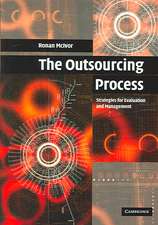 The Outsourcing ProcessRonan McIvor-22%Preț: 437.67 lei562.65 lei
 -
 Strategic ProcurementCaroline BoothPreț: 309.73 lei
 -
 Protean Supply ChainsJames A CookePreț: 437.36 lei
 -
 Supply Chain MetricsCecerePreț: 412.50 lei
 -
 Pricing Done RightTim J SmithPreț: 427.79 lei
 -
 Detecting and Reducing Supply Chain FraudNorman A. Katz-18%Preț: 929.28 lei1133.27 lei
 -
 Inventory and Production Management in Supply ChainsEdward A. Silver-18%Preț: 721.74 lei880.17 lei
 -
 -8%Preț: 492.92 lei535.79 lei
 -
 Managing the Global Supply ChainJuliana H Mikkola-24%Preț: 396.20 lei523.54 lei
Public țintă
ResearchCuprins
Organizational Design Implications of Global Sourcing: A Multiple Case Study Analysis on the application of Control Mechanisms.- Implementing Global Sourcing Through Purchasing Portfolio Management.- Elaborating the Information Processing Perspective in the Global Sourcing Context.
Notă biografică
Dr. Gerhard Trautmann promovierte bei Prof. Dr. Christopher Jahns am Supply Management Institute (SMI) der European Business School (EBS) in Oestrich-Winkel.
Textul de pe ultima copertă
Global sourcing has become an intended practice for the majority of multinational companies. Due to increasing competition, companies seek to exploit global purchasing synergies across geographical and business units. This requires an organisation that emphasizes the value of shared interest while granting each purchasing unit the necessary flexibility to adapt to their particular environment.
Gerhard Trautmann focuses on how companies can balance this trade-off in purchasing exploring the organization design requirements of a global sourcing strategy. The first essay presents a comprehensive framework for the analysis of integration mechanisms in hybrid purchasing organizations and empirical evidence for their application in MNCs. The second essay sets the focus of analysis at the category level providing a portfolio management approach for global sourcing. Finally, the third essay analyzes how global integration is carried out for different types of categories and provides explanations for the empirical findings by elaborating the information processing framework.
Gerhard Trautmann focuses on how companies can balance this trade-off in purchasing exploring the organization design requirements of a global sourcing strategy. The first essay presents a comprehensive framework for the analysis of integration mechanisms in hybrid purchasing organizations and empirical evidence for their application in MNCs. The second essay sets the focus of analysis at the category level providing a portfolio management approach for global sourcing. Finally, the third essay analyzes how global integration is carried out for different types of categories and provides explanations for the empirical findings by elaborating the information processing framework.