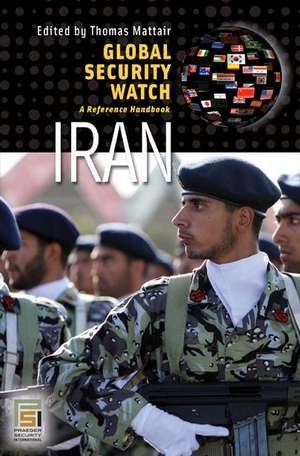
Global Security Watch—Iran: A Reference Handbook: Global Security Watch
Autor Thomas R. Mattairen Limba Engleză Hardback – 30 iun 2008
Mattair provides a comprehensive analysis of Iran's relations with its neighbors and major world powers. He begins with a review of Iran's foreign relations from the time of Iran's founding in the 5th century B.C. through the Islamic era beginning in the mid-600's A.D., and the native dynasties that ruled in more recent centuries as Iran faced challenges from foreign powers such as the Ottoman Empire and Western colonial empires. The rule of Shah Mohammed Reza Pahlavi, from 1941 until 1979, is analyzed in detail, covering his efforts to deter aggression by the Soviet Union, forge an alliance with the United States, assert Iran's power in the Persian Gulf, and exercise Iran's economic power, particularly through its oil wealth. The bulk of the book, however, focuses on the foreign relations of the Islamic Republic of Iran since 1979, during the time in which Ayatollah Khomeini and his successors have ruled. The reasons for Iran's early revolutionary activism, its antagonism toward the United States and Israel, and its war with Iraq from 1980 to 1988, are carefully examined. The reasons for international efforts to contain Iran, particularly efforts by the United States, are also analyzed. Iran's more pragmatic policies are explained, as well, including its close relations with Russia and China, its efforts to repair relations with Saudi Arabia and the other Arab states of the Gulf, its cooperation with U.S. efforts to topple the Taliban in Afghanistan after September 11, 2001, and its offer of comprehensive negotiations with the United States in May 2003. Finally, Mattair analyzes the current global debate about whether diplomacy, sanctions, or military action are appropriate responses to Iran's nuclear programs, its role in Iraq and the Persian Gulf, and its resistance to Israel.
Din seria Global Security Watch
- 18%
 Preț: 345.35 lei
 - 18%
 Preț: 330.16 lei
 - 28%
 Preț: 337.44 lei
 - 18%
 Preț: 345.98 lei
 - 18%
 Preț: 332.02 lei
 - 18%
 Preț: 330.16 lei
 - 27%
 Preț: 346.11 lei
 - 22%
 Preț: 247.27 lei
 - 19%
 Preț: 344.14 lei
 - 18%
 Preț: 345.35 lei
 - 17%
 Preț: 339.90 lei
 - 21%
 Preț: 212.93 lei
 - 13%
 Preț: 358.75 lei
 - 18%
 Preț: 361.19 lei
 - 13%
 Preț: 359.98 lei
 - 36%
 Preț: 331.16 lei
Preț: 387.78 lei
Preț vechi: 536.23 lei
-28%
Puncte Express: 582
Preț estimativ în valută:
68.63€ • 80.21$ • 59.58£
68.63€ • 80.21$ • 59.58£
Carte tipărită la comandă
Livrare economică 19 februarie-05 martie
Preluare comenzi: 021 569.72.76
Specificații
ISBN-13: 9780275994839
ISBN-10: 027599483X
Pagini: 224
Dimensiuni: 156 x 235 x 23 mm
Greutate: 0.48 kg
Editura: Bloomsbury Publishing
Colecția Praeger
Seria Global Security Watch
Locul publicării:New York, United States
ISBN-10: 027599483X
Pagini: 224
Dimensiuni: 156 x 235 x 23 mm
Greutate: 0.48 kg
Editura: Bloomsbury Publishing
Colecția Praeger
Seria Global Security Watch
Locul publicării:New York, United States
V-ar putea interesa
-
 PostCapitalism: A Guide to Our FuturePaul Mason-32%Preț: 60.95 lei89.20 lei
 -
 -14%Preț: 736.49 lei856.38 lei
 -
 -10%Preț: 336.81 lei374.92 lei
 -
 -34%Preț: 768.64 lei1159.91 lei
 -
 Preț: 269.94 lei
 -
 -19%Preț: 122.85 lei152.58 lei
 -
 Preț: 114.64 lei
 -
 -22%Preț: 331.37 lei424.34 lei
 -
 -22%Preț: 331.99 lei424.66 lei
 -
 Full Planet, Empty Plates: The New Geopolitics of Food ScarcityLester R. BrownPreț: 86.15 lei
 -
 The Heroines of SOEBeryl E EscottPreț: 89.42 lei
 -
 Preț: 282.69 lei
 -
 The Crisis of ZionismPeter BeinartPreț: 121.20 lei
 -
 Preț: 205.68 lei
 -
 -27%Preț: 360.06 lei494.86 lei
Cuprins
Foreword
Preface
1.The History of Iran
2.Iran Under Shah Mohammad Reza Pahlavi
3.The Foreign Policy of the Islamic Republic of Iran
4.The World and the Islamic Republic
5.Contemporary Dilemmas
6.Conclusion
Biographical Profiles
Chronology of Events
Documents
Glossary
Selected Bibliography
Index
Preface
1.The History of Iran
2.Iran Under Shah Mohammad Reza Pahlavi
3.The Foreign Policy of the Islamic Republic of Iran
4.The World and the Islamic Republic
5.Contemporary Dilemmas
6.Conclusion
Biographical Profiles
Chronology of Events
Documents
Glossary
Selected Bibliography
Index
Recenzii
This volume in the 'Global Security Watch' series makes an excellent attempt to explain the reasoning behind the
foreign policy decisions of the Iranian leadership, and those of its neighbors and major world powers that have
contributed to the current state of affairs.This work is a must read for policy makers, Middle East scholars and
students, and those wishing to have a better understanding of the US's relationship with Iran.Includes biographical profiles, a chronology, glossary, and pertinent documents.Highly recommended. Upper-level undergraduates and above in history and political science.
foreign policy decisions of the Iranian leadership, and those of its neighbors and major world powers that have
contributed to the current state of affairs.This work is a must read for policy makers, Middle East scholars and
students, and those wishing to have a better understanding of the US's relationship with Iran.Includes biographical profiles, a chronology, glossary, and pertinent documents.Highly recommended. Upper-level undergraduates and above in history and political science.