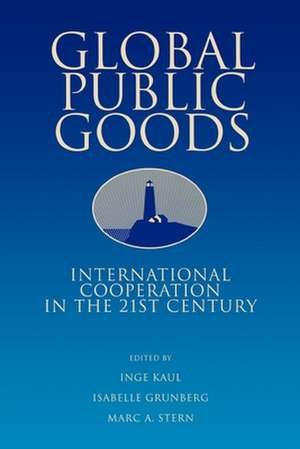
Global Public Goods
Editat de Inge Kaul, Marc Stern, Isabelle Grunbergen Limba Engleză Paperback – iun 1999
HIV, drug trafficking, and financial volatility. These issues are not poverty-related but instead concern global housekeeping, which helps to ensure an adequate provision of global public goods. Contributors include Amartya Sen, the 1998 Nobel Laureate in Economics, Jeffrey Sachs of the Harvard
Institute for International Development, Joseph Stiglitz of the World Bank, and many others.
Preț: 791.00 lei
Preț vechi: 1083.56 lei
-27%
Puncte Express: 1187
Carte tipărită la comandă
Livrare economică 01-15 iunie
Specificații
ISBN-13: 9780195130522
ISBN-10: 0195130529
Pagini: 588
Ilustrații: figures, tables
Dimensiuni: 156 x 234 x 31 mm
Greutate: 0.88 kg
Editura: Oxford University Press
Locul publicării:New York, United States
ISBN-10: 0195130529
Pagini: 588
Ilustrații: figures, tables
Dimensiuni: 156 x 234 x 31 mm
Greutate: 0.88 kg
Editura: Oxford University Press
Locul publicării:New York, United States
V-ar putea interesa
-
 A Bed for the NightDavid RieffPreț: 205.89 lei
 -
 Dead AidDambisa Moyo-21%Preț: 58.95 lei74.64 lei
 -
 Toxic Aid: Economic Collapse and Recovery in TanzaniaSebastian Edwards-34%Preț: 512.88 lei772.34 lei
 -
 -17%Preț: 90.84 lei109.85 lei
 -
 -19%Preț: 351.20 lei435.60 lei
 -
 -28%Preț: 705.16 lei975.05 lei
 -
 -28%Preț: 63.94 lei88.71 lei
 -
 Humanitarian InterventionThomas G WeissPreț: 127.62 lei
 -
 Hope in HellDan BortolottiPreț: 124.51 lei
 -
 -18%Preț: 202.63 lei247.90 lei
 -
 An Imperfect OfferingJames Orbinski-21%Preț: 92.09 lei115.95 lei
 -
 Carbonnier, G: Humanitarian EconomicsGilles Carbonnier-23%Preț: 229.64 lei297.67 lei
 -
 -20%Preț: 113.75 lei142.27 lei
 -
 Engineering in EmergenciesJan DavisPreț: 392.62 lei
Descriere
Edited by the United Nations Development Programme, this collection of papers offers a new rationale and framework for international development cooperation. Its main argument is that in actual practice development cooperation has already moved beyond aid. In the name of aid (i.e. assistance to poor countries), we are today dealing with issues such as the ozone hole, global climate change, HIV, drug trafficking and financial volatility. All of these issues are notreally poverty-related. Rather, they concern global housekeeping: ensuring an adequate provision of global public goods.
Recenzii
'Many common benifits such as law enforcement depend on the co-operation of national governments, not on supernational bodies, Jeffrey Sachs, one of the report's contributors. An the huge number of existing aid, health and envioromental charities can be relied on to help transfer costs and benifits, says Amartya Sen, last year's winner of the Nobel prize for economics, and moving spirit behind the report.' The Economist (UK) 8/5/1999