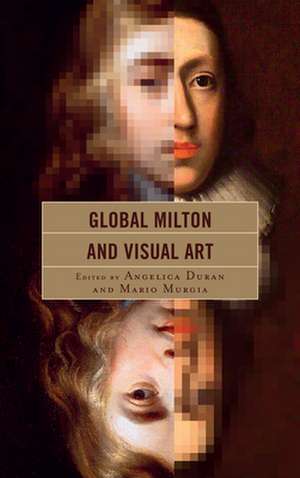
Global Milton and Visual Art
Editat de Angelica Duran, Mario Murgia Contribuţii de Joseph Wittreich, Hiroko Sano, Ana Elena González-Treviño, Nathalie Collé, Wendy Furman-Adams, Joshua Reid, Gabriela Villanueva, Chia-Yin Huang, Aaron Shapiro, Beverley Sherry, Matthew Geary, Islam Issa, Jonathan R. Olsonen Limba Engleză Hardback – 18 mar 2021
Preț: 694.90 lei
Preț vechi: 1056.03 lei
-34%
Puncte Express: 1042
Carte tipărită la comandă
Livrare economică 19 noiembrie-03 decembrie
Livrare prin curier în România Termenul estimat este afișat lângă disponibilitate.
Transport gratuit pentru acest produs Plată online sau ramburs, în funcție de opțiunile comenzii.
Retur gratuit în 14 zile Comandă securizată și suport în română.
Specificații
ISBN-13: 9781793617064
ISBN-10: 1793617066
Pagini: 384
Ilustrații: 93 b/w photos; 10 colour photos;
Dimensiuni: 164 x 228 x 32 mm
Greutate: 0.74 kg
Editura: Bloomsbury Publishing
Colecția Lexington Books
Locul publicării:New York, United States
ISBN-10: 1793617066
Pagini: 384
Ilustrații: 93 b/w photos; 10 colour photos;
Dimensiuni: 164 x 228 x 32 mm
Greutate: 0.74 kg
Editura: Bloomsbury Publishing
Colecția Lexington Books
Locul publicării:New York, United States
Cuprins
Part I: Panoramas
Chapter 1. An Introduction: Things Visible
Angelica Duran and Mario Murgia
Chapter 2. "More Worlds . . . Other Worlds . . . New Worlds": Translation / Illustration / Paradise Lost
Joseph Wittreich
Part II: Cameos
Chapter 3. Doré's Paradise Lost and Ukiyo-e Prints
Hiroko Sano
Chapter 4. Doré's Illustrations with Cromos in El Paraíso perdido
Angelica Duran
Chapter 5. Paradise Lost in Music Videos
Ana Elena González-Treviño
Part III: Textual Close-ups
Chapter 6. Author Portraits of Milton, Authorship, and Canonization
Nathalie Collé
Chapter 7. "Delectable to Behold": Milton's Eve in the Artist's Gaze
Wendy Furman-Adams
Chapter 8. Gender, Nature, and Desire in Dalí's Paradise Lost
Joshua Reid
Chapter 9. Paradise Lost as (Hispanic) Graphic Novel
Mario Murgia
Part IV: A Prospect beyond Books
Chapter 10. How Milton's Rebel Angels Landed in Mexico
Gabriela Villanueva
Chapter 11. The Milton Shield, Paradise Lost, and the 1867 Exposition universe
Chapter 1. An Introduction: Things Visible
Angelica Duran and Mario Murgia
Chapter 2. "More Worlds . . . Other Worlds . . . New Worlds": Translation / Illustration / Paradise Lost
Joseph Wittreich
Part II: Cameos
Chapter 3. Doré's Paradise Lost and Ukiyo-e Prints
Hiroko Sano
Chapter 4. Doré's Illustrations with Cromos in El Paraíso perdido
Angelica Duran
Chapter 5. Paradise Lost in Music Videos
Ana Elena González-Treviño
Part III: Textual Close-ups
Chapter 6. Author Portraits of Milton, Authorship, and Canonization
Nathalie Collé
Chapter 7. "Delectable to Behold": Milton's Eve in the Artist's Gaze
Wendy Furman-Adams
Chapter 8. Gender, Nature, and Desire in Dalí's Paradise Lost
Joshua Reid
Chapter 9. Paradise Lost as (Hispanic) Graphic Novel
Mario Murgia
Part IV: A Prospect beyond Books
Chapter 10. How Milton's Rebel Angels Landed in Mexico
Gabriela Villanueva
Chapter 11. The Milton Shield, Paradise Lost, and the 1867 Exposition universe
Recenzii
The 15 essays in Global Milton and Visual Art share a concern with the way that the illustrations accompanying Milton's Paradise Lost have contributed to an evolving understanding of the poem and helped to establish it as a work of global literature. The contributors address a wide variety of topics.. The physical book includes some 100 grayscale figures, ten of which are also illustrated by higher-quality color plates. The eBook links to 70 additional digital images, which are available on the Rowman & Littlefield website. Extensive notes and a bibliography follow each chapter, the writing is jargon-free and accessible, and the index is comprehensive. An interesting resource for advanced scholars. Recommended. Ambitious upper-division undergraduates, graduate students, researchers, faculty.
Global Milton tracks visual interpretations of the poet's work in diverse contexts - across multiple cultures and through a variety of historical moments. Stretching from Gustave Doré's engravings to contemporary music videos, passing via stained glass windows and comics, the contributors illustrate the creative complexity of these representations in analogue and digital forms. An invaluable resource for those interested in the cross-cultural portability and intermedial translatability of classic works of world literature.
Angelica Duran and Mario Murgia have assembled a collection of illuminating essays of astonishing chronological and culture diversity, which range from an account of William Marshall's portrait frontispiece to Milton's first poetry collection to analysis of modern films and pop videos. This ambitious project, drawing together scholars from around the world, deeply engages and substantially advances current appreciation of Milton's global reach.
Global Milton and Visual Art is, thus, in many ways, a ground-breaking collection of essays that looks at Milton's extratextual presence in diverse genres and cultures. By incorporating both the material culture and digital realm through printed illustrations and digital links to web images, the volume also presents novel ways for academic publishing. Consequently, Global Milton and Visual Art will be very helpful for academics and students from literature, art history, and media studies departments.
The most exciting contribution to scholarship in Global Milton and Visual Art is its bracingly new inventory of images, artifacts, and videos depicting Milton's "monumental contribution to art around the globe" (15). It refreshes the repository of stock visuals upon which teachers have had to rely to stimulate increasingly screen-addicted classrooms, yet also prompts new avenues, nay boulevards of inquiry into Milton's role as an iconic artist in both senses of the phrase-a maker of unforgettable, infinitely re-imaginable characters and an icon of the global public eye. Those of us who teach Milton year in and year out have long needed an outstanding, robust picture book (a category belittled by academics yet more sinned against than sinning) that would show rather than tell the extent to which Milton's synesthetic verse has borne visual fruit.
Overall this is a highly valuable volume that enriches our understanding of Milton through visual art across the centuries and across cultures. I recommend it highly and offer particular commendation to the essays by Wittreich, Sano, Furman-Adams, and Issa and Geary.
Global Milton tracks visual interpretations of the poet's work in diverse contexts - across multiple cultures and through a variety of historical moments. Stretching from Gustave Doré's engravings to contemporary music videos, passing via stained glass windows and comics, the contributors illustrate the creative complexity of these representations in analogue and digital forms. An invaluable resource for those interested in the cross-cultural portability and intermedial translatability of classic works of world literature.
Angelica Duran and Mario Murgia have assembled a collection of illuminating essays of astonishing chronological and culture diversity, which range from an account of William Marshall's portrait frontispiece to Milton's first poetry collection to analysis of modern films and pop videos. This ambitious project, drawing together scholars from around the world, deeply engages and substantially advances current appreciation of Milton's global reach.
Global Milton and Visual Art is, thus, in many ways, a ground-breaking collection of essays that looks at Milton's extratextual presence in diverse genres and cultures. By incorporating both the material culture and digital realm through printed illustrations and digital links to web images, the volume also presents novel ways for academic publishing. Consequently, Global Milton and Visual Art will be very helpful for academics and students from literature, art history, and media studies departments.
The most exciting contribution to scholarship in Global Milton and Visual Art is its bracingly new inventory of images, artifacts, and videos depicting Milton's "monumental contribution to art around the globe" (15). It refreshes the repository of stock visuals upon which teachers have had to rely to stimulate increasingly screen-addicted classrooms, yet also prompts new avenues, nay boulevards of inquiry into Milton's role as an iconic artist in both senses of the phrase-a maker of unforgettable, infinitely re-imaginable characters and an icon of the global public eye. Those of us who teach Milton year in and year out have long needed an outstanding, robust picture book (a category belittled by academics yet more sinned against than sinning) that would show rather than tell the extent to which Milton's synesthetic verse has borne visual fruit.
Overall this is a highly valuable volume that enriches our understanding of Milton through visual art across the centuries and across cultures. I recommend it highly and offer particular commendation to the essays by Wittreich, Sano, Furman-Adams, and Issa and Geary.