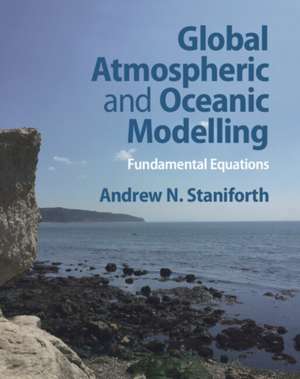
Global Atmospheric and Oceanic Modelling
Autor Andrew N. Staniforthen Limba Engleză Hardback – 28 apr 2022
Remarcăm faptul că Global Atmospheric and Oceanic Modelling se distanțează de documentația tehnică standard și de manualele introductive prin rigoarea cu care tratează consistența dinamică și termodinamică a ecuațiilor fundamentale. În timp ce multe resurse se bazează pe aproximări simplificate ale formei Pământului, Andrew N Staniforth construiește o bază teoretică ce ia în calcul geometria sferoidală a planetei, oferind astfel un instrument mult mai precis pentru dezvoltarea nucleelor dinamice ale modelelor de prognoză. Abordarea diferă de cea din Large-Scale Atmosphere-Ocean Dynamics: Volume 1 prin faptul că este mai puțin abstractă și mult mai aplicabilă în ingineria numerică directă — se pune accent pe derivarea unor ecuații care să poată fi implementate în algoritmi de calcul, nu doar pe analiza matematică a fluidelor. Structura cărții este una progresivă: prima parte, „Foundations”, stabilește coordonatele curvilinii și potențialele termodinamice pentru atmosfere umede și oceane, în timp ce partea a doua se concentrează pe seturi de ecuații „deep” și „shallow”, esențiale pentru modelarea la diverse scări de mărime. Considerăm că includerea soluțiilor non-liniare exacte reprezintă un avantaj major pentru cercetători, oferind un etalon necesar în testarea noilor modele climatice. Spre deosebire de Fundamentals of Atmospheric Modeling, care acoperă o gamă vastă de procese fizice precum microfizica norilor sau poluarea, volumul de față se concentrează strict și profund pe „motorul” matematic al mișcării fluidelor geofizice, asigurând o rigoare a conservării energiei și momentului prin metode variaționale și principiul acțiunii staționare a lui Hamilton.
Preț: 656.19 lei
Preț vechi: 721.09 lei
-9%
Carte tipărită la comandă
Livrare economică 29 septembrie-13 octombrie
Specificații
ISBN-10: 1108838332
Pagini: 816
Dimensiuni: 204 x 259 x 42 mm
Greutate: 2.03 kg
Ediția:Nouă
Editura: Cambridge University Press
Locul publicării:New York, United States
V-ar putea interesa
-
 Paleoclimatology: Reconstructing Climates of the QuaternaryRaymond S. Bradley-31%Preț: 479.56 lei692.05 lei
 -
 Incompressible Fluid DynamicsP. A. Davidson-20%Preț: 368.80 lei461.95 lei
 -
 -15%Preț: 372.68 lei437.37 lei
 -
 SpeedVaclav SmilPreț: 135.10 lei
 -
 Forecasting the OceanCommittee for the 2025-2035 Decadal Survey of Ocean Sciences for the National Science FoundationPreț: 140.95 lei
 -
 An Introduction to Synoptic-Dynamic MeteorologyGabriel Williams-33%Preț: 622.03 lei932.97 lei
 -
 The Atmosphere and OceanNeil C. Wells-19%Preț: 427.84 lei528.19 lei
 -
 Fluid Dynamics of the Mid-Latitude AtmosphereBrian J. HoskinsPreț: 428.76 lei
 -
 Fundamentals of AstrodynamicsRoger R Bate-18%Preț: 122.03 lei149.67 lei
 -
 Climate System ModelingKevin E. Trenberth-14%Preț: 749.19 lei871.15 lei
 -
 Numerical Methods for Atmospheric and Oceanic SciencesA. Chandrasekar-8%Preț: 462.41 lei502.63 lei
 -
 Introduction to Dual Polarization Weather RadarV. Chandrasekar-14%Preț: 744.58 lei865.79 lei
 -
 Statistical Methods for Climate ScientistsTimothy Delsole-11%Preț: 451.74 lei507.57 lei
 -
 Climate Variability and Tropical Cyclone ActivityPao-Shin Chu-11%Preț: 522.11 lei586.65 lei
 -
 Atmospheric Chemistry and PhysicsJohn H. Seinfeld-14%Preț: 805.01 lei936.05 lei
 -
 -42%Preț: 59.58 lei103.35 lei
 -
 AtmosphereTaylor Jenkins Reid-33%Preț: 88.53 lei131.89 leiRecomandat
 -
 -27%Preț: 66.57 lei91.40 lei
 -
 Atmospheric DynamicsUlrich Achatz-17%Preț: 483.47 lei582.49 lei
De ce să citești această carte
Recomandăm această lucrare specialiștilor în modelare numerică și meteorologilor care doresc să înțeleagă fundamentele fizice din spatele codurilor de prognoză. Cititorul câștigă o înțelegere profundă a ecuațiilor de mișcare fără a se baza pe aproximări sferice limitative. Este o resursă esențială pentru cei care proiectează modele climatice de ultimă generație, oferind certitudinea consistenței termodinamice în calcule complexe.
Descriere scurtă
Cuprins
Recenzii
'Well, this is an impressive book. It covers both the equations of motion and how those equations and their approximations can be used in models of the ocean and atmosphere. It is clearly written, careful and thorough, with a range and a depth that is unmatched elsewhere. It will be of immense value both to those interested in the fundamentals and those wishing to build models that have a sound foundation. It will be a standard for years to come.' Geoffrey K. Vallis, University of Exeter
'This is the textbook I wish I'd had as a graduate student and course instructor! This is an incredibly comprehensive resource for students and researchers alike. I am confident the book will become the go to reference on atmospheric and oceanic modelling for the 2020s and beyond.' Andrew Weaver, University of Victoria
'Global Atmospheric and Oceanic Modelling is bound to become a classic in the literature of Geophysical Fluid Dynamics. Written by a multi-decade insider to the design of the numerical “dynamical cores” that are at the heart of the models employed for both weather prediction and climate change projection, the book provides a meticulously documented development of dynamically and thermodynamically self-consistent sets of equations that are employed to describe the evolution of these geophysical fluids. Highlights of the book include a careful development of the influence of the ellipsoidal shape of the planet which acts through the gravitational field on the evolution of these fluid domains.' W. Richard Peltier, University of Toronto
'This text is a tremendous resource for anyone looking for a rigorous, thorough treatment of the fundamental equations needed for the development of dynamical cores of numerical models for weather and climate, especially for those interested and/or involved in model design and development. The treatment is detailed, general, and exact without ad-hoc approximations or simplifications. This includes a more truthful representation of variations in gravity due to the geometry of the system. Andrew Staniforth offers the reader unique insights from his experience of an entire career as a leading scholar in the field.' Thomas Birner, University of Munich