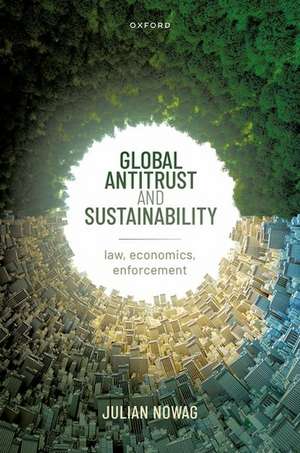
Global Antitrust and Sustainability: Law, Economics, Enforcement
Autor Julian Nowagen Limba Engleză Hardback – 7 oct 2025
Preț: 605.25 lei
Preț vechi: 880.35 lei
-31%
Puncte Express: 908
Carte disponibilă
Livrare economică 19-25 noiembrie
Livrare prin curier în România Termenul estimat este afișat lângă disponibilitate.
Transport gratuit pentru acest produs Plată online sau ramburs, în funcție de opțiunile comenzii.
Retur gratuit în 14 zile Comandă securizată și suport în română.
Specificații
ISBN-13: 9780192864505
ISBN-10: 0192864505
Pagini: 304
Dimensiuni: 165 x 240 x 25 mm
Greutate: 0.61 kg
Editura: OUP OXFORD
Colecția OUP Oxford
Locul publicării:Oxford, United Kingdom
ISBN-10: 0192864505
Pagini: 304
Dimensiuni: 165 x 240 x 25 mm
Greutate: 0.61 kg
Editura: OUP OXFORD
Colecția OUP Oxford
Locul publicării:Oxford, United Kingdom
V-ar putea interesa
-
 Sustainability: A Very Short IntroductionSaleem H. Ali-18%Preț: 58.30 lei71.45 lei
 -
 Competition Law and Intellectual Property in ChinaSpyros Maniatis-29%Preț: 1200.69 lei1693.67 lei
 -
 Competition Law: Analysis, Cases, & MaterialsIoannis Lianos-21%Preț: 579.50 lei734.92 lei
 -
 Economics for Competition Lawyers 3eGunnar Niels-27%Preț: 671.11 lei922.53 lei
 -
 Competition and Antitrust Law: A Very Short IntroductionAriel Ezrachi-20%Preț: 57.15 lei71.12 lei
 -
 Sustainable Development Law: Principles, Practices, and ProspectsMarie-Claire Cordonier Segger-13%Preț: 413.74 lei475.16 lei
 -
 Competition LawRichard Whish-16%Preț: 428.23 lei510.98 lei
 -
 EU Competition Law and EconomicsDamien Geradin-14%Preț: 1741.99 lei2025.57 lei
 -
 Competition Enforcement and ProcedureRenato Nazzini-14%Preț: 1999.75 lei2325.29 lei
 -
 -21%Preț: 92.10 lei115.93 lei
 -
 Preț: 423.69 lei
 -
 The Global Business EnvironmentJanet Morrison-19%Preț: 420.86 lei518.38 lei
 -
 The New Nature of BusinessAndre HoffmannPreț: 116.19 lei
 -
 The Sustainability ClassAaron VansintjanPreț: 153.70 lei
 -
 Competition Law as RegulationFabiana Di Porto-32%Preț: 881.74 lei1289.25 lei
 -
 The Age of ExtractionTim WuPreț: 107.73 lei
 -
 Global Competition Law and EconomicsEiner Elhauge-29%Preț: 535.49 lei758.84 lei
 -
 Competition Law 2024RoxburghPreț: 338.27 lei
 -
 Lean & Green: Best PracticeDaniel ReichertPreț: 451.09 lei
 -
 Sustainable Sustainability: Why ESG is Not EnoughRajeev PeshawariaPreț: 119.95 lei
Recenzii
This is an outstanding, useful, and welcome volume on efforts around the world to integrate sustainability into competition law. It features competition authorities as the guardians of sustainability, with comprehensive coverage of the soft law and hard law of various jurisdictions, uniquely bookended by refreshing stories.
This book is a fantastic contribution to our understanding of the relationship between competition law/policy/economics and sustainability in all its guises. With its global reach it is hoped it can help both businesses and competition authorities ensure that competition law is not an obstacle but a positive force as we strive to fight climate change and achieve a more sustainable future.
Sustainability will continue to challenge competition specialists and enforcers. This book is a comprehensive and accessible contribution to both the academic debate and the enforcement practice that fortunately move into a slow but steady paste towards integration.
This remarkable volume offers sustainability-oriented competition scholars a comprehensive foundation—spanning theoretical and empirical economic analysis, relevant constitutional frameworks, and institutional contexts. Its prose is exceptionally accessible yet intellectually rigorous, with a global scope and analytical depth that resonate across disciplines and geographies. The book makes a significant contribution to critical sustainability discourse and illuminates how diverse objectives have shaped, and may continue to shape, competition policies and enforcement across various jurisdictions.
This book is a timely exploration of the intersection between competition law and sustainability. It effectively showcases, through a refreshingly pragmatic approach, the emerging debates on the role of competition law in either enabling or hindering sustainability initiatives. It does this by drawing from the diverse approaches to sustainability by different jurisdictions as a contextual inquiry into opportunities within the framework of antitrust and competition law to advance sustainability goals. The book is a comprehensive and valuable resource for enforcers and policymakers to think about the approaches and tools to integrate sustainability goals into competition law, as well as a solid foundation for scholars to build upon.
This book offers the most substantive and insightful analysis to date on the intersection of competition law and sustainability. Combining a nuanced understanding of economic incentives with a robust theoretical framework, it draws on a wide range of examples from diverse jurisdictions to chart a clear course through this emerging field. The volume serves as an essential roadmap for academics, policymakers, and practitioners seeking to grasp the evolving role of competition policy in advancing sustainability goals, as well as its limitations. A compelling and timely contribution, it is required reading for anyone engaged in shaping the future of market regulation in a sustainability-driven world.
This book is a fantastic contribution to our understanding of the relationship between competition law/policy/economics and sustainability in all its guises. With its global reach it is hoped it can help both businesses and competition authorities ensure that competition law is not an obstacle but a positive force as we strive to fight climate change and achieve a more sustainable future.
Sustainability will continue to challenge competition specialists and enforcers. This book is a comprehensive and accessible contribution to both the academic debate and the enforcement practice that fortunately move into a slow but steady paste towards integration.
This remarkable volume offers sustainability-oriented competition scholars a comprehensive foundation—spanning theoretical and empirical economic analysis, relevant constitutional frameworks, and institutional contexts. Its prose is exceptionally accessible yet intellectually rigorous, with a global scope and analytical depth that resonate across disciplines and geographies. The book makes a significant contribution to critical sustainability discourse and illuminates how diverse objectives have shaped, and may continue to shape, competition policies and enforcement across various jurisdictions.
This book is a timely exploration of the intersection between competition law and sustainability. It effectively showcases, through a refreshingly pragmatic approach, the emerging debates on the role of competition law in either enabling or hindering sustainability initiatives. It does this by drawing from the diverse approaches to sustainability by different jurisdictions as a contextual inquiry into opportunities within the framework of antitrust and competition law to advance sustainability goals. The book is a comprehensive and valuable resource for enforcers and policymakers to think about the approaches and tools to integrate sustainability goals into competition law, as well as a solid foundation for scholars to build upon.
This book offers the most substantive and insightful analysis to date on the intersection of competition law and sustainability. Combining a nuanced understanding of economic incentives with a robust theoretical framework, it draws on a wide range of examples from diverse jurisdictions to chart a clear course through this emerging field. The volume serves as an essential roadmap for academics, policymakers, and practitioners seeking to grasp the evolving role of competition policy in advancing sustainability goals, as well as its limitations. A compelling and timely contribution, it is required reading for anyone engaged in shaping the future of market regulation in a sustainability-driven world.
Notă biografică
Julian Nowag is an Associate Professor at the University of Hong Kong and Lund University (Sweden). Professor Nowag earned a Master's degree (MSt) and a doctorate (DPhil) from the University of Oxford. He also completed an LLM in European Legal Studies at Durham University and undergraduate law studies in Germany and Austria. He is an associate at the Oxford Centre for Competition Law and Policy where he is on the editorial board of The Journal for Antitrust Enforcement. He works on the intersection of competition law with other areas such as sustainability and AI.