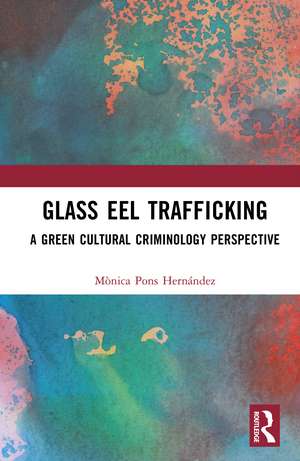
Glass Eel Trafficking: A Green Cultural Criminology Perspective
Autor Mònica Pons-Hernándezen Limba Engleză Hardback – 7 sep 2026
Drawing on green cultural criminology, the book examines the intertwined cultural, economic, legal, and political dimensions of glass eel trafficking. Adopting multiple perspectives, it shows how cultural practices, along with material and symbolic values, shape and sustain both legal and illegal eel trade. In doing so, it highlights the broader harms associated with glass eel trafficking, emphasizing its global reach and its consequences for marginalized local communities and nonhuman species.
Accessible to both academics and practitioners, Glass Eel Trafficking also offers practical recommendations for policymakers aimed at protecting the European eel and other vulnerable, often overlooked species from extinction. It concludes with critical insights into the drivers of legal and illegal wildlife trade, underscoring the central importance of culture in understanding and addressing these dynamics.
Preț: 1347.06 lei
Preț vechi: 1642.76 lei
-18% Nou
Puncte Express: 2021
Carte tipărită la comandă
Livrare economică 07-21 decembrie
Livrare prin curier în România Termenul estimat este afișat lângă disponibilitate.
Transport gratuit pentru acest produs Plată online sau ramburs, în funcție de opțiunile comenzii.
Retur gratuit în 14 zile Comandă securizată și suport în română.
Specificații
ISBN-13: 9781041011712
ISBN-10: 1041011717
Pagini: 226
Ilustrații: 38
Dimensiuni: 152 x 229 mm
Greutate: 0.58 kg
Ediția:1
Editura: Taylor & Francis
Colecția Routledge
Locul publicării:Oxford, United Kingdom
ISBN-10: 1041011717
Pagini: 226
Ilustrații: 38
Dimensiuni: 152 x 229 mm
Greutate: 0.58 kg
Ediția:1
Editura: Taylor & Francis
Colecția Routledge
Locul publicării:Oxford, United Kingdom
Public țintă
Academic and PostgraduateCuprins
Introduction 2. Glass Eel Trafficking: Europe’s Largest Wildlife Crime. 3. Smuggling Traditions: The Cultural Life of Eel Exploitation. 4. Eelconomics: The Global Eel Economy from River to Table. 5. Eel Law: Regulating the Exploitation of a Vanishing Species. 6. Operation Eel: Crime Control and the Politics of Enforcement. 7. Conclusion: Culture and the Making of Wildlife Trafficking.
Notă biografică
Mònica Pons-Hernández is a Marie Skłodowska-Curie Postdoctoral Researcher at the University of Bergen (Norway), specializing in green criminology. Her current research focuses on environmental harm, state-corporate crime, and the overexploitation of marine species. She holds a PhD in Law from Universitat Rovira i Virgili (Tarragona, Spain) and has an active publication record on environmental crime, including research on wildlife trafficking and the illegal trade in European eels, illegal fishing, waste trafficking, and state-corporate crimes. She is the recipient of various academic awards, including the Extraordinary Doctoral Award and prizes from the American Society of Criminology and the Spanish Society of Criminological Research.
Recenzii
Glass Eel Trafficking: A Green Cultural Criminology Perspective is a book about the European eel—a fascinating species with one of the most complex life cycles in the animal kingdom. It is a book about wildlife trade and trafficking, as well as broader harms to nonhuman animals. But it is really a book of stories: stories about culture (heritage, identity, meaning, traditions—and belonging); stories about economics or “eelconomics” (dynamics, incentives, structures, systems—from local livelihoods to global supply chains); stories about law and il/legality—authority, frameworks, inconsistencies, and questions of legitimacy; stories about politics (ambivalence, priorities) and practicalities (the challenges of enforcing environmental law); and stories about responsibility in the face of biological vulnerability and economic decline. Mònica Pons Hernández weaves all of these stories together in a rich and profound narrative—one that is remarkable for its layers of nuance and respectful consideration of multiple perspectives.
Avi Brisman, Professor, Eastern Kentucky University
In the world of ‘wildlife’, it is the cute and charismatic that attract attention and affection. But what about important but overlooked species? This original and comprehensive study of the global trade in European eels draws on green cultural criminology to show how shared values and social practices shape markets, laws, and political responses. This insightful contribution to contemporary green criminology makes a compelling call to rethink how we address wildlife trafficking.
Nigel South, Emeritus Professor, Sociology and Criminology, University of Essex.
In this masterfully crafted book, Pons-Hernández offers a distinctive lens on glass eel trafficking by framing it as a phenomenon shaped by “cultural, economic, legal, and political dynamics.” By focusing on the European eel, the book challenges dominant charisma-driven conservation biases and highlights the importance of examining less visible species. It shows that eel trafficking is not simply an illegal market, but one deeply embedded in cultural traditions and local identities. By integrating cultural, economic, legal, and political dimensions, Pons-Hernández demonstrates how these forces interact and mutually reinforce one another, highlighting why enforcement efforts are likely to remain limited if these dynamics are overlooked. In doing so, the book provides a more grounded understanding of why this form of wildlife trafficking persists and why addressing it requires more than enforcement alone. For those seeking a more comprehensive understanding of the illegal wildlife trade, this book is essential reading.
Gohar Petrossian, Professor, John Jay College of Criminal Justice, CUNY.
Avi Brisman, Professor, Eastern Kentucky University
In the world of ‘wildlife’, it is the cute and charismatic that attract attention and affection. But what about important but overlooked species? This original and comprehensive study of the global trade in European eels draws on green cultural criminology to show how shared values and social practices shape markets, laws, and political responses. This insightful contribution to contemporary green criminology makes a compelling call to rethink how we address wildlife trafficking.
Nigel South, Emeritus Professor, Sociology and Criminology, University of Essex.
In this masterfully crafted book, Pons-Hernández offers a distinctive lens on glass eel trafficking by framing it as a phenomenon shaped by “cultural, economic, legal, and political dynamics.” By focusing on the European eel, the book challenges dominant charisma-driven conservation biases and highlights the importance of examining less visible species. It shows that eel trafficking is not simply an illegal market, but one deeply embedded in cultural traditions and local identities. By integrating cultural, economic, legal, and political dimensions, Pons-Hernández demonstrates how these forces interact and mutually reinforce one another, highlighting why enforcement efforts are likely to remain limited if these dynamics are overlooked. In doing so, the book provides a more grounded understanding of why this form of wildlife trafficking persists and why addressing it requires more than enforcement alone. For those seeking a more comprehensive understanding of the illegal wildlife trade, this book is essential reading.
Gohar Petrossian, Professor, John Jay College of Criminal Justice, CUNY.
Descriere
Glass Eel Trafficking: A Green Cultural Criminology Perspective explores the complex legal and illegal trade in European eels, with a particular focus on Spain as a key site of fishing, trading, and consumption.