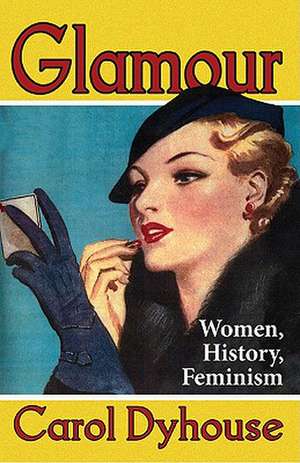
Glamour: Women, History, Feminism
Autor Professor Carol Dyhouseen Limba Engleză Paperback – 10 feb 2011
This unique and fascinating book tells the story of glamour. It explores the changing meanings of the word, its relationship to femininity and fashion, and its place in twentieth century social history. Using a rich variety of sources - from women's magazines and film to social surveys and life histories - Carol Dyhouse examines with wit and insight the history and meaning of costume, cosmetics, perfume and fur.
Dyhouse disentangles some of the arguments surrounding femininity, appearance and power, directly addressing feminist concerns. The book explores historical contexts in which glamour served as an expression of desire in women and an assertion of entitlement to the pleasures of affluence, finally arguing that glamour can't simply be dismissed as oppressive, or as male fantasy, but can carry celebratory meanings for women.
Preț: 109.93 lei
Preț vechi: 122.32 lei
-10%
Puncte Express: 165
Carte tipărită la comandă
Livrare economică 07-21 decembrie
Livrare prin curier în România Termenul estimat este afișat lângă disponibilitate.
Transport gratuit de la 400.00 lei Plată online sau ramburs, în funcție de opțiunile comenzii.
Retur gratuit în 14 zile Comandă securizată și suport în română.
Specificații
ISBN-13: 9781848138612
ISBN-10: 184813861X
Pagini: 306
Dimensiuni: 128 x 198 x 20 mm
Greutate: 0.32 kg
Editura: Bloomsbury Publishing
Colecția Zed Books
Locul publicării:London, United Kingdom
ISBN-10: 184813861X
Pagini: 306
Dimensiuni: 128 x 198 x 20 mm
Greutate: 0.32 kg
Editura: Bloomsbury Publishing
Colecția Zed Books
Locul publicării:London, United Kingdom
V-ar putea interesa
-
 Women, Gender, ReligionE. Castelli-15%Preț: 598.90 lei704.58 lei
 -
 Women and Work in Globalizing AsiaDong-Sook S. Gills-18%Preț: 1255.17 lei1530.69 lei
 -
 Socialist Women: Britain, 1880s to 1920sJune HannamPreț: 464.20 lei
 -
 Preț: 401.74 lei
 -
 Men Who Rape: The Psychology of the OffenderA. Nicholas GrothPreț: 131.90 lei
 -
 Women's Lives and the Eighteenth-Century English NovelElizabeth BrophyPreț: 412.95 lei
 -
 -15%Preț: 296.36 lei348.62 lei
 -
 Chinese Women Organizing: Cadres, Feminists, Muslims, QueersPing-Chun Hsiung-18%Preț: 1156.18 lei1409.97 lei
Cuprins
Introduction
1. The Origins of Glamour: Demi-Monde, Modernity, 'It'
2. Hollywood Glamour
3. Dreams, Desires and Spending
4. Princesses, Tarts and Cheesecake
5. Revolutions
6. Glamazons, Grunge and Bling
7. Perspectives and Reflections: Glamour for All?
Notes
Bibliography
Acknowledgements, Picture Credits
Index
1. The Origins of Glamour: Demi-Monde, Modernity, 'It'
2. Hollywood Glamour
3. Dreams, Desires and Spending
4. Princesses, Tarts and Cheesecake
5. Revolutions
6. Glamazons, Grunge and Bling
7. Perspectives and Reflections: Glamour for All?
Notes
Bibliography
Acknowledgements, Picture Credits
Index
Recenzii
In her relish for brassy blondes, gutsy flamboyance and tinsel vulgarity, Dyhouse writes like a woman who knows her way around the lipstick counter and the flea market. She shows how a parade in the trappings of glamour expressed aspiration and assertion at odds with mousy, unobtrusive conformity. Glamour was a cynical business, but also a shriek of camp defiance. All fur coat and no knickers. Dyhouse has whipped the stopper from a vintage bottle of 'Evening in Paris' and conjured a vanished world - cheap, a little tarty, but impossible to forget.
Rigorously researched and persuasively argued, this book represents an important contribution to the social history of fashion and of fabulousness.
In her survey of changing ideas about 'Glamour' throughout the twentieth century and beyond, Carol Dyhouse has succeeded in fashioning scholarly empirical research into a clear, engaging and enthusiastic account. Rejecting the idea that women are victims of the imperative to glamour, she makes a strong argument for the aspirational aspect of the perennial desire for physical beauty, glamour as a right rather than a prison.
Carol Dyhouse has written a study of the history of the conception of glamour in the twentieth century that is sprightly, provocative, and penetrating. She adds greatly to our understanding of a phenomenon that has been central to women's attitudes toward themselves, as they use the products of the beauty industry to both standardize their looks and to express cultural rebellion. This work will be interesting to both scholars and general readers alike.
Riveting - from perfume to sexual politics and the precise definition of "It", Dyhouse gives us an entertaining and innovative analysis of a topic that, while hitherto underexplored, has a huge impact on all our lives.
Rigorously researched and persuasively argued, this book represents an important contribution to the social history of fashion and of fabulousness.
In her survey of changing ideas about 'Glamour' throughout the twentieth century and beyond, Carol Dyhouse has succeeded in fashioning scholarly empirical research into a clear, engaging and enthusiastic account. Rejecting the idea that women are victims of the imperative to glamour, she makes a strong argument for the aspirational aspect of the perennial desire for physical beauty, glamour as a right rather than a prison.
Carol Dyhouse has written a study of the history of the conception of glamour in the twentieth century that is sprightly, provocative, and penetrating. She adds greatly to our understanding of a phenomenon that has been central to women's attitudes toward themselves, as they use the products of the beauty industry to both standardize their looks and to express cultural rebellion. This work will be interesting to both scholars and general readers alike.
Riveting - from perfume to sexual politics and the precise definition of "It", Dyhouse gives us an entertaining and innovative analysis of a topic that, while hitherto underexplored, has a huge impact on all our lives.