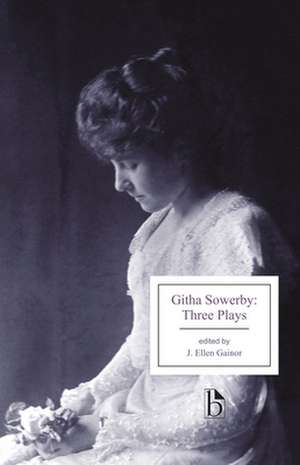
Githa Sowerby: Three Plays: Rutherford and Son, A Man and Some Women, The Stepmother
Autor Githa Sowerby Editat de J. Ellen Gainoren Limba Engleză Paperback – 10 mar 2021
With the acclaimed revival of Rutherford at the National Theatre in 1994, and with the efforts by feminist scholars and theatre artists to rediscover the work of such forgotten women writers, Sowerby and her dramas have secured renewed interest. This edition gathers Rutherford and Son, its companion piece A Man and Some Women, and the postwar play The Stepmother. The edition will provide teachers, students, and artists with important historical contexts for Sowerby’s dramas and will demonstrate the ongoing cogency of these dynamic, insightful, and engaging plays.
Preț: 163.15 lei
Preț vechi: 196.29 lei
-17%
Puncte Express: 245
Carte disponibilă
Livrare economică 05-19 noiembrie
Livrare express 22-28 octombrie pentru 66.99 lei
Livrare prin curier în România Termenul estimat este afișat lângă disponibilitate.
Transport gratuit de la 400.00 lei Plată online sau ramburs, în funcție de opțiunile comenzii.
Retur gratuit în 14 zile Comandă securizată și suport în română.
Specificații
ISBN-13: 9781554811854
ISBN-10: 1554811856
Pagini: 414
Ilustrații: 2 illustrations
Dimensiuni: 140 x 216 x 19 mm
Greutate: 0.52 kg
Editura: BROADVIEW PR
Colecția Broadview Press
Locul publicării:Peterborough, Canada
ISBN-10: 1554811856
Pagini: 414
Ilustrații: 2 illustrations
Dimensiuni: 140 x 216 x 19 mm
Greutate: 0.52 kg
Editura: BROADVIEW PR
Colecția Broadview Press
Locul publicării:Peterborough, Canada
Recenzii
Githa Sowerby’s Rutherford and Son took the London theatre by storm in 1912. Following its triumphant run, the play toured to New York, was produced throughout England, and was translated and staged in multiple European locations. Yet Sowerby’s initial theatrical success would not be repeated. With historical hindsight, we can see Sowerby’s experience as comparable to that of many other women writers who struggled to achieve lasting recognition, especially when their work was perceived as critiquing the forces restricting women’s lives. These vivid domestic dramas explore timely questions of capitalism, feminism, and personal freedom.
With the acclaimed revival of Rutherford at the National Theatre in 1994, and with the efforts by feminist scholars and theatre artists to rediscover the work of such forgotten women writers, Sowerby and her dramas have secured renewed interest. This edition gathers Rutherford and Son, its companion piece A Man and Some Women, and the postwar play The Stepmother. The edition will provide teachers, students, and artists with important historical contexts for Sowerby’s dramas and will demonstrate the ongoing cogency of these dynamic, insightful, and engaging plays.
“This collection is a revelation. It brings a new awareness of the full range of Sowerby’s playwriting, including her groundbreaking play Rutherford and Son and two others that few will have encountered. Through J. Ellen Gainor’s skillful editing and expertise, the book also shows what riches can emerge when theatre scholars join forces with theatre makers to recover ‘neglected’ plays and illuminate their continued relevance to our own times. Here is an outstanding example of the vital role of performance in the recovery of ‘lost’ play texts.” — Kirsten E. Shepherd-Barr, University of Oxford
“This edition of Githa Sowerby’s plays is a fantastic opportunity for students, researchers, and the general reader to engage with the work of this important but underrated Edwardian playwright. With its inclusion of introductory and critical editorials for each of the plays and an extensive range of original review materials, this rich volume provides an exemplary model. Once again, Broadview has commissioned an excellent edition that both brings to life the work of a marginalized playwright and will stand the tests of time.” — Maggie B. Gale, University of Manchester
“Although they were recognized in their day for their adroit craft and social acuity, until recent successful revivals, Githa Sowerby’s plays remained largely neglected. In this carefully curated edition of three of her more enduring works, J. Ellen Gainor deftly guides the reader through their contexts and critical reception. Sowerby should be regarded as a modern political dramatist of the first order, and in making these plays available for a wide readership, Gainor recuperates an important figure for feminist and theatre histories.” — Brad Kent, Laval University
With the acclaimed revival of Rutherford at the National Theatre in 1994, and with the efforts by feminist scholars and theatre artists to rediscover the work of such forgotten women writers, Sowerby and her dramas have secured renewed interest. This edition gathers Rutherford and Son, its companion piece A Man and Some Women, and the postwar play The Stepmother. The edition will provide teachers, students, and artists with important historical contexts for Sowerby’s dramas and will demonstrate the ongoing cogency of these dynamic, insightful, and engaging plays.
“This collection is a revelation. It brings a new awareness of the full range of Sowerby’s playwriting, including her groundbreaking play Rutherford and Son and two others that few will have encountered. Through J. Ellen Gainor’s skillful editing and expertise, the book also shows what riches can emerge when theatre scholars join forces with theatre makers to recover ‘neglected’ plays and illuminate their continued relevance to our own times. Here is an outstanding example of the vital role of performance in the recovery of ‘lost’ play texts.” — Kirsten E. Shepherd-Barr, University of Oxford
“This edition of Githa Sowerby’s plays is a fantastic opportunity for students, researchers, and the general reader to engage with the work of this important but underrated Edwardian playwright. With its inclusion of introductory and critical editorials for each of the plays and an extensive range of original review materials, this rich volume provides an exemplary model. Once again, Broadview has commissioned an excellent edition that both brings to life the work of a marginalized playwright and will stand the tests of time.” — Maggie B. Gale, University of Manchester
“Although they were recognized in their day for their adroit craft and social acuity, until recent successful revivals, Githa Sowerby’s plays remained largely neglected. In this carefully curated edition of three of her more enduring works, J. Ellen Gainor deftly guides the reader through their contexts and critical reception. Sowerby should be regarded as a modern political dramatist of the first order, and in making these plays available for a wide readership, Gainor recuperates an important figure for feminist and theatre histories.” — Brad Kent, Laval University
Cuprins
Acknowledgements
Introduction
Githa Sowerby: A Brief Chronology
A Note on the Texts
Rutherford and Son Introduction
Rutherford and Son: A Play in Three Acts
A Man and Some Women Introduction
A Man and Some Women: A Play in Three Acts
The Stepmother Introduction
The Stepmother: A Play in a Prologue and Three Acts
Appendix A: The Fabian Context
Introduction
Githa Sowerby: A Brief Chronology
A Note on the Texts
Rutherford and Son Introduction
Rutherford and Son: A Play in Three Acts
A Man and Some Women Introduction
A Man and Some Women: A Play in Three Acts
The Stepmother Introduction
The Stepmother: A Play in a Prologue and Three Acts
Appendix A: The Fabian Context
- 1. From Bernard Shaw, “Preface to the 1908 Reprint,” Fabian Essays (1908)
- 2. From William Archer, “Fabianism and the Drama,” The New Age (3–24 October 1908)
- 1. From Woman (26 September 1894)
- 2. From C. Morgan-Dockrell, “Is the New Woman a Myth?,” The Humanitarian (January–June 1896)
- 3. From Arabella Kenealy, “The Dignity of Love,” The Humanitarian (January–June 1896)v
- 4. From Cicely Hamilton, Marriage as a Trade (1909)
- 1. From Louise Creighton, “The Employment of Educated Women,” The Nineteenth Century (November 1901)
- 2. From “Statistics of Women’s Employment,” The Review of Reviews (July 1905)
- 3. From M.[abel] A.[tkinson], The Economic Foundations of the Women’s Movement (June 1914)
- 1. Rutherford and Son: First Performance and Cast List
- 2. Rutherford and Son: Critical Reception
- a. Phil Farnum, “Fame in a Day”
- b. “A New Playwright: Remarkable Achievement by K.G. Sowerby,” Westminster Gazette (1 February 1912)
- c. E.A. Baughan, “A New Dramatist: ‘Rutherford and Son’ at the Court”
- d. “Miss Sowerby’s Silence”
- e. J.W., “‘Rutherford and Son’ at the Royal Court Theatre,” Westminster Gazette (1 February 1912)
- f. “Royal Court Theatre,” London Times (2 February 1912)
- g. “Our Point of View: Woman Wins,” The Vote (10 February 1912)
- h. “The Little Theatre,” London Times (19 March 1912)
- i. R.P., “A New Woman Playwright,” Votes for Women (29 March 1912)
- j. From John Palmer, “‘Rutherford and Son,’” Saturday Review (30 March 1912)
- k. C.N.B., “‘Rutherford and Son’ a Great Suffrage Play,” The Vote (20 July 1912)
- l. From Emma Goldman, The Social Significance of the Modern Drama (1914)
- 3. G.S. Street, “Licensing Note” for Githa Sowerby, “A Man and Some Women” (13 October 1914)
- 4. A Man and Some Women: First Performance and Cast List
- 5. A Man and Some Women: Critical Reception
- a. From “New Plays at the Gaiety,” Manchester Courier (27 October 1914)
- b. From “New Play at the Gaiety,” Manchester Despatch (26 October 1914)
- c. From H.[arold] B.[righouse], “Gaiety Theatre: Two New Plays,” Manchester Guardian (27 October 1914)
- d. From “The Gaiety,” Manchester Weekly Times (1 November 1914)
- e. From “A Man and Some Women,” Sunday Chronicle (1 November 1914)
- 6. The Stepmother: First Performance and Cast List
- 7. The Stepmother: Critical Reception
- a. “The Stepmother,” The Era (16 January 1924)
- b. “‘The Stepmother’ by Ghita [sic] Sowerby,” Illustrated London News (26 January 1924)
- c. “The Stepmother”
- d. E.A.B.[aughan], “‘The Stepmother’: New Drama Produced by The Play Actors”
- e. S.R.L., “The Stepmother,” Referee (20 January 1924)