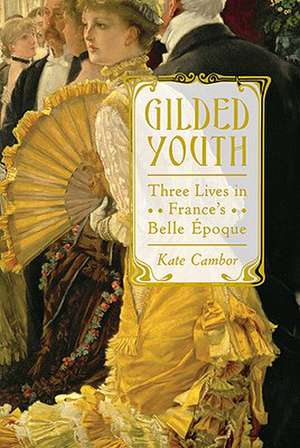
Gilded Youth
Autor Kate Camboren Limba Engleză Paperback – 3 aug 2010
In Gilded Youth, Kate Cambor paints a portrait of a generation lost in upheaval. While France weathered social unrest, violent crime, the birth of modern psychology, and the dawn of World War I, these three young adults experienced the disorientation of a generation forced to discover that the faith in science and progress that had sustained their fathers had failed them.
With masterful storytelling, Cambor captures the hopes and disillusionments of those who were destined to see the golden world of their childhood disappear-and the universal challenges that emerge as the dreams of youth collide with the realities of experience.
Preț: 138.91 lei
Puncte Express: 208
Carte disponibilă
Livrare economică 05-19 octombrie
Livrare prin curier în România Termenul estimat este afișat lângă disponibilitate.
Transport gratuit de la 400.00 lei Plată online sau ramburs, în funcție de opțiunile comenzii.
Retur gratuit în 14 zile Comandă securizată și suport în română.
Specificații
ISBN-13: 9780374532246
ISBN-10: 0374532249
Pagini: 334
Dimensiuni: 152 x 229 x 20 mm
Greutate: 0.54 kg
Editura: Farrar, Strauss & Giroux-3pl
ISBN-10: 0374532249
Pagini: 334
Dimensiuni: 152 x 229 x 20 mm
Greutate: 0.54 kg
Editura: Farrar, Strauss & Giroux-3pl
V-ar putea interesa
-
 The Killing of Major Denis MahonPeter DuffyPreț: 91.83 lei
 -
 Panzer LeaderHeinz GuderianPreț: 93.47 lei
 -
 Parents of Poor Children in England 1580-1800Patricia Crawford-19%Preț: 461.78 lei570.10 lei
 -
 Suicide in the Middle Ages: Volume 1: The Violent against ThemselvesAlexander Murray-22%Preț: 458.84 lei588.08 lei
 -
 Access to History: Napoleon, France and Europe Third EditionAndrina StilesPreț: 231.79 lei
 -
 The Ancient Greeks For DummiesStephen BatchelorPreț: 138.62 lei
 -
 D-DayRobert J KershawPreț: 67.51 lei
 -
 -26%Preț: 68.04 lei92.44 lei
 -
 Latin American Independence: An Anthology of SourcesSarah C. Chambers-18%Preț: 113.10 lei138.29 lei
 -
 A History of Florence, 1200 - 1575John M. NajemyPreț: 321.96 lei
 -
 Modern Greece - A History sincKoliopoulos-9%Preț: 723.74 lei795.32 lei
 -
 Germany, 1914-1933: Politics, Society and CultureMatthew StibbePreț: 417.65 lei
 -
 The Enemy at the GateAndrew Wheatcroft-18%Preț: 116.93 lei142.97 lei
 -
 Spectacle in the Roman WorldHazel Dodge-23%Preț: 161.14 lei210.37 lei
Recenzii
Praise for "Gilded Youth"
"Narrated with brio and style."--Miranda Seymour, "The New York Times Book Review ""In this dramatic, real-life tale of three intertwined lives, Kate Cambor conveys the dashed hopes not just of families and individuals, but of an entire culture. Jean-Baptiste Charcot, the son of famed neurologist Jean-Martin Charcot (mentor to Sigmund Freud); Leon Daudet, the son of the writer Alphonse Daudet (whose closest friends included Flaubert, Zola, Goncourt and Tolstoy); and Jeanne Hugo, the granddaughter of the writer Victor Hugo were the celebrity brats of France's Belle Epoque. None of the three friends had shoulders quite broad enough to carry the legacies of their forebears . . . "Gilded Youth" is full of glittering things--ideas, salons, dreams--ultimately blinding to the three young people. Paris burns brightly in the background." --Susan Salter Reynolds, "Los Angeles"" Times ""As Cambor notes, the problem was primarily one of momentum--the 'faith in science and progress' that defined the Gilded Age was eroded by the arrival of mechanized combat, psychoanalytic theory and a dizzying rush of experimental art. Born to one era, Charcot, Daudet and Hugo struggled, and failed, to adjust to the mores of the next." --Michael Shaer, "The Washington Post ""[Cambor] succinctly and masterfully offers an illuminating glimpse into belle epoque realities through the experiences of three childhood friends destined to do great things, who later saw the golden world of their childhoods disappear. This fascinating volume is highly recommended to a broad readership in 19th and 20th-century French studies and literature." --Ali Houissa, "Library Journal ""A fascinating snapshot of three uniquely situated individuals who helped to define, and were in turn defined by, this fascinating juncture in European history." --"Booklist ""This is a Proust lover's idea of a sexy read: the tale of the offspring of three of belle e
"Narrated with brio and style."--Miranda Seymour, "The New York Times Book Review ""In this dramatic, real-life tale of three intertwined lives, Kate Cambor conveys the dashed hopes not just of families and individuals, but of an entire culture. Jean-Baptiste Charcot, the son of famed neurologist Jean-Martin Charcot (mentor to Sigmund Freud); Leon Daudet, the son of the writer Alphonse Daudet (whose closest friends included Flaubert, Zola, Goncourt and Tolstoy); and Jeanne Hugo, the granddaughter of the writer Victor Hugo were the celebrity brats of France's Belle Epoque. None of the three friends had shoulders quite broad enough to carry the legacies of their forebears . . . "Gilded Youth" is full of glittering things--ideas, salons, dreams--ultimately blinding to the three young people. Paris burns brightly in the background." --Susan Salter Reynolds, "Los Angeles"" Times ""As Cambor notes, the problem was primarily one of momentum--the 'faith in science and progress' that defined the Gilded Age was eroded by the arrival of mechanized combat, psychoanalytic theory and a dizzying rush of experimental art. Born to one era, Charcot, Daudet and Hugo struggled, and failed, to adjust to the mores of the next." --Michael Shaer, "The Washington Post ""[Cambor] succinctly and masterfully offers an illuminating glimpse into belle epoque realities through the experiences of three childhood friends destined to do great things, who later saw the golden world of their childhoods disappear. This fascinating volume is highly recommended to a broad readership in 19th and 20th-century French studies and literature." --Ali Houissa, "Library Journal ""A fascinating snapshot of three uniquely situated individuals who helped to define, and were in turn defined by, this fascinating juncture in European history." --"Booklist ""This is a Proust lover's idea of a sexy read: the tale of the offspring of three of belle e