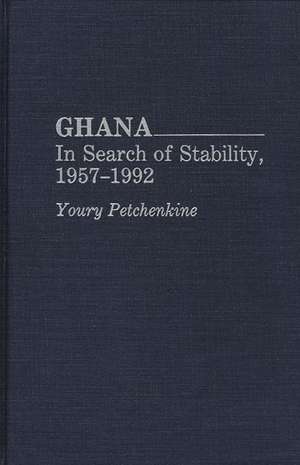
Ghana: In Search of Stability, 1957-1992
Autor Youry Lamberten Limba Engleză Hardback – 26 ian 1993
This unique work will be a valuable resource for researchers and students interested in problems of political, social, and economic stability in Africa.
Preț: 474.36 lei
Preț vechi: 675.48 lei
-30%
Puncte Express: 712
Carte tipărită la comandă
Livrare economică 07-21 decembrie
Livrare prin curier în România Termenul estimat este afișat lângă disponibilitate.
Transport gratuit pentru acest produs Plată online sau ramburs, în funcție de opțiunile comenzii.
Retur gratuit în 14 zile Comandă securizată și suport în română.
Specificații
ISBN-13: 9780275943264
ISBN-10: 0275943267
Pagini: 264
Dimensiuni: 156 x 235 x 19 mm
Greutate: 0.55 kg
Ediția:New.
Editura: Bloomsbury Publishing
Colecția Praeger
Locul publicării:New York, United States
ISBN-10: 0275943267
Pagini: 264
Dimensiuni: 156 x 235 x 19 mm
Greutate: 0.55 kg
Ediția:New.
Editura: Bloomsbury Publishing
Colecția Praeger
Locul publicării:New York, United States
V-ar putea interesa
-
 Keeper Of GenesisRobert Bauval-18%Preț: 64.84 lei79.39 lei
 -
 The Ancient Egyptians For DummiesCharlotte BoothPreț: 120.06 lei
 -
 SahelSebastiao Salgado-14%Preț: 399.90 lei465.00 lei
 -
 BerbersElizabeth FentressPreț: 425.56 lei
 -
 Rorke's Drift & Isandlwana 1879Chris PeersPreț: 149.92 lei
 -
 Lords of the AtlasGavin Maxwell-28%Preț: 77.42 lei107.40 lei
 -
 -26%Preț: 90.55 lei122.49 lei
 -
 The War for AfricaFred BridglandPreț: 222.00 lei
 -
 The Addis Ababa MassacreIan Campbell-20%Preț: 204.82 lei255.38 lei
 -
 How Long Will South Africa Survive?R. W. JohnsonPreț: 103.41 lei
 -
 David Livingstone: Mission and EmpireDr Andrew C. Ross-38%Preț: 380.85 lei611.50 lei
Cuprins
Introduction
Historical Approach to Political Development
Rule of the Convention People's Party
Rule of the National Liberation Council and the Second Republic
Regime of General Ignatius Acheampong
General Fred Akuffo's Rule and the "June Revolution"
The Third Republic
Rule of the Provisional National Defence Council
Structural Approach to Issues of Political Stability
Economic Development and Political Stability
Driving Forces of Political Development
State Government and Political Stability. Forms of State Power Organization
Struggle for Political Power
Conclusion
References
Index
Historical Approach to Political Development
Rule of the Convention People's Party
Rule of the National Liberation Council and the Second Republic
Regime of General Ignatius Acheampong
General Fred Akuffo's Rule and the "June Revolution"
The Third Republic
Rule of the Provisional National Defence Council
Structural Approach to Issues of Political Stability
Economic Development and Political Stability
Driving Forces of Political Development
State Government and Political Stability. Forms of State Power Organization
Struggle for Political Power
Conclusion
References
Index
Recenzii
[R]ecommended for graduate collections.
The author, a Russian diplomat, combines subtlety with a refreshing bluntness too often missing in Western academic writing.
The author, a Russian diplomat, combines subtlety with a refreshing bluntness too often missing in Western academic writing.