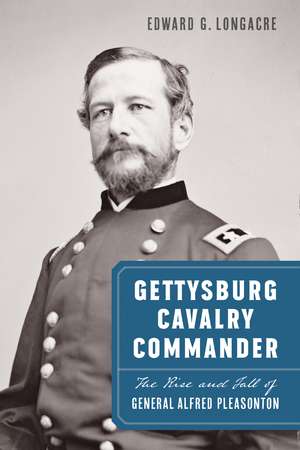
Gettysburg Cavalry Commander: The Rise and Fall of General Alfred Pleasonton
Autor Edward G. Longacreen Limba Engleză Hardback – dec 2026
Even so, Pleasonton had supporters at all levels of command. He was praised by army commanders, including George B. McClellan and Joseph Hooker, for his commitment to offensive warfare if not always for his intelligence-gathering skills. Although an inveterate army politician, Pleasonton did not hesitate to criticize superiors he thought lacking. When Ulysses S. Grant took over the Union armies in 1864, Pleasonton was exiled to the Trans-Mississippi Department. In that backwater theater he dealt Confederates invading Missouri and Kansas a series of dramatic defeats, but his career never revived. He retired from the army in 1867 to avoid serving under former subordinates.
Despite his flaws and shortcomings—real and imagined—it remains fact that Pleasonton commanded the Cavalry Corps, Army of the Potomac, during a critical period of its service, when it transitioned from a punching bag for Stuart’s vaunted cavaliers to the most effective mounted command in any theater of the conflict. Edward G. Longacre makes a thorough and conscientious attempt to separate fact from fiction and truth from deception in Gettysburg Cavalry Commander.
Preț: 271.87 lei
Precomandă
Puncte Express: 408
Carte nepublicată încă
Livrare prin curier în România Precomanda se expediază când titlul devine disponibil.
Transport gratuit de la 400.00 lei Plată online sau ramburs, în funcție de opțiunile comenzii.
Retur gratuit în 14 zile Comandă securizată și suport în română.
Doresc să fiu notificat când acest titlu va fi disponibil:
Se trimite...
Specificații
ISBN-13: 9781640127104
ISBN-10: 1640127100
Pagini: 360
Ilustrații: 26 photographs, 12 maps, index
Dimensiuni: 152 x 229 mm
Editura: Potomac Books Inc
Colecția Potomac Books
Locul publicării:United States
ISBN-10: 1640127100
Pagini: 360
Ilustrații: 26 photographs, 12 maps, index
Dimensiuni: 152 x 229 mm
Editura: Potomac Books Inc
Colecția Potomac Books
Locul publicării:United States
Notă biografică
Edward G. Longacre is the author or editor of more than thirty books on the Civil War, including J. E. B. Stuart: The Soldier and the Man, Unsung Hero of Gettysburg: The Story of Union General David McMurtrie Gregg (Potomac Books, 2021), and The Sharpshooters: A History of the Ninth New Jersey Volunteer Infantry in the Civil War (Potomac Books, 2017). His books have garnered numerous awards, including the Fletcher Pratt Award, the Douglas Southall Freeman History Award, and the Dr. James I. Robertson Jr. Literary Prize for Confederate History. He lives in Newport News, Virginia.
Cuprins
List of Illustrations
List of Maps
Acknowledgements
Introduction
ONE: West Point, Mexico, and the “Prince of Dragoons”
TWO: From “Pig War” to Civil War
THREE: A Most Excellent Soldier
FOUR: His Name in the Newspapers
FIVE: The Man Who Saved the Army
SIX: Corps Command
SEVEN: A Second Star, but No Stardom
EIGHT: Leading from the Rear
NINE: Prelude to Exile
TEN: Unheralded Victories
ELEVEN: Three Decades of Peace and Strife
Notes
Selective Bibliography
Index
List of Maps
Acknowledgements
Introduction
ONE: West Point, Mexico, and the “Prince of Dragoons”
TWO: From “Pig War” to Civil War
THREE: A Most Excellent Soldier
FOUR: His Name in the Newspapers
FIVE: The Man Who Saved the Army
SIX: Corps Command
SEVEN: A Second Star, but No Stardom
EIGHT: Leading from the Rear
NINE: Prelude to Exile
TEN: Unheralded Victories
ELEVEN: Three Decades of Peace and Strife
Notes
Selective Bibliography
Index
Recenzii
“The transformation of the Union cavalry in the latter stages of the Civil War into the formidable strike force it became is a subject about which little has been written. Edward Longacre, with his vast knowledge of cavalry operations and engaging prose, has written the definitive study of Alfred Pleasonton, the man who initiated the cavalry’s march to glory.”—Adolfo Ovies, author of The Boy Generals: George Custer, Wesley Merritt, and the Cavalry of the Army of the Potomac
“This overdue study fills a long neglected gap in the study of the cavalry of the Army of the Potomac. In this thoroughly researched and well written book, Edward Longacre even-handedly covers the cases both for and against this controversial and oft vilified cavalry leader. A must-read for fans of Civil War cavalry.”—Donald C. Caughey, coauthor of The 6th United States Cavalry in the Civil War
“Edward Longacre continues his remarkable run as a biographer by taking on one of the Civil War’s most overlooked and complex characters: cavalry commander Alfred Pleasonton. . . . Longacre untangles Pleasonton’s puffery and intrigue from his performance in the field, giving us an unsparing but balanced portrait of a curiously flawed man who commanded the Union cavalry in both the largest cavalry battle of the war (Brandy Station) and at the war’s most famous battle, Gettysburg. This is a biography long overdue, produced by the historian most qualified to do it.”—John J. Hennessy, retired historian for the National Park Service and author of Return to Bull Run: The Campaign and Battle of Second Manassas
“This overdue study fills a long neglected gap in the study of the cavalry of the Army of the Potomac. In this thoroughly researched and well written book, Edward Longacre even-handedly covers the cases both for and against this controversial and oft vilified cavalry leader. A must-read for fans of Civil War cavalry.”—Donald C. Caughey, coauthor of The 6th United States Cavalry in the Civil War
“Edward Longacre continues his remarkable run as a biographer by taking on one of the Civil War’s most overlooked and complex characters: cavalry commander Alfred Pleasonton. . . . Longacre untangles Pleasonton’s puffery and intrigue from his performance in the field, giving us an unsparing but balanced portrait of a curiously flawed man who commanded the Union cavalry in both the largest cavalry battle of the war (Brandy Station) and at the war’s most famous battle, Gettysburg. This is a biography long overdue, produced by the historian most qualified to do it.”—John J. Hennessy, retired historian for the National Park Service and author of Return to Bull Run: The Campaign and Battle of Second Manassas
Descriere
Separating fact from fiction, Edward G. Longacre tells the story of Major General Alfred Pleasonton, a controversial but supposedly a key player in helping save the Union Army of the Potomac from disaster during the Civil War.