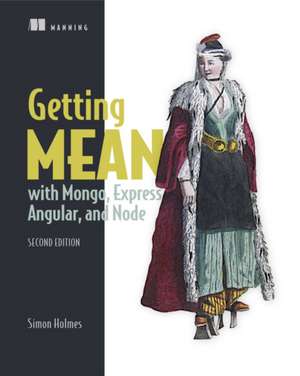
Getting Mean with Mongo, Express, Angular, and Node
Autor Simon Holmes, Clive Herberen Limba Engleză Paperback – 10 mai 2019
Getting MEAN, Second Edition teaches you how to develop full-stack web applications using the MEAN stack. This edition was completely revised and updated to cover MongoDB 4, Express 4, Angular 7, Node 11, and the latest mainstream release of JavaScript ES2015.
About the Technology
Juggling languages mid-application can radically slow down a full-stack web project. The MEAN stack—MongoDB, Express, Angular, and Node—uses JavaScript end to end, maximizing developer productivity and minimizing context switching. And you'll love the results! MEAN apps are fast, powerful, and beautiful.
About the Book
Getting MEAN, Second Edition teaches you how to develop full-stack web applications using the MEAN stack. Practical from the very beginning, the book helps you create a static site in Express and Node. Expanding on that solid foundation, you'll integrate a MongoDB database, build an API, and add an authentication system. Along the way, you'll get countless pro tips for building dynamic and responsive data-driven web applications!
What's inside
- MongoDB 4, Express 4, Angular 7, and Node.js 11
- MEAN stack architecture
- Mobile-ready web apps
- Best practices for efficiency and reusability
About the Reader
Readers should be comfortable with standard web application designs and ES2015-style JavaScript.
About the Author
Simon Holmes and Clive Harber are full-stack developers with decades of experience in JavaScript and other leading-edge web technologies.
Table of Contents
- PART 1 - SETTING THE BASELINE
- Introducing full-stack development
- Designing a MEAN stack architecturePART 2 - BUILDING A NODE WEB APPLICATION
- Creating and setting up a MEAN project
- Building a static site with Node and Express
- Building a data model with MongoDB and Mongoose
- Writing a REST API: Exposing the MongoDB database to the application
- Consuming a REST API: Using an API from inside ExpressPART 3 - ADDING A DYNAMIC FRONT END WITH ANGULAR
- Creating an Angular application with TypeScript
- Building a single-page application with Angular: Foundations
- Building a single-page application with Angular: The next levelPART 4 - MANAGING AUTHENTICATION AND USER SESSIONS
- Authenticating users, managing sessions, and securing APIs
- Using an authentication API in Angular applications
Preț: 367.54 lei
Preț vechi: 459.43 lei
-20%
Carte indisponibilă temporar
Specificații
ISBN-10: 1617294756
Pagini: 504
Ilustrații: Illustrations, unspecified
Dimensiuni: 187 x 233 x 32 mm
Greutate: 0.92 kg
Ediția:2nd edition
Editura: Manning Publications
Descriere
Traditional web dev stacks use a different programming language in every layer, resulting in a complex mashup of code and frameworks. Developers and businesses love it because it's scalable and cost-effective. End users love it because the apps created with it are fast and responsive.
It's a win-win-win! Getting MEAN, Second Edition is completely revised and updated to cover Angular 2, Node 6 and the latest mainstream release of JavaScript ES2015 (ES6). Key features* Completely revised* Hands-on examples* Step-by-step guide Readers should have some web development experience. This book is based on MongoDB 3, Express 4, Angular 2, and Node.js 6, making use of the ES2015 JavaScript syntax.
The MEAN stack is a pure JavaScript stack comprised of four main technologies, with a cast of supporting technologies: MongoDB-the database, Express-the web framework, Angular-the front-end framework, and Node.js-the web server.