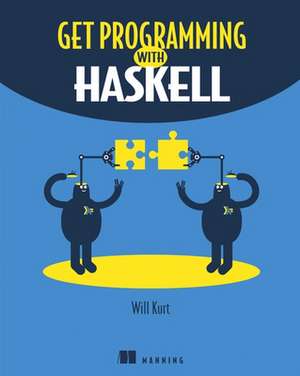
Get Programming with Haskell
Autor Will Kurten Limba Engleză Paperback – 13 iun 2018
Metodologia propusă de Get Programming with Haskell prioritizează design-ul funcțional și arhitectura bazată pe tipuri, eliminând barierele teoretice abstracte în favoarea implementării imediate. Observăm o structură progresivă, organizată în 43 de lecții concise, care ghidează cititorul de la fundamentele funcțiilor lambda până la managementul proiectelor complexe cu Stack și testarea automată prin QuickCheck. Suntem de părere că forța acestui volum rezidă în secțiunile de tip „Capstone”, unde conceptele sunt sintetizate în proiecte concrete, cum ar fi un sistem de mesaje secrete sau un motor de interogări asemănător SQL. Pe linia practică a volumului Practical Haskell, dar cu focus pe simplificarea procesului de învățare pentru programatorii care vin din medii imperative, Will Kurt demonstrează cum imutabilitatea și evaluarea leneșă (lazy evaluation) pot fi aplicate în scenarii cotidiene. În timp ce Real World Haskell explorează aplicații de mare anvergură într-un ritm accelerat, volumul de față adoptă un ton tehnic dar pedagogic, dedicând spațiu generos manipulării datelor JSON prin Aeson și interacțiunii cu bazele de date. Credem că abordarea autorului, ancorată în experiența sa de data scientist, oferă o perspectivă valoroasă asupra modului în care Haskell gestionează efectele secundare prin sistemul de tipuri IO, transformând o disciplină considerată adesea academică într-un instrument de producție eficient și robust.
Preț: 290.75 lei
Preț vechi: 363.45 lei
-20%
Carte disponibilă
Livrare economică 01-15 iunie
Livrare express 16-22 mai pentru 55.80 lei
Specificații
ISBN-10: 1617293768
Pagini: 616
Ilustrații: Illustrations, unspecified
Dimensiuni: 189 x 233 x 35 mm
Greutate: 1.02 kg
Editura: Manning Publications
V-ar putea interesa
-
 We, ProgrammersRobert Martin-20%Preț: 239.39 lei299.24 lei
 -
 Absolute Beginner's Guide to AlgorithmsKirupa Chinnathambi-20%Preț: 194.49 lei243.12 lei
 -
 Shaw, Z: Learn Python the Hard WayZed Shaw-20%Preț: 244.74 lei305.93 lei
 -
 Preț: 323.29 lei
 -
 Programming in Scala, Fifth EditionBill Venners-20%Preț: 312.20 lei390.24 lei
 -
 C++ How to Program, Global EditionPaul Deitel-20%Preț: 507.25 lei634.05 lei
 -
 Coding For Dummies, All New EditionPaul McFedries-20%Preț: 134.85 lei168.56 lei
 -
 Getting Started with PythonThomas Theis-20%Preț: 196.24 lei245.30 lei
 -
 RustNouman Azam-20%Preț: 297.17 lei371.46 lei
 -
 Learn You a Haskell for Great GoodMiran Lipovaca-36%Preț: 223.61 lei350.16 lei
 -
 Camel in Action, Second EditionClaus Ibsen-20%Preț: 478.71 lei598.39 lei
 -
 Haskell in DepthVitaly Bragilevsky-20%Preț: 340.07 lei425.09 lei
 -
 Getting Started with Natural Language ProcessingEkaterina Kochmar-20%Preț: 259.01 lei323.75 lei
 -
 Go by ExampleInanc Gumus-20%Preț: 269.87 lei337.34 lei
 -
 Hugging Face in ActionWei-Meng Lee-20%Preț: 267.32 lei334.15 lei
 -
 Learn Haskell by ExamplePhilipp Hagenlocher-20%Preț: 328.26 lei410.32 lei
 -
 Fortran Programming in easy stepsMike Mcgrath-20%Preț: 112.15 lei140.19 lei
 -
 Perl Programming in Easy StepsMike Mcgrath-20%Preț: 112.00 lei140.00 lei
 -
 Python in easy stepsMike Mcgrath-20%Preț: 76.83 lei96.04 lei
 -
 .NET 10 RevealedKajetan Duszy¿ski-20%Preț: 231.42 lei289.28 lei
De ce să citești această carte
Recomandăm această carte programatorilor care doresc să stăpânească paradigma funcțională fără a se bloca în terminologia matematică densă. Prin cele 43 de lecții practice, cititorul câștigă abilitatea de a scrie cod sigur, predictibil și ușor de testat. Este o resursă esențială pentru cei care vor să utilizeze Haskell în proiecte reale, beneficiind de exemple de cod pentru HTTP, baze de date și procesare de date.