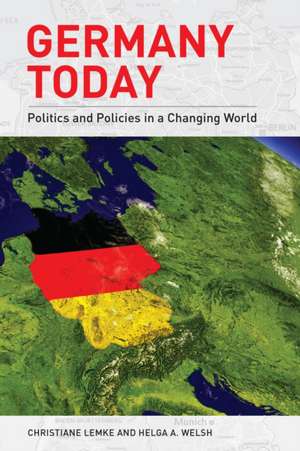
Germany Today: Politics and Policies in a Changing World: Europe Today
Autor Christiane Lemke, Helga A. Welshen Limba Engleză Paperback – dec 2017
| Toate formatele și edițiile | Preț | Express |
|---|---|---|
| Paperback (1) | 243.89 lei 6-8 săpt. | |
| Bloomsbury Publishing – dec 2017 | 243.89 lei 6-8 săpt. | |
| Hardback (1) | 480.71 lei 6-8 săpt. | |
| Bloomsbury Publishing – dec 2017 | 480.71 lei 6-8 săpt. |



Preț: 243.89 lei
Preț vechi: 315.91 lei
-23%
Puncte Express: 366
Preț estimativ în valută:
43.16€ • 50.44$ • 37.47£
43.16€ • 50.44$ • 37.47£
Carte tipărită la comandă
Livrare economică 20 februarie-06 martie
Preluare comenzi: 021 569.72.76
Specificații
ISBN-13: 9781442229976
ISBN-10: 1442229977
Pagini: 272
Ilustrații: 6 b/w illustrations; 1 map; 23 tables
Dimensiuni: 152 x 225 x 15 mm
Greutate: 0.36 kg
Editura: Bloomsbury Publishing
Colecția Rowman & Littlefield Publishers
Seria Europe Today
Locul publicării:New York, United States
ISBN-10: 1442229977
Pagini: 272
Ilustrații: 6 b/w illustrations; 1 map; 23 tables
Dimensiuni: 152 x 225 x 15 mm
Greutate: 0.36 kg
Editura: Bloomsbury Publishing
Colecția Rowman & Littlefield Publishers
Seria Europe Today
Locul publicării:New York, United States
Cuprins
List of Tables and Figures
Abbreviations
Authors' Notes
Preface
Chapter 1: The German Polity in Context
Chapter 2: Power Distribution in a Complex Democracy
Chapter 3: Political Actors, Parties, and Elections
Chapter 4: Citizens and Politics
Chapter 5: Migration, Immigration, Integration
Chapter 6: Political Economy
Chapter 7: Germany and the European Union
Chapter 8: Germany in Global Politics
Chapter 9: Looking Backward and Forward
References
Index
Abbreviations
Authors' Notes
Preface
Chapter 1: The German Polity in Context
Chapter 2: Power Distribution in a Complex Democracy
Chapter 3: Political Actors, Parties, and Elections
Chapter 4: Citizens and Politics
Chapter 5: Migration, Immigration, Integration
Chapter 6: Political Economy
Chapter 7: Germany and the European Union
Chapter 8: Germany in Global Politics
Chapter 9: Looking Backward and Forward
References
Index
Recenzii
An excellent and comprehensive introduction to the politics of the new Germany that emerged after unification in 1990. Presenting an inside and outside perspective, the book covers institutions and policies while paying particular attention to contentious issues like migration and economic success. It is indispensable reading for anyone seeking to understand the Federal Republic's difficulties with its leading role in Europe as well as its global entanglements.
In the midst of Brexit and Trump, Germany's status as a pillar of liberal democracy in a changing world order has attracted far-reaching attention and commentary. This marvelous book is the necessary primer for anyone looking to understand contemporary Germany, as well as the long and tumultuous political journey that has shaped the unified country's role in an integrated Europe and a globalized world. From the German Question to reunification to the refugee crisis, Lemke and Welsh's sweeping account of contemporary German politics provides an indispensable resource for students of European politics, comparative politics, and international relations.
Authored by two established political scientists equally familiar with Germany and the United States, this comprehensive textbook clearly portrays the German political system while acquainting North American readers with concepts such as parliamentary system, multi-party system, coalition government, and the European Union. Empirically rich, it conveys an excellent historical and systematic overview while at the same time familiarizing the reader with current debates and challenges facing the present German polity.
Christiane Lemke and Helga Welsh's new review of recent German political history covers a huge amount of empirical ground and contains an impressive body of scholarship. I learned something new in every chapter.
Germany Today provides an excellent in-depth look at the state of the Berlin Republic. The authors' explicit focus on the intersections between domestic and international politics proves to be a productive lens for understanding the German predicament in the early twenty-first century. Christiane Lemke and Helga Welsh present us with a highly readable and compelling analysis that explains Germany today as a product of the tensions of unification, Europeanization, and globalization.
In the midst of Brexit and Trump, Germany's status as a pillar of liberal democracy in a changing world order has attracted far-reaching attention and commentary. This marvelous book is the necessary primer for anyone looking to understand contemporary Germany, as well as the long and tumultuous political journey that has shaped the unified country's role in an integrated Europe and a globalized world. From the German Question to reunification to the refugee crisis, Lemke and Welsh's sweeping account of contemporary German politics provides an indispensable resource for students of European politics, comparative politics, and international relations.
Authored by two established political scientists equally familiar with Germany and the United States, this comprehensive textbook clearly portrays the German political system while acquainting North American readers with concepts such as parliamentary system, multi-party system, coalition government, and the European Union. Empirically rich, it conveys an excellent historical and systematic overview while at the same time familiarizing the reader with current debates and challenges facing the present German polity.
Christiane Lemke and Helga Welsh's new review of recent German political history covers a huge amount of empirical ground and contains an impressive body of scholarship. I learned something new in every chapter.
Germany Today provides an excellent in-depth look at the state of the Berlin Republic. The authors' explicit focus on the intersections between domestic and international politics proves to be a productive lens for understanding the German predicament in the early twenty-first century. Christiane Lemke and Helga Welsh present us with a highly readable and compelling analysis that explains Germany today as a product of the tensions of unification, Europeanization, and globalization.