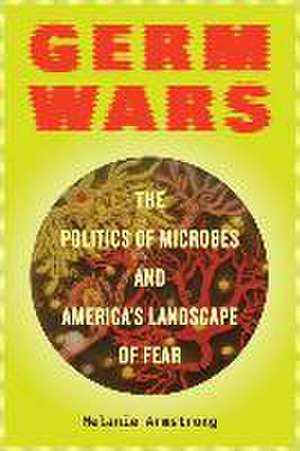
Germ Wars: Critical Environments: Nature, Science, and Politics
Autor Melanie Armstrongen Limba Engleză Paperback – 17 ian 2017
Germ Wars demonstrates that these movements did not occur separately but are instead deeply entwined--new scientific knowledge of microbes makes possible new mechanisms of war. Whether to eliminate disease or create weapons, the work to harness and control germs and the history of these endeavors provide an important opportunity for investigating how biological natures shape modern life. Germ Wars aims to convince students and scholars as well as policymakers and activists that the ways in which bioterrorism has been produced have consequences for how people live in this world of unspecifiable risks.
Din seria Critical Environments: Nature, Science, and Politics
-
 Preț: 210.31 lei
 -
 Preț: 230.84 lei
 -
 Preț: 228.59 lei
 -
 Preț: 224.35 lei
 -
 Preț: 230.84 lei
 -
 Preț: 263.59 lei
 -
 Preț: 162.39 lei
 - 23%
 Preț: 536.39 lei
 - 23%
 Preț: 484.64 lei
 -
 Preț: 204.95 lei
 -
 Preț: 263.67 lei
 -
 Preț: 221.57 lei
 -
 Preț: 228.95 lei
 -
 Preț: 226.92 lei
 - 23%
 Preț: 540.64 lei
 -
 Preț: 211.08 lei
 - 25%
 Preț: 487.12 lei
Preț: 243.29 lei
Puncte Express: 365
Carte disponibilă
Livrare economică 20 iulie-03 august
Livrare express 04-10 iulie pentru 29.97 lei
Livrare prin curier în România Termenul estimat este afișat lângă disponibilitate.
Transport gratuit de la 400.00 lei Plată online sau ramburs, în funcție de opțiunile comenzii.
Retur gratuit în 14 zile Comandă securizată și suport în română.
Specificații
ISBN-13: 9780520292772
ISBN-10: 0520292774
Pagini: 304
Dimensiuni: 229 x 153 x 19 mm
Greutate: 0.42 kg
Editura: University of California Press
Colecția Critical Environments: Nature, Science, and Politics
Seria Critical Environments: Nature, Science, and Politics
ISBN-10: 0520292774
Pagini: 304
Dimensiuni: 229 x 153 x 19 mm
Greutate: 0.42 kg
Editura: University of California Press
Colecția Critical Environments: Nature, Science, and Politics
Seria Critical Environments: Nature, Science, and Politics
Notă biografică
Melanie Armstrong is Assistant Professor of Environmental Studies and the Public Lands Coordinator at Western State Colorado University.
Descriere
US government has spent billions of dollars to prepare the nation for bioterrorism despite the extremely rare occurrence of biological attacks in American history. This book argues that bioterrorism has emerged as a prominent fear in the modern age, arising with the production of new forms of microbial nature and the changing practices of warfare.