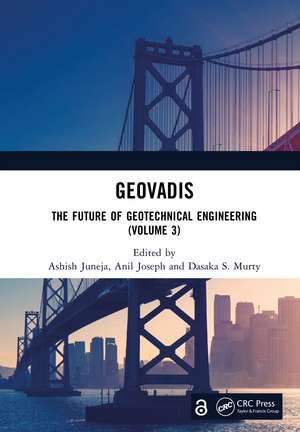
GeoVadis: The Future of Geotechnical Engineering (Volume 3): Taylor and Francis Proceedings in Civil and Structural Engineering
Editat de Ashish Juneja, Anil Joseph, Dasaka S. Murtyen Limba Engleză Hardback – 26 apr 2026
This publication brings together contributions across 19 technical themes, including cold region geotechnics, deep excavations, earthquake engineering, foundation systems, and underground construction. It also delves into artificial intelligence and machine learning applications, environmental and transportation geotechnics, site characterisation, slope stability, embankments and dams, and ground improvement techniques.
It is intended for academics, practising engineers, consultants, contractors, industry professionals, government authorities, and students involved in geotechnical research, education, and design and implementation.
The Open Access version of this book, available at http://www.taylorfrancis.com, has been made available under a Creative Commons [Attribution-Non Commercial-No Derivatives (CC BY-NC-ND)] 4.0 license



Preț: 1636.89 lei
Preț vechi: 1996.21 lei
-18%
Puncte Express: 2455
Carte tipărită la comandă
Livrare economică 08-22 decembrie
Livrare prin curier în România Termenul estimat este afișat lângă disponibilitate.
Transport gratuit pentru acest produs Plată online sau ramburs, în funcție de opțiunile comenzii.
Retur gratuit în 14 zile Comandă securizată și suport în română.
Specificații
ISBN-13: 9781041085546
ISBN-10: 1041085540
Pagini: 676
Dimensiuni: 174 x 246 mm
Greutate: 1.41 kg
Ediția:1
Editura: CRC Press
Colecția CRC Press
Seria Taylor and Francis Proceedings in Civil and Structural Engineering
ISBN-10: 1041085540
Pagini: 676
Dimensiuni: 174 x 246 mm
Greutate: 1.41 kg
Ediția:1
Editura: CRC Press
Colecția CRC Press
Seria Taylor and Francis Proceedings in Civil and Structural Engineering
V-ar putea interesa
-
 Foundations of Engineering GeologyA.C. WalthamPreț: 279.00 lei
 -
 Geotechnical Earthquake EngineeringSteven L. Kramer-9%Preț: 1001.61 lei1100.66 lei
 -
 -18%Preț: 1501.70 lei1831.33 lei
 -
 -18%Preț: 1754.65 lei2139.82 lei
 -
 Geotechnical Design and PracticeK. Ilamparuthi-18%Preț: 759.66 lei926.42 lei
 -
 Modern Applications of Geotechnical Engineering and ConstructionMahdi O. Karkush-24%Preț: 1248.23 lei1642.41 lei
 -
 -18%Preț: 1639.48 lei1999.37 lei
 -
 -24%Preț: 1630.62 lei2145.56 lei
 -
 -24%Preț: 1652.71 lei2174.62 lei
 -
 Ground Engineering and ApplicationsT. Thyagaraj-18%Preț: 1446.96 lei1764.59 lei
 -
 -18%Preț: 1162.44 lei1417.60 lei
 -
 -18%Preț: 1728.43 lei2107.83 lei
 -
 -18%Preț: 1161.70 lei1416.72 lei
 -
 -18%Preț: 1149.82 lei1402.21 lei
 -
 -18%Preț: 1437.81 lei1753.42 lei
 -
 -18%Preț: 1444.83 lei1761.99 lei
 -
 Recent Developments in Geotechnics and Structural EngineeringSanjay Kumar Shukla-24%Preț: 1667.11 lei2193.56 lei
 -
 Best Practices in Geotechnical and Pavement EngineeringSreevalsa Kolathayar-18%Preț: 1448.15 lei1766.03 lei
 -
 Geo-Sustainnovation for Resilient SocietyHemanta Hazarika-18%Preț: 1277.28 lei1557.65 lei
Public țintă
Academic, General, Postgraduate, and Professional ReferenceNotă biografică
Ashish Juneja is a Professor of Civil Engineering at IIT Bombay, with over two decades of academic service. His research focuses on dynamic soil behaviour, underground structures and ground improvement. He has guided numerous doctoral and postgraduate students and published widely. A recipient of IIT Bombay’s Excellence in Teaching and Industrial Impact Awards, he actively contributes to national and international research through major funded projects and technical committees.
Anil Joseph is a leading geotechnical and structural consultant with 34 years of experience and serves as the MD of Geostructurals Pvt Ltd., and President of the Indian Geotechnical Society (2023–2026). He has led 3,500+ High rise projects in India and abroad, authored papers on ground improvement, forensic geotechnical engineering, and soil stabilization, and serves as the reviewer for ASCE and IGJ. His accolades include the Shri M. Visvesvaraya award and multiple ICI Ultratech Awards.
Dasaka S. Murty is a Professor of Civil Engineering at IIT Bombay, specializing in Geotechnical Engineering. He holds a Ph.D. from IISc Bangalore and was a Post-doctoral Fellow at HKUST. His research focuses on pile foundations and retaining structures. He has received multiple research grants, published extensively, and served as a consultant. He currently serves on the Executive Committee of IGS and as Secretary of TC 302, ISSMGE.
Anil Joseph is a leading geotechnical and structural consultant with 34 years of experience and serves as the MD of Geostructurals Pvt Ltd., and President of the Indian Geotechnical Society (2023–2026). He has led 3,500+ High rise projects in India and abroad, authored papers on ground improvement, forensic geotechnical engineering, and soil stabilization, and serves as the reviewer for ASCE and IGJ. His accolades include the Shri M. Visvesvaraya award and multiple ICI Ultratech Awards.
Dasaka S. Murty is a Professor of Civil Engineering at IIT Bombay, specializing in Geotechnical Engineering. He holds a Ph.D. from IISc Bangalore and was a Post-doctoral Fellow at HKUST. His research focuses on pile foundations and retaining structures. He has received multiple research grants, published extensively, and served as a consultant. He currently serves on the Executive Committee of IGS and as Secretary of TC 302, ISSMGE.
Cuprins
Plenary papers Sustainability evaluation of geosynthetic and geothermal solutions for transportation infrastructure; Advanced geotechnical solutions for sustainable transportation infrastructure using waste materials; Ideal/conceptual versus possible/actual – for the case of self-boring pressuremeter tests in stiff clay; Slope stability-soil runout integrated analysis considering rainfall infiltration and runoff; The experience of geotechnical constructions and testing of piling foundations of megastructures on problematical soil ground of Kazakhstan; Use of geomembranes in embankment dams: State-of-the-art report; The long-time behavior in service of geomembranes in dams; Seismic geophysics in tunnel look-ahead: Expanded methodologies and field implementations; Lateral flow-induced damage in residential buildings: Case study of the 2024 Noto Peninsula Earthquake, Japan; Debunking the myth of ground improvement applications; Micro to macro of sand liquefaction and its mitigation; A decade after the 2015 Gorkha earthquake: Reassessing Nepal’s readiness for future seismic events; Rock mass characterization and support pressure for a head race tunnel; Engineering the impossible: Foundation design innovation and slope stabilization beneath the Chenab Bridge; Session 1 AI and computational geomechanics Bearing capacity factor prediction of strip footing on spatially varying slope using surrogate model; Analytical model for evaluating forces during extra-terrestrial regolith drilling for lunar missions; Progress and obstacles of artificial intelligence in geotechnical engineering; Influence of rock mass on uplift anchor behavior: Field and FEM studies; Session 2 Cold, coastal and environmental geotechnical engineering Unconfined compressive strength of bentonite-based backfill materials; Red mud effects on shrinkage potential of bentonite clay; A novel nano-based approach to mitigate alkali-induced swelling in red soil; Safe utilization of wastewater sludge: From lab characterization to field use; Effectiveness of sugarcane molasses as a broth medium in MICP; Numerical simulation of floating offshore wind turbines under environmental and seismic loading; Geotechnical romance with landfills; Session 3 Earthquake and soil dynamics Effect of nonlinear soil behavior on the seismic performance of a zoned embankment dam; Towards a particle-based approach for simplified liquefaction susceptibility assessment; Critical review on seismic performance-based design of quay walls as per Indian and Japanese codes; Seismic response and instability analysis of moraine dam of Imja Glacier Lake; Seismic response of Imja Lake moraine dam and outlet structure under Kobe and Chile earthquakes; Dynamic response of circular footing: Findings from experimental soil-foundation interactions; Session 4 Foundations and deep excavation Numerical investigation of the cushion-dependent behaviour of disconnected piled raft system; In search of alternative solutions for bridge substructure: A case study; Assessment of vertical anchor stability in unsaturated sandy soil; Seismic lateral capacity analysis of skirted ring foundation in layered soil; Forensic geotechnical analysis of sinking of large concrete slurry tanks; Designing against failure: Early lessons on geotechnical and construction pitfalls; Excavation-induced deformations in adjacent pile foundations; Design and construction of seepage barriers using plastic concrete; A study on the minimum required cohesion for retention of soil in excavations using soil nailing systems; Evaluating hybrid SOE systems for high-risk urban excavations: A case study approach; Influence of deep excavation and foundation loading on the response of the existing tunnel in sand; Session 5 Geosynthetic engineering State-of-the-art review of the creep behaviour of geotextiles; Comparison of ASD- and LRFD-based designs of reinforced soil walls; Evaluation of MIF/LCR through laboratory test for polypropylene and polyester biaxial geogrid; Session 6 Ground improvement and stabilisation Strength behaviour of soluble sulphate contaminated lime treated soil; Comparative analysis of improved soaked CBR values in local subgrade soil using geogrid and fiber reinforcement; Infrastructure soil stabilization and ground improvement: Case studies and insights; Foundations solutions for structures on soft saturated clays: A case study; Improvement of Leda clay stiffness by columns installation; Planning and detailed engineering of micro-tunnelling through deep-seated soft marine clay for a sewerage project; Shear strength behavior of cementitious mixes incorporating copper slag and rice husk ash; Stabilization of high-sulfate soils using lime and quarry dust; Session 7 Practice, risk and education Experimental investigation of rock anchor for pile load testing; Application of Six Sigma in the precision testing of standard soil mixes; Stabilization of clayey sand embankment soil using guar gum biopolymer: An eco-friendly solution; Dynamic behavior of clay-rubber soils: A probabilistic approach using index test and empirical model; Integrating geophysics into geotechnical workflows: Principles, practices, and pitfalls; Development and evaluation of correlation of shear strength parameters for silty sand (SM) soils using SPT (N1)60 values in Gujarat, India; An efficient GUI for risk analysis of retaining walls using extreme learning machine; Harnessing geophysical methods as quality assurance and quality control tools for large fills; Engineering the unsaturated soil behavior for agricultural drought preparedness; From grains to internal friction angle (j) in the Siwalik of Nepal: Misinterpretation risk; Case studies on characterization of carbonate soils and their impact on geotechnical designs; Session 8 Rock mechanics and tunnelling engineering A generalized 3D implicit constitutive model for predicting uniaxial stress-strain response of granite rocks; Effects of tunneling on the ground surface movement; Performance of tunnel boring machine in basaltic Deccan Trap rock: A case study 519G.V.; Negotiating through geological hazards of deccan trap for NATM tunnel; Impact of nearby excavation on stability of existing urban tunnel; Stiffnesses and shear strength of rock joints; Probabilistic analysis of a wellbore in rocks; Session 9 Slope stability and landslides Rheological properties and flow behavior of mine tailings and fly ash: Lessons from failures; Landslide susceptibility mapping of East Khasi Hills, Meghalaya, using GIS-based logistic regression method; Application of GIS-based logistic regression for landslide susceptibility mapping in Gajapati district, Odisha: A case study; Weathering the future: Climate-resilient road design lessons from Nepal’s BP Highway flood 2024; Hydrometeorological analysis of rainfall variability (2000–2024) and its implications for slope failures in Nepal; Integrated geophysical and geotechnical assessment of landslide-prone slope in the Kaligandaki Corridor (NH 48), Nepal; Lessons learnt from recent landslides in Goa; Application of micro-pile for protection of valley side slope stability, case study of Jhyaple Khola, Nagdhungha-Naubise-Mugling road section, Nepal; Integrating TabNet and SHAP for interpretable landslide susceptibility modeling in Minnesota; Comparison of the stability of slope in Chamoli-Uttarakhand using LEM and FEM; Session 10 Transportation geotechnics A comparative study of durability characteristics of bio-enzyme-cement-treated RAP mixes; Dune sand stabilization using sustainable pozzolanic cement supplementary material; Performance evaluation of geosynthetic-reinforced pavements under monotonic and repeated loading
Descriere
This book contains a prolific compilation of research on geotechnical engineering presented at the First Geotech Asia International Conference (GAIC 2025). The papers reflect dynamic engagement of researchers, engineers, and professionals from all over Asia to offer insights into ongoing developments and applied problem-solving.