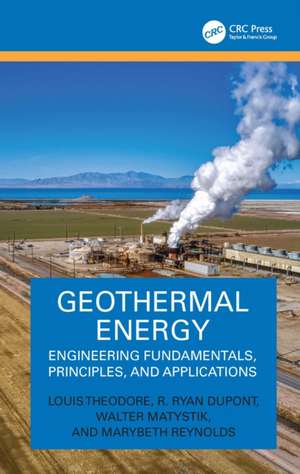
Geothermal Energy: Engineering Fundamentals, Principles, and Applications
Autor Louis Theodore, R. Ryan Dupont, Walter Matystik, Marybeth Reynoldsen Limba Engleză Hardback – 2 aug 2026
Coverage includes:
- a comprehensive coverage of geothermal energy fundamentals and principles;
- a review of environmental/economic considerations associated with the various geothermal energy technologies;
- a practical, engineer-focused approach with real-world applications, design methods, and calculation tools;
- a review of legal and regulatory concerns;
- an examination of the potential role of artificial intelligence in the future of this technology;
- a review of potential investment opportunities in the geothermal field; and
- illustrative examples and predictive algorithms to support system design and analysis.
Preț: 806.13 lei
Preț vechi: 983.08 lei
-18% Nou
Puncte Express: 1209
Carte tipărită la comandă
Livrare economică 01-15 decembrie
Livrare prin curier în România Termenul estimat este afișat lângă disponibilitate.
Transport gratuit pentru acest produs Plată online sau ramburs, în funcție de opțiunile comenzii.
Retur gratuit în 14 zile Comandă securizată și suport în română.
Specificații
ISBN-13: 9781041130352
ISBN-10: 104113035X
Pagini: 314
Ilustrații: 100
Dimensiuni: 156 x 234 mm
Greutate: 0.74 kg
Ediția:1
Editura: CRC Press
Colecția CRC Press
ISBN-10: 104113035X
Pagini: 314
Ilustrații: 100
Dimensiuni: 156 x 234 mm
Greutate: 0.74 kg
Ediția:1
Editura: CRC Press
Colecția CRC Press
Public țintă
Academic and Professional ReferenceCuprins
Part 1: Prologue 1. Energy History 2. U.S. Department of Energy 3. U.S. Energy Regulations 4. Energy Resources: Fossil Fuels 5. Energy Resources: Renewables Part 2: Energy Fundamentals and Principles 6. Introduction to Engineering Fundamentals and Principles 7. Conservation Laws 8. Thermodynamics 9. Heat Exchangers 10. Prime Movers 11. Steam: The Quintessential Medium in Energy Applications 12. Air Conditioning, Refrigeration, and Cryogenics 13. Power Plant Thermodynamic Cycle Analysis Part 3: Geothermal Energy Applications 14. Deep Well Construction Technologies 15. Geothermal Energy: The Quintessential Energy Resource 16. Geothermal Energy Conversion Processes 17. Geothermal Energy Environmental Impacts and Considerations Part 4: Epilogue 18. The Future of Geothermal Energy 19. Geothermal Energy Applications and Illustrative Examples
Notă biografică
Marybeth Reynolds is a researcher and author specializing in clean energy and climate solutions. With more than 20 years of experience integrating engineering, public policy, and technical communication, she focuses on environmental impacts, regulatory frameworks, and sustainable pathways for decarbonization.
Most recently, Ms. Reynolds has worked on geothermal energy research and technology-transfer initiatives supporting the deployment of geothermal sources for electricity generation. Previously, at the Natural Resources Defense Council (NRDC), she managed digital production and developed policy and advocacy resources for a full portfolio of environmental priorities, including renewable energy, environmental health, biodiversity protection, and equitable climate policy. She is a contributing author to publications on environmental considerations and barriers to deployment for hydrogen energy, and served as technical editor for research and market studies focused on energy efficiency standards and policies.
Ms. Reynolds began her career at BOC Edwards, managing knowledge-sharing initiatives to leverage internal engineering competencies and environmental, health, and safety resources to serve the semiconductor industry. She has spearheaded research and communications projects across a number of nonprofit and philanthropic organizations, including the Verizon Foundation.
Ms. Reynolds holds a Bachelor's of Science in Chemical Engineering from Manhattan College, a Master's of Public Policy from Georgetown University, and is currently engaged in graduate studies in climate, energy, and environmental sustainability at Johns Hopkins University. Born and raised in the Bronx, she resides in the New York metro area with her husband and two children.
Walter Matystik M.E., J.D. started his 45-year academic career in 1972 upon earning a Bachelor of Engineering degree in Chemical Engineering from the acclaimed industry-sponsored program at Manhattan College. He was an undergraduate research assistant in the Department of Energy-sponsored Particulate Solids Research Institute at the College’s Paulian Labs under the direction of Dr. Frederick Zenz, innovator of fluidization technology for the petrochemical industry. He earned an EPA Training Fellowship, and entering the prestigious Environmental Engineering Program at Manhattan College. He completed his Master of Engineering in Environmental Engineering in 1974, and stayed at the College to work with Dr. Thomann as a research engineer under an EPA grant to address eutrophication in the Great Lakes. Dr. Matystik decided to pursue a law degree part-time earning a Juris Doctor from New York Law School in 1981 and admitted to the NY Bar in 1982 and the U.S. District Court in 1984.
Manhattan College appointed Dr. Matystik as Assistant Provost in 1992 and later as Associate Provost in 2010. Wanting to share his engineering and legal expertise with undergraduate and graduate students, Walter became a member of the College’s adjunct faculty rising quickly to full professor and developing and teaching courses such as Legal Aspects of Engineering; Environmental Law; Hazardous Waste Management; Environmental Impacts of Construction Projects; and Environmental Impact Analysis. He is the recipient of EPRI’s Distinguished Service Award.
Retiring from the College (now Manhattan University) in 2018, Dr. Matystik continues the pro bono environmental law work he started while at the College assisting organizations such as the Bronx Council for Environmental Quality, the Bronx River Alliance, and the Environmental Law and Justice Project. He still serves as Secretary and Board Member of the Academic Federal Credit Union since 2008.
Dr. Matystik’s interest in geothermal energy combines his chemical and environmental engineering background along with his concern for the environmental impacts of technology plus his expertise with regulatory compliance. Geothermal has significant potential for energy production and grid enhancement with no need for fracking fluids or water wastage and, in some cases, the re-use of already existing wells. His current interest in how artificial intelligence can inform/impact future exploration and exploitation led him to this collaboration.
R. Ryan Dupont has more than 40 years of experience teaching and conducting applied and basic research in environmental engineering at the Utah Water Research Laboratory at Utah State University. His main research areas have addressed soil and groundwater bioremediation, stormwater management via green stormwater infrastructure, field remediation technology demonstration and treatment system performance verification, and wastewater and biosolids reuse affected by contaminants of emerging concern (pharmaceuticals, personal care products and PFAS compounds).
He received a BS degree in Civil Engineering, and MS and PhD degrees in Environmental Health Engineering from the University of Kansas, Lawrence. Dr. Dupont has been a Full Professor of Civil and Environmental since 1995. He served as the Head of the Environmental Engineering Division for 10 years, was instrumental in establishing an Undergraduate Degree in Environmental Engineering at USU, and has been responsible for attracting more than $5.8x10⁶ in extramural funding through the Water Research Lab since joining the faculty in 1982.
Dr. Dupont is a member of Sigma Xi, Tau Beta Pi, Chi Epsilon, the American Society of Civil Engineers, the Water Environment Federation, and the Air and Waste Management Association. Dr. Dupont was recognized as an Outstanding Young Engineering Educator by the American Society of Engineering Education, and was a 2015 recipient of the Richard I. Stessel Waste Management Award, for “distinguished achievement as an educator in the field of waste management” from the Air and Waste Management Association.
Dr. Dupont was recognized as an endowed Cazier Professor of Civil and Environmental Engineering in 2021 for lifetime academic achievement and public service by Utah State University. One of the university’s most prestigious honors, the award recognizes senior faculty members who have demonstrated more than 20 years of consistent excellence in their academic careers.
Louis Theodore was raised in Hell's Kitchen by poor immigrant Greek parents, and obtained the degrees of M.Ch. E and Eng. Sc.D from New York University and B.Ch.E. from The Cooper Union. Dr. Theodore was a successful educator for over 50 years at Manhattan College (holding the rank of Full Professor of Chemical Engineering), Graduate Program Director, researcher, professional innovator, and technical communicator. During this period, he was primarily responsible for his program achieving a No. 2 ranking by the U.S. News & World Report and particularly successful in placing students in internships, jobs, and graduate schools
Dr. Theodore is an internationally recognized lecturer who has provided more than 200 seminars/courses to industry, government, and technical associations. He also developed and served as the principal moderator/lecturer for U.S. Environmental Protection Agency (EPA) courses on air pollution control equipment, consulted for several industrial companies in the field of air pollution control equipment, pollution prevention and environmental management, and served as a consultant/expert witness for the U.S. EPA and U.S. Department of Justice. He currently serves as a part-time consultant to Theodore Tutorials and is actively involved in air pollution control equipment, geothermal energy, and potable water/desalination activities.
Dr. Theodore is the author of more than 130 text/reference books ranging from air pollution control equipment to pollution prevention to hazardous waste incineration to engineering and environmental ethics. He has also served as section editor of Environmental Management for the last four editions of Perry's Chemical Engineers’ Handbook.
Dr. Theodore is the recipient of the Air & Waste Management Association's (AWMA) prestigious Ripperton award that is "presented to an outstanding educator who through example, dedication and innovation has so inspired students to achieve excellence in their professional endeavors." He was also the recipient of the American Society for Engineering Education (ASEE) AT&T Foundation award for “excellence in the instruction of engineering students.”
In addition to providing invited testimony to a presidential (Ford) Crime Commission Hearing, Dr. Theodore was honored at Madison Square Garden in 2008 for his contributions to basketball and youth of America. He is also the author of Basketball Coaching 101 (2015) and Winning at Casinos: The Definitive Guide (2024).
Dr. Theodore is a member of Phi Lambda Upsilon, Sigma Xi, Tau Beta Pi, American Chemical Society, American Society of Engineering Education, Air & Waste Management Association, and The Royal Hellenic Society.
Most recently, Ms. Reynolds has worked on geothermal energy research and technology-transfer initiatives supporting the deployment of geothermal sources for electricity generation. Previously, at the Natural Resources Defense Council (NRDC), she managed digital production and developed policy and advocacy resources for a full portfolio of environmental priorities, including renewable energy, environmental health, biodiversity protection, and equitable climate policy. She is a contributing author to publications on environmental considerations and barriers to deployment for hydrogen energy, and served as technical editor for research and market studies focused on energy efficiency standards and policies.
Ms. Reynolds began her career at BOC Edwards, managing knowledge-sharing initiatives to leverage internal engineering competencies and environmental, health, and safety resources to serve the semiconductor industry. She has spearheaded research and communications projects across a number of nonprofit and philanthropic organizations, including the Verizon Foundation.
Ms. Reynolds holds a Bachelor's of Science in Chemical Engineering from Manhattan College, a Master's of Public Policy from Georgetown University, and is currently engaged in graduate studies in climate, energy, and environmental sustainability at Johns Hopkins University. Born and raised in the Bronx, she resides in the New York metro area with her husband and two children.
Walter Matystik M.E., J.D. started his 45-year academic career in 1972 upon earning a Bachelor of Engineering degree in Chemical Engineering from the acclaimed industry-sponsored program at Manhattan College. He was an undergraduate research assistant in the Department of Energy-sponsored Particulate Solids Research Institute at the College’s Paulian Labs under the direction of Dr. Frederick Zenz, innovator of fluidization technology for the petrochemical industry. He earned an EPA Training Fellowship, and entering the prestigious Environmental Engineering Program at Manhattan College. He completed his Master of Engineering in Environmental Engineering in 1974, and stayed at the College to work with Dr. Thomann as a research engineer under an EPA grant to address eutrophication in the Great Lakes. Dr. Matystik decided to pursue a law degree part-time earning a Juris Doctor from New York Law School in 1981 and admitted to the NY Bar in 1982 and the U.S. District Court in 1984.
Manhattan College appointed Dr. Matystik as Assistant Provost in 1992 and later as Associate Provost in 2010. Wanting to share his engineering and legal expertise with undergraduate and graduate students, Walter became a member of the College’s adjunct faculty rising quickly to full professor and developing and teaching courses such as Legal Aspects of Engineering; Environmental Law; Hazardous Waste Management; Environmental Impacts of Construction Projects; and Environmental Impact Analysis. He is the recipient of EPRI’s Distinguished Service Award.
Retiring from the College (now Manhattan University) in 2018, Dr. Matystik continues the pro bono environmental law work he started while at the College assisting organizations such as the Bronx Council for Environmental Quality, the Bronx River Alliance, and the Environmental Law and Justice Project. He still serves as Secretary and Board Member of the Academic Federal Credit Union since 2008.
Dr. Matystik’s interest in geothermal energy combines his chemical and environmental engineering background along with his concern for the environmental impacts of technology plus his expertise with regulatory compliance. Geothermal has significant potential for energy production and grid enhancement with no need for fracking fluids or water wastage and, in some cases, the re-use of already existing wells. His current interest in how artificial intelligence can inform/impact future exploration and exploitation led him to this collaboration.
R. Ryan Dupont has more than 40 years of experience teaching and conducting applied and basic research in environmental engineering at the Utah Water Research Laboratory at Utah State University. His main research areas have addressed soil and groundwater bioremediation, stormwater management via green stormwater infrastructure, field remediation technology demonstration and treatment system performance verification, and wastewater and biosolids reuse affected by contaminants of emerging concern (pharmaceuticals, personal care products and PFAS compounds).
He received a BS degree in Civil Engineering, and MS and PhD degrees in Environmental Health Engineering from the University of Kansas, Lawrence. Dr. Dupont has been a Full Professor of Civil and Environmental since 1995. He served as the Head of the Environmental Engineering Division for 10 years, was instrumental in establishing an Undergraduate Degree in Environmental Engineering at USU, and has been responsible for attracting more than $5.8x10⁶ in extramural funding through the Water Research Lab since joining the faculty in 1982.
Dr. Dupont is a member of Sigma Xi, Tau Beta Pi, Chi Epsilon, the American Society of Civil Engineers, the Water Environment Federation, and the Air and Waste Management Association. Dr. Dupont was recognized as an Outstanding Young Engineering Educator by the American Society of Engineering Education, and was a 2015 recipient of the Richard I. Stessel Waste Management Award, for “distinguished achievement as an educator in the field of waste management” from the Air and Waste Management Association.
Dr. Dupont was recognized as an endowed Cazier Professor of Civil and Environmental Engineering in 2021 for lifetime academic achievement and public service by Utah State University. One of the university’s most prestigious honors, the award recognizes senior faculty members who have demonstrated more than 20 years of consistent excellence in their academic careers.
Louis Theodore was raised in Hell's Kitchen by poor immigrant Greek parents, and obtained the degrees of M.Ch. E and Eng. Sc.D from New York University and B.Ch.E. from The Cooper Union. Dr. Theodore was a successful educator for over 50 years at Manhattan College (holding the rank of Full Professor of Chemical Engineering), Graduate Program Director, researcher, professional innovator, and technical communicator. During this period, he was primarily responsible for his program achieving a No. 2 ranking by the U.S. News & World Report and particularly successful in placing students in internships, jobs, and graduate schools
Dr. Theodore is an internationally recognized lecturer who has provided more than 200 seminars/courses to industry, government, and technical associations. He also developed and served as the principal moderator/lecturer for U.S. Environmental Protection Agency (EPA) courses on air pollution control equipment, consulted for several industrial companies in the field of air pollution control equipment, pollution prevention and environmental management, and served as a consultant/expert witness for the U.S. EPA and U.S. Department of Justice. He currently serves as a part-time consultant to Theodore Tutorials and is actively involved in air pollution control equipment, geothermal energy, and potable water/desalination activities.
Dr. Theodore is the author of more than 130 text/reference books ranging from air pollution control equipment to pollution prevention to hazardous waste incineration to engineering and environmental ethics. He has also served as section editor of Environmental Management for the last four editions of Perry's Chemical Engineers’ Handbook.
Dr. Theodore is the recipient of the Air & Waste Management Association's (AWMA) prestigious Ripperton award that is "presented to an outstanding educator who through example, dedication and innovation has so inspired students to achieve excellence in their professional endeavors." He was also the recipient of the American Society for Engineering Education (ASEE) AT&T Foundation award for “excellence in the instruction of engineering students.”
In addition to providing invited testimony to a presidential (Ford) Crime Commission Hearing, Dr. Theodore was honored at Madison Square Garden in 2008 for his contributions to basketball and youth of America. He is also the author of Basketball Coaching 101 (2015) and Winning at Casinos: The Definitive Guide (2024).
Dr. Theodore is a member of Phi Lambda Upsilon, Sigma Xi, Tau Beta Pi, American Chemical Society, American Society of Engineering Education, Air & Waste Management Association, and The Royal Hellenic Society.
Descriere
Geothermal Energy: Engineering Fundamentals, Principles, and Applications is a much-needed book that offers a timely, practical, and comprehensive treatment of geothermal energy from the perspective of engineers and applied scientists.