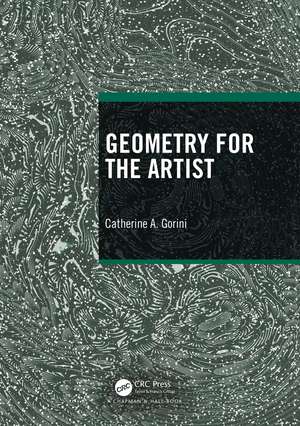
Geometry for the Artist: AK Peters/CRC Recreational Mathematics Series
Autor Catherine A. Gorinien Limba Engleză Paperback – 26 mai 2023
This book is an exceptional resource for students in a general-education mathematics course or teacher-education geometry course, and since many assignments involve writing about art, this text is ideal for a writing-intensive course. Moreover, this book will be enjoyed by anyone with an interest in connections between mathematics and art.
Features
- Abundant examples of artwork displayed in full color
- Suitable as a textbook for a general-education mathematics course or teacher-education geometry course
- Designed to be enjoyed by both artists and mathematicians
Din seria AK Peters/CRC Recreational Mathematics Series
- 14%
 Preț: 889.21 lei
 - 11%
 Preț: 616.27 lei
 -
 Preț: 298.28 lei
 -
 Preț: 386.78 lei
 -
 Preț: 270.76 lei
 - 14%
 Preț: 833.06 lei
 -
 Preț: 245.92 lei
 -
 Preț: 217.34 lei
 - 8%
 Preț: 467.87 lei
 -
 Preț: 277.42 lei
 - 8%
 Preț: 552.87 lei
 -
 Preț: 357.41 lei
 -
 Preț: 300.02 lei
 -
 Preț: 280.45 lei
 -
 Preț: 377.56 lei
 -
 Preț: 229.83 lei
 -
 Preț: 323.93 lei
 -
 Preț: 285.65 lei
 - 8%
 Preț: 463.05 lei
 - 18%
 Preț: 1357.72 lei
 -
 Preț: 240.41 lei
 - 18%
 Preț: 724.09 lei
 -
 Preț: 351.02 lei
 -
 Preț: 237.26 lei
 - 18%
 Preț: 1259.34 lei
 -
 Preț: 379.50 lei
 - 13%
 Preț: 1271.72 lei
 -
 Preț: 477.59 lei
 - 8%
 Preț: 433.43 lei
 - 18%
 Preț: 1415.48 lei
 - 18%
 Preț: 894.29 lei
 - 15%
 Preț: 441.60 lei
 - 18%
 Preț: 1516.18 lei
 - 9%
 Preț: 663.16 lei
 -
 Preț: 317.72 lei
 - 15%
 Preț: 611.12 lei
 -
 Preț: 367.60 lei
 -
 Preț: 224.95 lei
 - 18%
 Preț: 1500.80 lei
 -
 Preț: 247.47 lei
Preț: 449.82 lei
Puncte Express: 675
Carte disponibilă
Livrare economică 02-16 noiembrie
Livrare express 17-23 octombrie pentru 33.63 lei
Livrare prin curier în România Termenul estimat este afișat lângă disponibilitate.
Transport gratuit pentru acest produs Plată online sau ramburs, în funcție de opțiunile comenzii.
Retur gratuit în 14 zile Comandă securizată și suport în română.
Specificații
ISBN-13: 9780367628253
ISBN-10: 0367628252
Pagini: 254
Ilustrații: 6 Tables, black and white; 159 Line drawings, color; 85 Halftones, color; 244 Illustrations, color
Dimensiuni: 178 x 254 x 15 mm
Greutate: 0.42 kg
Ediția:1
Editura: CRC Press
Colecția Chapman and Hall/CRC
Seria AK Peters/CRC Recreational Mathematics Series
ISBN-10: 0367628252
Pagini: 254
Ilustrații: 6 Tables, black and white; 159 Line drawings, color; 85 Halftones, color; 244 Illustrations, color
Dimensiuni: 178 x 254 x 15 mm
Greutate: 0.42 kg
Ediția:1
Editura: CRC Press
Colecția Chapman and Hall/CRC
Seria AK Peters/CRC Recreational Mathematics Series
Public țintă
Academic and GeneralCuprins
Section I. Introduction. 1. Introduction. 1.1. Overview. 1.2. Ways to Analyze Art. 1.3. How to use this Book. Section II. Symmetry. 2. Symmetry. 2.1. The Nature of Symmetry. 2.2. Overview of Symmetry. 3. Finite Designs. 3.1. Symmetric Designs. 3.2. Symmetry Transformations. 3.3. Symmetries of a Square. 3.4. Symmetries of a Pinwheel. 3.5. Leonardo’s Theorem. 3.6. Signature of a Symmetric Design. 3.7. Important Examples of Symmetric Designs. 3.8. Compound or Layered Designs. 3.9. Symbols and Logos. 3.10. Sacred Geometry. 3.11. Tips for Determining the Symmetries of a Design. 3.12. Creating Symmetric Designs. 4. Band Ornaments. 4.1. Overview. 4.2. Symmetries of a Band. 4.3. The Seven Types of Band Ornaments. 4.4. The Seven Types of Symmetries of Band Ornaments. 4.5. Making a Band Ornament of Your Own. 5. The Regular Tilings. 5.1. Overview. 5.2. Translations of a Tiling. 5.3. A Tiling by Squares. 5.4. A Tiling by Equilateral Triangles. 5.5. A Tiling by Regular Hexagons. 5.6. What We Have Learned about Regular Tilings. 5.7. New Tilings from Old. 6. Tilings. 6.1. Overview. 6.2. Tilings without Rotations—Four Tilings. 6.3. Tilings with Gyrations Only—Six Tilings. 6.4. Tilings with Kaleidoscopes—Five New Tilings Plus Two Regular Tilings. 6.5. Tips For Determining the Signature of a Tiling Pattern. 6.6. Summary of Tilings. 7. Symmetry in The Work of MC Escher. 7.1. MC Escher’s Tilings. 7.2. How to Create Escher-Type Tilings. 7.3. Day and Night. 7.4. Cycle. Section III. Perspective. 8. Introduction to Linear Perspective. 8.1. Overview. 8.2. Introduction to Linear Perspective. 8.3. The Geometry of Linear Perspective. 8.4. The Central Vanishing Point. 8.5. Analysis of a Perspective Picture. 8.6. How to Draw a Picture in One-Point Perspective. 8.7. Aerial or Atmospheric Perspective. 9. Drawing Grids in Perspective. 9.1. Overview. 9.2. Drawing a Square Grid in Perspective. 9.3. Where is the Diagonal Vanishing Point? 9.4. Finding the Diagonal Vanishing Point in a Painting. 9.5. Foreshortening Distances in a Perspective Painting. 9.6. Using Grids to Draw Shapes in Perspective. 10. The Conic Sections. 10.1. Overview. 10.2. The Conic Sections. 10.3. The Circle. 10.4. The Ellipse: A Circle in Perspective. 10.5. The Parabola: A Fountain of Water. 10.6. The Hyperbola: A Shadow on a Wall. 10.7. Drawing a Circle in Perspective. 11. Two-Point and Three-Point Perspective. 11.1. Overview. 11.2. Two-Point Perspective. 11.3. Esher’s Cycle—An Example of Two-Point Perspective. 11.4. Three-Point Perspective. 11.5. Using Two-Point and Three-Point Perspective. 12. Perspective in the Work of MC Escher. 12.1. Overview. 12.2. Relativity. 12.3. Belvedere. 12.4. Ascending and Descending. Section IV. Fractals. 13. Proportion and Similarity. 13.1. Overview. 13.2. Congruent Figures. 13.3. Similar Figures. 13.4. Congruence and Similarity in Art. 13.5. Important Examples of Congruence and Similarity. 14. Fractals. 14.1. Overview. 14.2. Constructing Geometric Fractals. 14.3. Natural Fractals. 14.4. Fractal Dimension. 14.5. Applications OF Fractals. 15. Dynamical Systems and Chaos. 15.1. Overview. 15.2. Dynamical Systems. 15.3. Mathematical Dynamical Systems. 15.4. Chaos. 15.5. Dynamical Systems and Chaos in Art. 15.6. Chaos and Chance. 16. The Mandelbrot Set. 16.1. Overview. 16.2. The Complex Numbers. 16.3. Graphing Complex Numbers. 16.4. Constructing the Mandelbrot Set. 16.5. Properties of the Mandelbrot Set. Section V. Curves, Spaces, and Geometries. 17. Lines and Curves. 17.1. Overview. 17.2. Straight Lines and their Slopes. 17.3. Curves and Curvature. 17.4. Special Curves. 17.5. How Artists Use Lines and Curves. 18. Surfaces. 18.1. Overview. 18.2. Surfaces. 18.3. Euclidean Geometry. 18.4. Elliptic Geometry. 18.5. Hyperbolic Geometry. 18.6. The Three Geometries and Curvature. 18.7. The Three Geometries around You. 19. Euclidean and Non-Euclidean Geometries. 19.1. Overview. 19.2. Euclid’s Postulates. 19.3. The Validity of Non-Euclidean Geometries. 20. Topology. 20.1. Overview. 20.2. The Konigsberg Bridge Problem. 20.3. Topology. 20.4. Topology in Art. 21. Pictorial Composition. 21.1. Overview. 21.2. Geometric Principles of Pictorial Composition. 21.3. Portraits. 21.4. How The Eye Moves Around a Picture. 21.5. Understanding Pictorial Composition. Bibliography. Appendix A. Suggestions for Final Projects. A.1. Art Research Project. A.2. Art Research Team Project. A.3. Creative Project. Appendix B. Answers to Selected Exercises. Index.
Notă biografică
Catherine A. Gorini is a professor of mathematics at Maharishi International University (MIU) in Fairfield, Iowa, where she has taught for over forty years and served as dean of the faculty and dean of the College of Arts and Sciences. Her interests include geometry and connections between geometry and art, as well as mathematics education, connections between mathematics and consciousness, and liberal arts education. She started developing a geometry course for art majors over thirty years ago. This course is now popular with students of all majors. Her numerous teaching awards include the Outstanding Teacher of the Year award by MIU students in 2021 and the Award for Distinguished College or University Teaching of Mathematics given by the Mathematical Association of America in 2001. She received the 2019 Wege Award for Research from MIU.
Gorini edited Geometry at Work, published by the Mathematical Association of America, wrote the Facts on File Geometry Handbook, and has published journal articles in geometry, mathematics education, connections between mathematics and art, and the relationship between consciousness and mathematics. She is the executive editor of the International Journal of Mathematics and Consciousness and holds a PhD in mathematics from the University of Virginia in algebraic topology.
Gorini edited Geometry at Work, published by the Mathematical Association of America, wrote the Facts on File Geometry Handbook, and has published journal articles in geometry, mathematics education, connections between mathematics and art, and the relationship between consciousness and mathematics. She is the executive editor of the International Journal of Mathematics and Consciousness and holds a PhD in mathematics from the University of Virginia in algebraic topology.
Descriere
It is aimed both at artists willing to dive deeper into geometry and at mathematicians open to learning about applications of mathematics in art. The book includes topics such as perspective, symmetry, topology, fractals, curves, surfaces, and more.