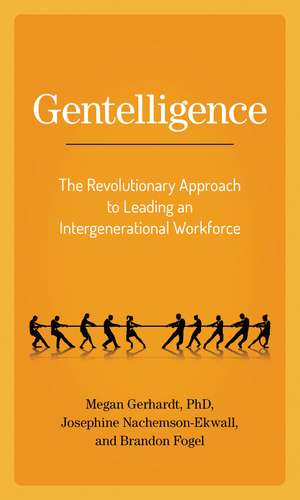
Gentelligence: The Revolutionary Approach to Leading an Intergenerational Workforce
Autor Megan Gerhardt, Josephine Nachemson-Ekwall, Brandon Fogel Cuvânt înainte de Paul Allenen Limba Engleză Hardback – 8 iun 2021
Gentelligence: The Revolutionary Approach to Leading an Intergenerational Workforce presents a transformative way to end the generational wars once and for all. This book first introduces Gentelligence as a powerful business strategy and shows why it is critical for the future of work. It then presents a practical guide and a call to action for leaders of all ages to unlock the potential strengths of each generation. Readers will learn how an intergenerational workforce can be reframed as a profound business opportunity and discover how Gentelligence can help them win the talent war, create strong, diverse teams, and build adaptable cultures that will flourish in an era of rapid change.
Gentelligence shares groundbreaking evidence that will have readers thinking about their generationally diverse workforce in an entirely different way. Readers will discover:
·Where generational conflict originates, and how it results in both dangerous ageism and reverse ageism in today's workplaces.
·Why the generation gap stems from a misunderstanding of shared core values across all generations.
·How to find essential common ground with colleagues, both older and younger, and recognize the unique needs that come with different generational identities.
·How generational shaming leads us to view those from other generations as competitors rather than collaborators, further damaging employee engagement, team dynamics, innovation, and organizational culture.
·How leveraging the unique strengths of each generation at work can lead to a win-win outcome for all.
·How traditional views on leadership have been turned upside down as a result of new generational dynamics, with many employees currently being led by managers that are younger than themselves, and older leaders struggling to make sense of changing norms around authority and power.
Gentelligence reveals the opportunities within an intergenerational workforce and provides actionable tools to help leaders build Gentelligent organizations. Unlike other books on generational leadership, this book rejects common stereotypes assigned to different generations, replacing them with a deep understanding of why those who grew up in different times may behave in unique and valuable, ways. We challenge leaders to go beyond simply accepting generational differences to leverage them proactively to increase engagement, innovation, and organizational success.
Preț: 230.35 lei
Preț vechi: 306.45 lei
-25%
Carte tipărită la comandă
Livrare economică 02-16 decembrie
Specificații
ISBN-10: 1538142147
Pagini: 256
Ilustrații: 1 b/w illustration; 5 tables; 2 textboxes
Dimensiuni: 140 x 218 x 24 mm
Greutate: 0.52 kg
Editura: Bloomsbury Publishing
Colecția Rowman & Littlefield
Locul publicării:New York, United States
V-ar putea interesa
-
 Preț: 152.26 lei
 -
 -11%Preț: 88.38 lei99.84 lei
 -
 Preț: 142.05 lei
 -
 Preț: 83.53 lei
 -
 The Language of Winners!Jose Luis Hinojosa MDPreț: 159.61 lei
 -
 El Lenguaje de los Triunfadores!Jose Luis Hinojosa MDPreț: 168.18 lei
 -
 Preț: 94.84 lei
 -
 Sell It!William S. CrenshawPreț: 126.14 lei
 -
 Preț: 108.39 lei
 -
 Preț: 154.99 lei
 -
 ReflectionsMichael MaitrePreț: 86.01 lei
 -
 Think and Grow Rich Every DayNapoleon HillPreț: 138.03 lei
 -
 It's Never Ok to Kiss the InterviewerJane Sunley-12%Preț: 62.55 lei71.14 lei
Descriere
"Vital for any organization with multigenerational staffs, and for marketers, public relations professionals, HRD managers, or executives." Library Journal, Starred Review
Gentelligence: The Revolutionary Approach to Leading an Intergenerational Workforce presents a transformative way to end the generational wars once and for all. This book first introduces Gentelligence as a powerful business strategy and shows why it is critical for the future of work. It then presents a practical guide and a call to action for leaders of all ages to unlock the potential strengths of each generation. Readers will learn how an intergenerational workforce can be reframed as a profound business opportunity and discover how Gentelligence can help them win the talent war, create strong, diverse teams, and build adaptable cultures that will flourish in an era of rapid change.
Gentelligence shares groundbreaking evidence that will have readers thinking about their generationally diverse workforce in an entirely different way. Readers will discover:
·Where generational conflict originates, and how it results in both dangerous ageism and reverse ageism in today's workplaces.
·Why the generation gap stems from a misunderstanding of shared core values across all generations.
·How to find essential common ground with colleagues, both older and younger, and recognize the unique needs that come with different generational identities.
·How generational shaming leads us to view those from other generations as competitors rather than collaborators, further damaging employee engagement, team dynamics, innovation, and organizational culture.
·How leveraging the unique strengths of each generation at work can lead to a win-win outcome for all.
·How traditional views on leadership have been turned upside down as a result of new generational dynamics, with many employees currently being led by managers that are younger than themselves, and older leaders struggling to make sense of changing norms around authority and power.
Gentelligence reveals the opportunities within an intergenerational workforce and provides actionable tools to help leaders build Gentelligent organizations. Unlike other books on generational leadership, this book rejects common stereotypes assigned to different generations, replacing them with a deep understanding of why those who grew up in different times may behave in unique and valuable, ways. We challenge leaders to go beyond simply accepting generational differences to leverage them proactively to increase engagement, innovation, and organizational success.
Cuprins
Introduction
Chapter 1: Blame 60 Minutes: How Morley Safer Fueled the Generation Wars
Chapter 2: Our Generational Identities
Chapter 3: Mind the Gap: Roadblocks to Closing the Generational Divide
Chapter 4: The Gentelligence Solution: 4 Key Practices
Chapter 5: Filling the Pipeline: Leading Up (and Down)
Chapter 6: The Secrets of Gentelligent Teams
Chapter 7: A Gentelligent People Strategy
Chapter 8: Creating a Gentelligent Work Culture
Chapter 9: Gentelligence for the Future of Work
Recommended Resources List
Bibliography
Notes
Index
About the Authors
Recenzii
The idea of "us versus them" has pervaded the workplace, argue management professor Gerhardt, leadership coach Nachemson-Ekwall, and Ernst & Young consultant Fogel in their outstanding debut on building intergenerational respect. The authors tout the benefits of "gentelligence," or seeing the potential of generational diversity in the workplace as an opportunity rather than a threat, and lay out the roadblocks businesses may face in "closing the generational divide": "generation shaming," for example, is when blame is put on an entire age group, and ageism can be directed at both older and younger people. To counter these, the authors explain four practices that lead to gentelligence: resisting assumptions by replacing stereotypes with personal connections, adjusting one's lens by asking questions, strengthening trust with a psychological safety zone, and "expanding the pie" by proactively searching for win-win opportunities. The guidance comes judgment-free, and the authors make a convincing case that a mixed-generation workforce can only benefit companies: "Every war has casualties. In the case of generational conflict, the loss is one of talent potential." Informative and instructive, the strategies here will be invaluable to business leaders.
Readers interested in business and personnel management, organizational development, human resources, and leadership will find this timely, relevant book good for both reading straight through and consulting as a reference for supporting intergenerational workforce cultures and needs.
With organizations everywhere promoting diversity and inclusion, Gentelligence is an essential but overlooked piece to the D&I puzzle. As managers and leaders, we stand to create far more effective working and personal relationships around us if we had a greater awareness and understanding of generational blind spots. This book is the "how to" manual on navigating an intergenerational workforce, complete with lessons to tap all it has to offer. It's hard to imagine winning the War for Talent without fostering an environment that celebrates generational diversity rather than stifling it. Gentelligence is indeed the future of work.
A critical resource for any leader that is overseeing a transition from "old school" to whatever is next. As social media, tech, and big data have more and more of an impact on every decision that we make, how do we make sure valuable perspectives shaped by experience and in possession of the most institutional knowledge are not left in our wake? Every major league sports executive is confronting these issues and is sure to benefit from framing them through the lens that Dr. Gerhardt provides.
As a millennial who has led teams and consulted for senior leaders from each generation in the workforce, I found Gentelligence: The Revolutionary Approach to Leading an Intergenerational Workforce to be one of the most practical and thought-provoking books on leadership I have ever read. The intersection of stories, case studies, and research not only opened my eyes to how I perceive other generations, but it also gave me actionable steps to better understand, relate to, and inspire people from every generation to find meaning and purpose in their work.