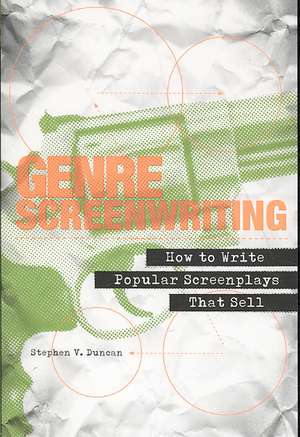
Genre Screenwriting: How to Write Popular Screenplays That Sell
Autor Stephen V. Duncanen Limba Engleză Paperback – 15 dec 2008
Genre Screenwriting: How to Write Popular Screenplays That Sell does not attempt to probe in the deepest psyche of screenwriters and directors of famous or seminal films, nor does it attempt to analyze the deep theoretic machinations of films. Duncan's simple goal is to give the reader, the screenwriter, a practical guide to writing each popular film genre. Employing methods as diverse as using fairy tales to illustrate the 'how to' process for each popular genre, and discussing these popular genres in modern television and its relation to its big screen counterpart, Duncan provides a one-stop shop for novices and professionals alike.
Preț: 184.67 lei
Preț vechi: 222.00 lei
-17%
Puncte Express: 277
Carte tipărită la comandă
Livrare economică 23 noiembrie-07 decembrie
Livrare prin curier în România Termenul estimat este afișat lângă disponibilitate.
Transport gratuit de la 400.00 lei Plată online sau ramburs, în funcție de opțiunile comenzii.
Retur gratuit în 14 zile Comandă securizată și suport în română.
Specificații
ISBN-13: 9780826429933
ISBN-10: 0826429939
Pagini: 222
Dimensiuni: 140 x 212 x 14 mm
Greutate: 0.27 kg
Editura: Bloomsbury Publishing
Colecția Continuum
Locul publicării:New York, United States
ISBN-10: 0826429939
Pagini: 222
Dimensiuni: 140 x 212 x 14 mm
Greutate: 0.27 kg
Editura: Bloomsbury Publishing
Colecția Continuum
Locul publicării:New York, United States
V-ar putea interesa
-
 Complete Fawlty TowersCleese John & Booth ConniePreț: 117.77 lei
 -
 Keeping the Dream AliveRaymond Webster ThompsonPreț: 111.26 lei
 -
 Sunset BoulevardBilly WilderPreț: 208.51 lei
 -
 Pulp FictionQuentin TarantinoPreț: 70.14 lei
 -
 Reservoir DogsQuentin TarantinoPreț: 70.04 lei
 -
 T2 TrainspottingJohn HodgePreț: 87.87 lei
 -
 Sense and SensibilityEmma Thompson-29%Preț: 61.95 lei87.63 lei
 -
 How To Be Your Own Script DoctorJennifer Kenning-17%Preț: 155.80 lei187.60 lei
 -
 Genre: A Guide to Writing for Stage and ScreenAndrew Tidmarsh-26%Preț: 170.22 lei228.65 lei
 -
 The Hateful EightQuentin TarantinoPreț: 95.58 lei
 -
 -30%Preț: 78.23 lei111.60 lei
 -
 -21%Preț: 103.77 lei131.46 lei
Cuprins
Chapter 1: The Basics of Dramatic Screenwriting
The Film Premise
Story Theme
Character
Suspension of Disbelief
Story & Plot
The Seven Elements of a Scene
The Sequence Approach
Screenplay Structure: Classic & Alternative Approaches
The "Rules" Versus the "Visceral" Approach
Chapter 2: Writing the Action-Adventure Genre
Lights! Camera! Action!
Origins of the Action-Adventure
Some Important Definitions
Hollywood's Love Affair with the Action-Adventure Genre
Key "How To" Elements to the Action-Adventure Screenplay
Writing Style Examples from Produced Screenplays
Action-Adventure & Television Series
Your Assignment
Chapter 3: Writing a Thriller Genre
Spine Tingling Nail Biter
First Things First: The Key Elements to the Murder Mystery
Brief Historical Perspective & Key Elements of Noir
The Thriller & Television Series
Your Assignment
Chapter 4: Writing the Science-Fiction-Fantasy Genre
The Illusion of Reality
Hollywood's Addiction to Computer Generated Images
Science-Fiction-Fantasy & Television Series
Your Assignment
Chapter 5: Writing the Horror-Fantasy
A Frightening Journey
A Brief Historical Perspective of the Horror-Fantasy Genre
Horror-Fantasy & Television Series
Your Assignment
Chapter 6: Writing the Comedy & Romantic Comedy Genres
Make "Em Laugh
The Origins of Comedy
The Romantic Comedy Genre
Comedy & Television Series
Your Assignment
Chapter 7: Marketing Your Finished Genre Screenplay
Nirvana: The Four Quadrants
From Script to Screen: How Films Get Made
Selling Your Screenplay
Landing Representation
The Screenplay Marketplace by Genre
The Appendix: Genre Screenwriting Templates
The Film Premise
Story Theme
Character
Suspension of Disbelief
Story & Plot
The Seven Elements of a Scene
The Sequence Approach
Screenplay Structure: Classic & Alternative Approaches
The "Rules" Versus the "Visceral" Approach
Chapter 2: Writing the Action-Adventure Genre
Lights! Camera! Action!
Origins of the Action-Adventure
Some Important Definitions
Hollywood's Love Affair with the Action-Adventure Genre
Key "How To" Elements to the Action-Adventure Screenplay
Writing Style Examples from Produced Screenplays
Action-Adventure & Television Series
Your Assignment
Chapter 3: Writing a Thriller Genre
Spine Tingling Nail Biter
First Things First: The Key Elements to the Murder Mystery
Brief Historical Perspective & Key Elements of Noir
The Thriller & Television Series
Your Assignment
Chapter 4: Writing the Science-Fiction-Fantasy Genre
The Illusion of Reality
Hollywood's Addiction to Computer Generated Images
Science-Fiction-Fantasy & Television Series
Your Assignment
Chapter 5: Writing the Horror-Fantasy
A Frightening Journey
A Brief Historical Perspective of the Horror-Fantasy Genre
Horror-Fantasy & Television Series
Your Assignment
Chapter 6: Writing the Comedy & Romantic Comedy Genres
Make "Em Laugh
The Origins of Comedy
The Romantic Comedy Genre
Comedy & Television Series
Your Assignment
Chapter 7: Marketing Your Finished Genre Screenplay
Nirvana: The Four Quadrants
From Script to Screen: How Films Get Made
Selling Your Screenplay
Landing Representation
The Screenplay Marketplace by Genre
The Appendix: Genre Screenwriting Templates
Recenzii
"[This book] reveals the secrets of a successful screenplay across a range of genres and employs a variety of methods to illustrate the processes" Writer's Forum, December 2008
"Duncan (screenwriting, Loyola Marymount Univ.; A Guide to Screenwriting) concentrates here on the nuts and bolts of writing commercial screenplays. He explores each of the five primary film genres and a few subgenres to help readers understand the formula for each well enough to write-and perhaps sell-a successful screenplay of their own. Although not aiming for a general screenwriting primer, Duncan gives a brief overview on screenwriting basics. He uses his own speculative scripts, based on reworked fairy tales, as illustrations for each genre covered...Each chapter closes with helpful textual notes; appendixes provide worksheets for genre and character development." -Stacey Rae Brownlie, Library Journal, February 1, 2009
In this useful and approachable offering, screenwriter Duncan (whose film credits include A Man Called Hawk and Tour of Duty) provides aspiring screenwriters with the tools to write the most popular genres on the big screen, including action-adventure, thriller, science fiction and fantasy, horror-fantasy, and romantic comedy. Duncan breaks down the elements of each genre, showing readers how the protagonist, the antagonist, and the supporting characters function within the structure of the plot. Duncan uses his own spec scripts for dialogue and format tips and transforms fairy tales like Little Red Riding Hood and Goldilocks and the Three Bears into examples of various genres. In addition to his own work, Duncan references popular films in each category and shows how they typify their respective genres. At the end of the book, he offers suggestions for marketing and attempting to sell the finished screenplay. Indie aficionados might turn up their noses, but Duncan's handy how-to is a practical, accessible guide for those eager to work in popular contemporary movies."-Booklist
"Duncan (screenwriting, Loyola Marymount Univ.; A Guide to Screenwriting) concentrates here on the nuts and bolts of writing commercial screenplays. He explores each of the five primary film genres and a few subgenres to help readers understand the formula for each well enough to write-and perhaps sell-a successful screenplay of their own. Although not aiming for a general screenwriting primer, Duncan gives a brief overview on screenwriting basics. He uses his own speculative scripts, based on reworked fairy tales, as illustrations for each genre covered...Each chapter closes with helpful textual notes; appendixes provide worksheets for genre and character development." -Stacey Rae Brownlie, Library Journal, February 1, 2009
In this useful and approachable offering, screenwriter Duncan (whose film credits include A Man Called Hawk and Tour of Duty) provides aspiring screenwriters with the tools to write the most popular genres on the big screen, including action-adventure, thriller, science fiction and fantasy, horror-fantasy, and romantic comedy. Duncan breaks down the elements of each genre, showing readers how the protagonist, the antagonist, and the supporting characters function within the structure of the plot. Duncan uses his own spec scripts for dialogue and format tips and transforms fairy tales like Little Red Riding Hood and Goldilocks and the Three Bears into examples of various genres. In addition to his own work, Duncan references popular films in each category and shows how they typify their respective genres. At the end of the book, he offers suggestions for marketing and attempting to sell the finished screenplay. Indie aficionados might turn up their noses, but Duncan's handy how-to is a practical, accessible guide for those eager to work in popular contemporary movies."-Booklist