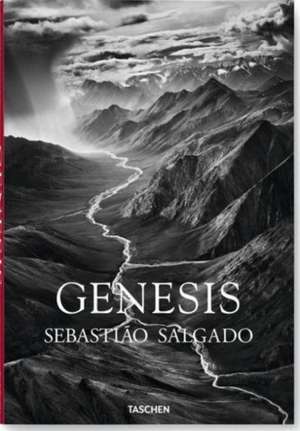
Genesis: Cărți și albume Salgado
Autor Lélia Wanick Salgado Fotografii de Sebastião Salgadoen Limba Engleză Hardback – 31 mar 2013
Deși publicul l-a cunoscut pe Sebastião Salgado prin documentarea suferinței umane și a condițiilor socio-economice devastatoare, Genesis ne propune o schimbare radicală de perspectivă: o celebrare a purității și a supraviețuirii. Descoperim aici nu o lume în agonie, ci una aflată la începuturi, surprinsă într-un efort monumental de opt ani de a regăsi acele 46 de procente din planetă care au rămas intacte în fața amprentei moderne. Apreciem în acest volum de 520 de pagini o măiestrie a tehnicii alb-negru care depășește simpla documentare. Salgado folosește o paletă de clarobscur ce amintește de marii maeștri ai picturii, precum Rembrandt, transformând texturile ghețarilor din Alaska sau pielea crocodililor din Amazon în compoziții de o profunzime aproape tactilă. Ca și Sebastião Salgado. Africa, acest album pune în valoare demnitatea peisajelor și a comunităților indigene, dar cu un accent pe starea primordială, pe echilibrul fragil dintre regnul animal și cel mineral, fără a filtra realitatea prin prisma crizelor economice. Observăm cum această „scrisoare de dragoste către planetă” se distanțează de temele din Workers sau Migrations. Dacă lucrările anterioare analizau impactul umanității asupra pământului, Genesis explorează însăși esența vieții. Ritmul lecturii este unul contemplativ; parcurgem cele cinci secțiuni geografice — de la Sanctuarele din Galapagos până în Amazonia — simțind asprimea frigului arctic și arșița Saharei. Calitatea producției de la TASCHEN GmbH asigură o redare fidelă a variațiilor tonale, oferind fiecărei fotografii spațiul necesar pentru a respira și pentru a comunica direct cu privitorul.

Preț: 692.71 lei
Preț vechi: 814.95 lei
-15%
Carte disponibilă
Livrare economică 12-26 noiembrie
Specificații
ISBN-10: 3836538725
Pagini: 520
Ilustrații: Illustrations
Dimensiuni: 250 x 360 x 46 mm
Greutate: 3.92 kg
Editura: TASCHEN GmbH
Seria Cărți și albume Salgado
V-ar putea interesa
-
 Preț: 67.84 lei
 -
 -32%Preț: 63.14 lei92.27 lei
 -
 Before You Know ItJohn Bargh-18%Preț: 65.03 lei79.53 lei
 -
 War and TurpentineStefan Hertmans-19%Preț: 58.05 lei71.24 lei
 -
 White NoiseDon DelilloPreț: 107.81 lei
 -
 The Oxford Handbook of PragmaticsYan Huang-18%Preț: 373.34 lei456.80 lei
 -
 12 Rules for LifeJordan B. Peterson-23%Preț: 151.43 lei195.57 lei
 -
 Preț: 199.39 lei
 -
 Madness and CivilizationMichel FoucaultPreț: 110.80 lei
 -
 Naughty Truth or DareRunning Press-47%Preț: 43.52 lei82.86 lei
 -
 The E-Myth Landscape ContractorMichael E. GerberPreț: 328.45 lei
 -
 Vivian Maier: Street PhotographerVivian MaierPreț: 266.90 lei
 -
 The Doctor Will See You NowTamer Seckin MDPreț: 201.11 lei
 -
 The Ride of a LifetimeRobert Iger-20%Preț: 110.74 lei138.12 lei
 -
 -25%Preț: 81.42 lei108.67 lei
 -
 Peter Lindbergh. Shadows on the WallPeter Lindbergh-18%Preț: 911.29 lei1111.33 lei
 -
 Sebastião Salgado. GoldSebastiao Salgado-8%Preț: 441.46 lei479.84 lei
 -
 Sebastião Salgado. AmazôniaSebastiao Salgado-18%Preț: 932.78 lei1137.53 lei
 -
 Preț: 149.00 lei
De ce să citești această carte
Recomandăm acest album oricărui pasionat de fotografie care dorește să înțeleagă puterea narativă a moncromiei. Dincolo de valoarea estetică, cititorul câștigă o perspectivă rară asupra locurilor unde timpul pare să fi stat în loc. Este o piesă de colecție esențială pentru cei care apreciază natura în starea ei brută și vor să descopere viziunea unuia dintre cei mai importanți fotografi contemporani asupra conservării planetei.
Despre autor
Sebastião Salgado este un fotograf brazilian de renume mondial, cunoscut pentru proiectele sale documentare pe termen lung. Deși a început să fotografieze târziu, la vârsta de 26 de ani, camera a devenit rapid instrumentul său principal de interacțiune cu lumea. Educat ca economist, Salgado a renunțat la cariera academică pentru a documenta condiția umană și natura, preferând exclusiv estetica alb-negru. Alături de soția sa, Lélia Wanick Salgado, a fondat Instituto Terra, o organizație dedicată reîmpăduririi și conservării mediului în Brazilia, transformând viziunea sa artistică într-o misiune ecologică activă.
Notă biografică
Sebastião Salgado began his career as a professional photographer in Paris in 1973 and subsequently worked with the photo agencies Sygma, Gamma, and Magnum Photos. In 1994 he and his wife Lélia created Amazonas Images, an agency that handles exclusively his work. Salgado's photographic projects have been featured in many exhibitions as well as books, including Other Americas (1986), Sahel: l’homme en détresse (1986), Workers (1993), Terra (1997), Migrations (2000), and The Children (2000).
The editor and author:
Lélia Wanick Salgado studied Architecture and Urban Planning in Paris. Her interest in photography started in the early 1970s and she moved on to conceiving and designing photography books and organizing exhibitions, numerous of them on Sebastião Salgado. Since 1994 Lélia Wanick Salgado is director of the press agency Amazonas Images.
Descriere
On a very fortuitous day in 1970, 26-year-old Sebastião Salgado held a camera for the first time. When he looked through the viewfinder, he experienced a revelation: suddenly life made sense. From that day onward—though it took years of hard work before he had the experience to earn his living as a photographer—the camera became his tool for interacting with the world. Salgado, who “always preferred the chiaroscuro palette of black-and-white images,” shot very little color in his early career before giving it up completely.
Raised on a farm in Brazil, Salgado possessed a deep love and respect for nature; he was also particularly sensitive to the ways in which human beings are affected by their often devastating socio-economic conditions. Of the myriad works Salgado has produced in his acclaimed career, three long-term projects stand out: Workers (1993), documenting the vanishing way of life of manual laborers across the world, Migrations (2000), a tribute to mass migration driven by hunger, natural disasters, environmental degradation and demographic pressure, and this new opus, Genesis, the result of an epic eight-year expedition to rediscover the mountains, deserts and oceans, the animals and peoples that have so far escaped the imprint of modern society—the land and life of a still-pristine planet. “Some 46% of the planet is still as it was in the time of genesis,” Salgado reminds us. “We must preserve what exists.” The Genesis project, along with the Salgados’ Instituto Terra, are dedicated to showing the beauty of our planet, reversing the damage done to it, and preserving it for the future.
Over 30 trips—travelled by foot, light aircraft, seagoing vessels, canoes, and even balloons, through extreme heat and cold and in sometimes dangerous conditions—Salgado created a collection of images showing us nature, animals, and indigenous peoples in breathtaking beauty. Mastering the monochrome with an extreme deftness to rival the virtuoso Ansel Adams, Salgado brings black-and-white photography to a new dimension; the tonal variations in his works, the contrasts of light and dark, recall the works of Old Masters such as Rembrandt and Georges de La Tour.
What does one discover in Genesis? The animal species and volcanoes of the Galápagos; penguins, sea lions, cormorants, and whales of the Antarctic and South Atlantic; Brazilian alligators and jaguars; African lions, leopards, and elephants; the isolated Zo’é tribe deep in the Amazon jungle; the Stone Age Korowai people of West Papua; nomadic Dinka cattle farmers in Sudan; Nenet nomads and their reindeer herds in the Arctic Circle; Mentawai jungle communities on islands west of Sumatra; the icebergs of the Antarctic; the volcanoes of Central Africa and the Kamchatka Peninsula; Saharan deserts; the Negro and Juruá rivers in the Amazon; the ravines of the Grand Canyon; the glaciers of Alaska... and beyond. Having dedicated so much time, energy, and passion to the making of this work, Salgado likens Genesis to “my love letter to the planet.”
Whereas the limited Collector’s Edition is conceived like a large-format portfolio that meanders across the planet, this unlimited book presents a selection of photographs arranged in five chapters geographically: Planet South, Sanctuaries, Africa, Northern Spaces, Amazonia and Pantanal.
Each in its own way, this book and the Collector’s edition—both edited and designed by Lélia Wanick Salgado—pay homage to Salgado’s triumphant and unparalleled Genesis project.
The world premiere of Sebastião Salgado: Genesis will open at the Natural History Museum in London on April 11, 2013. The exhibition builds on the Museum’s reputation as the home of the planet’s best nature photography. For further information and to book tickets please go to www.nhm.ac.uk/salgado. Additionally, from May 14th, a special portfolio of plantinum prints from Genesis will be shown at Phillips Howick Place gallery in London.
Worldwide venues for the Genesis exhibition:
- The Natural History Museum, London, UK - April 11 through September 8, 2013
- The Royal Ontario Museum, Toronto, Canada - May 2 through September 2, 2013
- Ara Pacis Museum, Rome, Italy - May 15 through September 15, 2013
- Jardim Botânico, Rio de Janeiro, RJ, Brazil - May 28 through August 25, 2013
- Musée de l’Elysée, Lausanne, Switzerland - September 21, 2013 through January 12, 2014
- La Maison Européenne de la Photographie (MEP), Paris, France - September 25, 2013 through January 5, 2014
- SESC Belenzinho, São Paulo, SP, Brazil - September 9 - November 2013