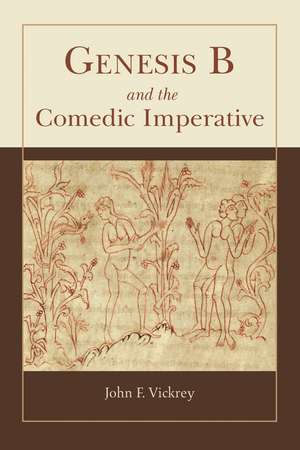
Genesis B and the Comedic Imperative
Autor John F. Vickreyen Limba Engleză Hardback – 12 feb 2015
The inference of orthodoxy follows as a nigh-inevitable conclusion of the interpretation of several motifs: the poem's culturally imbued martiality, its allegorical bent, and also what A. N. Doane noted as its tropological bent. The argument depends heavily upon philological inquiry and on examination of prevailing beliefs and attitudes of contemporaneous Frankish society, religious and civil, leading to the reinterpretation of crucial passages. Of these, most notably, is the passage in which Adam, in refusing the Tempter's invitation to eat the fruit, observes that the Tempter has given no tacen 'sign' as evidence that he truly is God's emissary. Other passages that have impeded critical perception of the poem's significance are also examined, such as the notorious micel wundor clause (lines 595-98) and the pseudo-gnomic declaration swa hire eaforan sculon after lybban (623-35). In sum, Genesis B sustains the orthodoxy otherwise of the Junius 11 manuscript.
Preț: 402.65 lei
Preț vechi: 928.89 lei
-57%
Puncte Express: 604
Carte disponibilă
Livrare economică 20 noiembrie-02 decembrie
Livrare prin curier în România Termenul estimat este afișat lângă disponibilitate.
Transport gratuit pentru acest produs Plată online sau ramburs, în funcție de opțiunile comenzii.
Retur gratuit în 14 zile Comandă securizată și suport în română.
Specificații
ISBN-13: 9781611461671
ISBN-10: 1611461677
Pagini: 342
Ilustrații: 4 colour photos
Dimensiuni: 154 x 230 x 32 mm
Greutate: 0.64 kg
Editura: Bloomsbury Publishing
Colecția Lehigh University Press
Locul publicării:New York, United States
ISBN-10: 1611461677
Pagini: 342
Ilustrații: 4 colour photos
Dimensiuni: 154 x 230 x 32 mm
Greutate: 0.64 kg
Editura: Bloomsbury Publishing
Colecția Lehigh University Press
Locul publicării:New York, United States
Cuprins
Contents
Introductory Note
List of Abbreviations
Foreword
I: Deposition of a Dame
II: Comedy, Wit, Tropology, Allegory
III: Adamic Resolve
IV: Adamic Failure
V: Father of Lies
VI: "God Was Himself a Warlord"
VII: "No Fiend Here in the Realm"
VIII: Dom Is Darker and Deeper
IX: The Boda and Gottschalk
X: Adam and Eve and the Light
Notes
Bibliography
Index
Introductory Note
List of Abbreviations
Foreword
I: Deposition of a Dame
II: Comedy, Wit, Tropology, Allegory
III: Adamic Resolve
IV: Adamic Failure
V: Father of Lies
VI: "God Was Himself a Warlord"
VII: "No Fiend Here in the Realm"
VIII: Dom Is Darker and Deeper
IX: The Boda and Gottschalk
X: Adam and Eve and the Light
Notes
Bibliography
Index
Recenzii
This is a serious, highly polemical study by a distinguished scholar. Vickrey seeks to establish his view that the Anglo-Saxon poetic fragment known as Genesis B, dealing with the fall of Eve and Adam, was composed in conformity with the Christian 'happy ending' of human salvation from that original sin through Christ (this he terms 'the comedic imperative'). In particular, he seeks to discredit critics who espouse the 'exonerative' reading of the poem as treating that act as merely a lapse of judgment, while God remains a remote and inscrutable deity. Vickery argues with great plausibility, through much explicit textual citation and interpretation, that the poem has a tropological structure enabling it to represent the temptations of Genesis 3 and their consequences while reflecting the tribus modis structure of temptation (through suggestio, sensus, and ratio); the comitatus structure of early medieval Frankish and Germanic societies; and the doctrine of the 'fortunate fall,' with the correlative importance of the sign of the cross. . . .Vickrey decisively achieves his objective. Summing Up: Recommended . . . Graduate students, researchers, faculty.
Vickrey is at his best when he offers detailed analyses of subtle dramatic movements in Genesis B that arise from grammatical structures and semantic change. He explores themes of obedience, Anglo-Saxon martiality, the Christianization of Anglo-Saxon warrior ethos and vocabulary, the languages of visionary experience and cunning. His close readings reveal a sharp ear for modulations in tone, especially in dialogue, where he teaches us to hear the living voice as it cajoles, threatens, commands, and defies. At such moments, Vickrey makes his most convincing case for the poet's largely unacknowledged wit. Throughout the book he also illuminates Genesis B's historical and theological contexts in ways that modern critics should find instructive.. There is much to be learned from this book, the summa of the author's lifelong study of Genesis B.
Vickrey is at his best when he offers detailed analyses of subtle dramatic movements in Genesis B that arise from grammatical structures and semantic change. He explores themes of obedience, Anglo-Saxon martiality, the Christianization of Anglo-Saxon warrior ethos and vocabulary, the languages of visionary experience and cunning. His close readings reveal a sharp ear for modulations in tone, especially in dialogue, where he teaches us to hear the living voice as it cajoles, threatens, commands, and defies. At such moments, Vickrey makes his most convincing case for the poet's largely unacknowledged wit. Throughout the book he also illuminates Genesis B's historical and theological contexts in ways that modern critics should find instructive.. There is much to be learned from this book, the summa of the author's lifelong study of Genesis B.