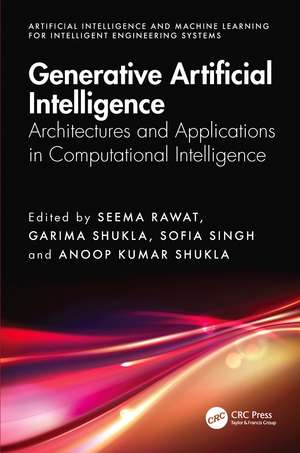
Generative Artificial Intelligence: Architectures and Applications in Computational Intelligence: Artificial Intelligence and Machine Learning for Intelligent Engineering Systems
Editat de Seema Rawat, Garima Shukla, Sofia Singh, Anoop Kumar Shuklaen Limba Engleză Hardback – 5 feb 2027
Features:
- Discusses advanced generative models, including Generative Adversarial Networks, Variational Autoencoders, diffusion models, and transformer-based architectures.
- Provides insights into emerging fields like quantum artificial intelligence, artificial intelligence-powered automation, and metaverse applications, ensuring that readers stay ahead in the fast-evolving artificial intelligence landscape.
- Presents practical case studies, showing how artificial intelligence models are applied in real-world scenarios, such as artificial intelligence-driven medical imaging, fraud detection, and intelligent automation.
- Showcases a practical and hands-on approach by providing step-by-step coding examples, Python-based implementations, and tutorials using frameworks.
- Covers artificial intelligence ethics, responsible artificial intelligence deployment, and global regulatory frameworks.

Preț: 1133.75 lei
Preț vechi: 1489.28 lei
-24% Precomandă
Puncte Express: 1701
Carte nepublicată încă
Livrare prin curier în România Precomanda se expediază când titlul devine disponibil.
Transport gratuit pentru acest produs Plată online sau ramburs, în funcție de opțiunile comenzii.
Retur gratuit în 14 zile Comandă securizată și suport în română.
Doresc să fiu notificat când acest titlu va fi disponibil:
Se trimite...
Specificații
ISBN-13: 9781041342991
ISBN-10: 1041342993
Pagini: 424
Ilustrații: 216
Dimensiuni: 156 x 234 mm
Ediția:1
Editura: CRC Press
Colecția CRC Press
Seria Artificial Intelligence and Machine Learning for Intelligent Engineering Systems
ISBN-10: 1041342993
Pagini: 424
Ilustrații: 216
Dimensiuni: 156 x 234 mm
Ediția:1
Editura: CRC Press
Colecția CRC Press
Seria Artificial Intelligence and Machine Learning for Intelligent Engineering Systems
Public țintă
Academic, Postgraduate, and Undergraduate AdvancedCuprins
Section 1. Generative Models & Generative AI in Cybersecurity and Threat Detection. Chapter 1. Generative AI-Enhanced Chaotic Key Exchange for Mitigating Man-in-the-Middle Attacks in Mobile Ad Hoc Networks. Chapter 2. Design and Development of a Hybrid Artificial Immune System Framework for Generative AI-Enabled Autonomous Network Threat Detection. Chapter 3. Smart Video Processing for AI-Generated Art: Evaluating Contour Detection and Background Subtraction Methods. Chapter 4. Optimizing CBIR Systems Using Genetic Algorithms: Insights in the Era of Generative AI Models. Chapter 5. Generative Adversarial Networks (GANs): Theory and Implementation. Chapter 6. Hybrid Models and Multi-Modal Learning. Chapter 7. Natural Language Processing and Text Generation. Section 2. Generative AI in Healthcare and Biomedical Sciences. Chapter 8. CFD Study of Unsteady Non-Newtonian Blood Flow in a Symmetric Coronary Artery Stenosis. Chapter 9. Computational Intelligence based Numerical Analysis of Blood Flow in a Two-Dimensional Artery with Symmetric and Asymmetric Variable-Shaped Stenosis. Chapter 10. Predictive Insights into Cardiac Calcification: A Data Mining Approach to Cardiovascular Risk Assessment. Chapter 11. Sonographic Assessment of Carotid Intima-Media Thickness (CIMT) in Diabetic Patients: A Data-Driven Analysis. Chapter 12. Deep Learning and Generative AI-Based Automatic Speech and Emotion Detection Model Section 1. Generative Models & Generative AI in Cybersecurity and Threat Detection. Chapter 1. Generative AI-Enhanced Chaotic Key Exchange for Mitigating Man-in-the-Middle Attacks in Mobile Ad Hoc Networks. Chapter 2. Design and Development of a Hybrid Artificial Immune System Framework for Generative AI-Enabled Autonomous Network Threat Detection. Chapter 3. Smart Video Processing for AI-Generated Art: Evaluating Contour Detection and Background Subtraction Methods. Chapter 4. Optimizing CBIR Systems Using Genetic Algorithms: Insights in the Era of Generative AI Models. Chapter 5. Generative Adversarial Networks (GANs): Theory and Implementation. Chapter 6. Hybrid Models and Multi-Modal Learning. Chapter 7. Natural Language Processing and Text Generation. Section 2. Generative AI in Healthcare and Biomedical Sciences. Chapter 8. CFD Study of Unsteady Non-Newtonian Blood Flow in a Symmetric Coronary Artery Stenosis. Chapter 9. Computational Intelligence based Numerical Analysis of Blood Flow in a Two-Dimensional Artery with Symmetric and Asymmetric Variable-Shaped Stenosis. Chapter 10. Predictive Insights into Cardiac Calcification: A Data Mining Approach to Cardiovascular Risk Assessment. Chapter 11. Sonographic Assessment of Carotid Intima-Media Thickness (CIMT) in Diabetic Patients: A Data-Driven Analysis. Chapter 12. Deep Learning and Generative AI-Based Automatic Speech and Emotion Detection Model for Especially Abled Persons: A Detailed Study. Chapter 13. Recent Advances in Facial Emotion Recognition Using Deep Learning and Generative AI-Based Methods and Applications. Chapter 14. Generative AI-Enabled Gamification and VR/AR for Elderly Cognitive and Physical Health under SDG 3. Chapter 15. Experimental Analysis of Histopathological Alterations in Gill and Reproductive Tissues of Channa punctatus (Bloch, 1793) Following Sublethal Exposure to Nickel and Mercury: Evidence from River-Collected and Laboratory-Reared Fish. Section 3. Generative AI in Precision Agriculture. Chapter 16. Disease Detection Robotic System for Machine Vision and Precision Agriculture of Maize Cultivation. Chapter 17. Impact and Prediction of Fertilizers on Crop Yield Using a Hybrid Generative AI–Transformer–UAV–IoT Framework with Edge-Federated Explainable Intelligence. Chapter 18. Maize Disease Classification Using EfficientNetB7 for Precision Agriculture and Machine Vision. Section 4. Generative Urban Planning & Sustainable Development. Chapter 19. Smart Technologies for Climate-Resilient Cities: Innovative Approaches to Reduce Carbon Footprints. Chapter 20. Self-Sustaining Neighbourhoods In India By Integrating Bioclimatic Design, Low-Impact Prefabrication, And Closed-Loop Urban Systems. Chapter 21. Mathematical Modeling and Computational Intelligence for Understanding Barriers to Women’s Participation in STEM in the Era of AI and Sustainable Development. Chapter 22. Intelligent Competency Cartography: An AI-Driven Framework for Micro-Credential Design and Global Remote-Work Readiness in Higher Education. Chapter 23. Artificial Intelligence as Creative Collaborator: Implications for Digital Art Practice in Digital and AI-assisted Visual Artists in India. Chapter 24. AI based Two Layer Security Technique Architecture Cryptography and Steganography in Cloud Computing Environment: A Review Study
Notă biografică
Seema Rawat is a distinguished academician, researcher, and industry expert specializing in Artificial Intelligence, Image Processing, Signal Processing, Pattern Matching, and Natural Language Processing. She is currently a Professor at the Amity School of Engineering & Technology, Amity University, Uttar Pradesh, India.
Garima Shukla, Senior Member IEEE and Associate Professor in the Department of Computer Science & Engineering at Amity School of Engineering and Technology, Amity University, Mumbai, is a distinguished academician and researcher. Currently pursuing a Postdoctoral Fellowship at SIT, Singapore, she specializes in Deep Learning, Artificial Intelligence (AI), Computational Intelligence, Machine Learning (ML), Optoelectronics, the Internet of Things (IoT).
Sofia Singh, Ph.D. (CSE/IT), Senior Member IEEE, Distinguished Alumnus Awardee, is an accomplished Associate Professor in the Department of AI at ASET, Amity University, Noida. Her research focuses on cutting-edge advancements in Artificial Intelligence, Machine Learning, and Data Science.
Anoop Kumar Shukla is currently an Assistant Professor in the Department of Mechanical Engineering at Amity University, Noida, India. His research interests include energy conversion, thermal management, multigeneration systems, AI applications to Energy Systems.
Garima Shukla, Senior Member IEEE and Associate Professor in the Department of Computer Science & Engineering at Amity School of Engineering and Technology, Amity University, Mumbai, is a distinguished academician and researcher. Currently pursuing a Postdoctoral Fellowship at SIT, Singapore, she specializes in Deep Learning, Artificial Intelligence (AI), Computational Intelligence, Machine Learning (ML), Optoelectronics, the Internet of Things (IoT).
Sofia Singh, Ph.D. (CSE/IT), Senior Member IEEE, Distinguished Alumnus Awardee, is an accomplished Associate Professor in the Department of AI at ASET, Amity University, Noida. Her research focuses on cutting-edge advancements in Artificial Intelligence, Machine Learning, and Data Science.
Anoop Kumar Shukla is currently an Assistant Professor in the Department of Mechanical Engineering at Amity University, Noida, India. His research interests include energy conversion, thermal management, multigeneration systems, AI applications to Energy Systems.
Descriere
The text discusses the core concepts of computational intelligence and the mathematical and theoretical underpinnings of generative models. It explores different artificial intelligence architectures, while also addressing the integration of hybrid approaches and multi-modal learning techniques.