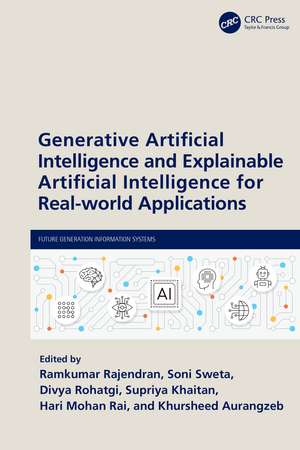
Generative Artificial Intelligence and Explainable Artificial Intelligence for Real-world Applications: Future Generation Information Systems
Editat de Ramkumar Rajendran, Soni Sweta, Divya Rohatgi, Supriya Khaitan, Hari Mohan Rai, Khursheed Aurangzeben Limba Engleză Hardback – 27 oct 2026
The book:
- Focuses on the principles and methodologies of explainable artificial intelligence, providing readers with a thorough understanding of how artificial intelligence models can be made transparent and interpretable.
- Explores explainable artificial intelligence techniques, including feature importance, SHAP values, LIME, and counterfactual explanations.
- Offers an in-depth examination of generative artificial intelligence, covering cutting-edge advancements in generative models like GANs, VAEs, and transformer-based architectures.
- Bridges the gap between theoretical concepts and their practical applications, making advanced artificial intelligence technologies accessible to the readers.
- Includes numerous case studies and real-world examples that demonstrate the successful application of generative artificial intelligence and explainable artificial intelligence.
Din seria Future Generation Information Systems
- 15%
 Preț: 418.13 lei
 -
 Preț: 490.93 lei
 - 20%
 Preț: 461.26 lei
 - 18%
 Preț: 957.96 lei
 - 15%
 Preț: 457.36 lei
 -
 Preț: 481.14 lei
 - 15%
 Preț: 454.70 lei
 - 19%
 Preț: 531.62 lei
 - 15%
 Preț: 502.32 lei
 - 20%
 Preț: 1058.50 lei
 - 18%
 Preț: 956.92 lei
 - 18%
 Preț: 1125.98 lei
 - 18%
 Preț: 1122.83 lei
 - 20%
 Preț: 1012.74 lei
 - 20%
 Preț: 1506.53 lei
Preț: 1623.54 lei
Preț vechi: 1979.93 lei
-18% Precomandă
Puncte Express: 2435
Carte nepublicată încă
Livrare prin curier în România Precomanda se expediază când titlul devine disponibil.
Transport gratuit pentru acest produs Plată online sau ramburs, în funcție de opțiunile comenzii.
Retur gratuit în 14 zile Comandă securizată și suport în română.
Doresc să fiu notificat când acest titlu va fi disponibil:
Se trimite...
Specificații
ISBN-13: 9781041068761
ISBN-10: 104106876X
Pagini: 478
Ilustrații: 240
Dimensiuni: 156 x 234 mm
Greutate: 1.04 kg
Ediția:1
Editura: CRC Press
Colecția CRC Press
Seria Future Generation Information Systems
ISBN-10: 104106876X
Pagini: 478
Ilustrații: 240
Dimensiuni: 156 x 234 mm
Greutate: 1.04 kg
Ediția:1
Editura: CRC Press
Colecția CRC Press
Seria Future Generation Information Systems
Public țintă
Academic, Postgraduate, and Undergraduate AdvancedCuprins
1. Decoding GenAI: An Introduction to Transformers 2. Bridging the Gap: Integrating Generative AI and Explainability 3. XAI decoded: A systematic literature review on Explainability 4. Applications of Explainable Artificial Intelligence in Healthcare 5. Interactive UI for Captum: Enhancing Explainable AI Accessibility 6. Filling the AI Data Void: Synthesizing Domain-Specific Knowledge using Generative AI 7. Generating Synthetic Images in Multi-Agent Cooperating Environment Focusing on Generalizability 8. Exploring Diffusion Models: Techniques, Applications, and Future Directions 9. Multimodal Generative AI in Healthcare: A Comprehensive Review of Models and Applications 10. Comparative Analysis of Convolutional Neural Network Architectures for Diabetic Retinopathy Classification and Grading in Retinal Images Using Generative AI and Explainable AI 11. From Steps to Signals: Machine Learning for Explainable Gait Analysis 12. A Study on Deep Learning and Machine Learning Methods for Automated Brain Hemorrhage Detection 13. GenAIED: GenAI in Education 14. Generative Intelligence Meets Precision Farming: A Hybrid CNN-RAG Approach for Early Plant Disease Management 15. Applications of Generative AI in Education: A Conceptual Framework for Ethical Implementation in Higher Education Curricula 16. AI in Industry 5.0: Future Trends, Green AI, and Accountability 17. Exploring Multimodal AI Applications in Healthcare, Smart Homes, Autonomous Vehicles, and Speech Recognition
Notă biografică
Ramkumar Rajendran is an Associate Professor at the Centre for Educational Technology at IITB. Previously, he worked as a research scholar at Vanderbilt University in the USA and as a researcher at NEC Central Research Laboratory in Japan. His research interests include Learning Analytics, AI in Education, Affective Computing, Educational Data Mining, Intelligent Learning environments, and Self-Regulated Learning. Ramkumar received a Ph.D. from the IITB-Monash Research Academy, a joint venture between IITB, India, and Monash University, Melbourne. He served as Program Chair and Track Chair for international conferences, including IEEE T4E, ICALT, LAK, and ICCE. He serves on the Board of Directors for the International Educational Data Mining Society (IEDMS) and is a member of the Executive Committee for the Asia-Pacific Society for Computers in Education and the EdTech Society.
Soni Sweta holds a Ph.D. in Computer Science and Engineering from BIT Mesra, Ranchi, and is currently serving as an Assistant Professor in the Department of Computer Engineering at MPSTME, SVKM’s NMIMS, Mumbai. She completed her Master of Technology from Rajiv Gandhi Proudyogiki Vishwavidyalaya, Bhopal. Over the years, she has guided numerous MCA, B.Tech, M.Tech students in their dissertations and final projects, as well as several Ph.D. research scholars.
Her research interests include Artificial Intelligence, Natural Language Processing, Soft Computing, Data Mining, Machine Learning, and Data Science. As a Member of IEEE and a Life Member of CSI (India), she is actively engaged with reputed journals as a reviewer and editorial board member. She has also served on the technical program committees of several esteemed conferences.
Sweta has authored one book, contributed six book chapters, and published multiple high-impact SCI and Scopus-indexed research papers in peer-reviewed international journals. Additionally, she serves as an examiner for various Computer Science courses, including Ph.D. thesis evaluations across several universities in India. With over 18 years of academic experience, she has taught as an Assistant Professor and Visiting Faculty in leading engineering institutions.
Divya Rohatgi is working as Associate Professor, Dept. of CSE at Bharati Vidyapeeth Deemed to be University Department of Engineering & Technology, Navi Mumbai, Maharashtra. She is also acting as HOD IT along with Institution Innovation Council (IIC) Convenor, E-Cell Convenor and IPR Coordinator of the organization. Since past 20 years she has also worked in various reputed engineering colleges of Mumbai University, Amity University and UPTU Lucknow. She is Gate Qualified, Microsoft Technology Associate certified and All India Topper of NPTEL certification for Software Testing by IIT Kharagpur. She is an approved Research Guide in Computer Engineering for PG/ Ph.D programs. She has published research papers in the field of AIML, Software Testing in SCI/Scopus indexed journals and conferences. She has also authored a book on Cyber Law and Cyber Crimes published by reputed publication houses. She has organized various national and international conferences and was session chair in various international conferences. Apart from this she has developed MOOC for Amity Online University and served as reviewer in journals and conferences. She has patents/ copyrights in the field of AI-ML and completed technical consultancy projects. Her area of interests includes Software Engineering, AIML and Deep Learning.
Supriya Khaitan Ph.D. in Computer Science and Engineering is presently working in the Department of Engineering and Technology, Bharati Vidyapeeth, Navi Mumbai, India. She received her Master of Technology degree from Guru Gobind Singh Indraprastha University, Delhi. Supriya Khaitan areas of interest are artificial intelligence, machine learning, deep learning, and network security. She is associated with a few reputed SCI/Scopus journals as a reviewer. She has published many SCI/Scopus-indexed papers in high-impact peer-reviewed international journals; She has authored multiple book chapters;She can be contacted at email: Supriyakhaitan21@gmail.com
Hari Mohan Rai is an Assistant Professor in the Department of Computer Science at the School of Engineering and Digital Sciences, Nazarbayev University, Astana, Kazakhstan. He received his Ph.D. from IIT (ISM) Dhanbad in 2022, where he developed hybrid deep neural network models for early detection of fatal diseases from biomedical signals and images, contributing significantly to AI-driven healthcare diagnostics.
A Gold Medalist in M.Tech. (Control Systems Engineering) from Government Engineering College, Jabalpur, Dr. Rai also holds a B.E. in Electronics and Communication Engineering. He has taught at several international institutions, including International IT University (Kazakhstan), Gachon University (South Korea), NJUPT (China), and Samarkand State University (Uzbekistan), gaining extensive experience in AI, digital systems, and cybersecurity.
His research spans artificial intelligence, biomedical signal and image processing, IoT and robotics, antenna design, and cybersecurity. Rai has published over 50 peer-reviewed papers in leading Q1/Q2 journals such as Bioengineering, Scientific Reports, Sensors, and Expert Systems with Applications. He also holds multiple patents in AI-driven healthcare, smart farming, autonomous drones, and cyber-physical security.
Active in global research communities, he serves as a reviewer and editorial board member for reputed journals and has chaired international conferences. His ongoing work focuses on cancer diagnostics, ECG/EEG analysis, IoT–blockchain systems, and quantum-inspired cryptography.
Khursheed Khursheed is a Professor in the Department of Computer Engineering at the College of Computer and Information, King Saud University, Riyadh. With a Ph.D. in Electronics Design from Midsweden University, Sweden, his doctoral work focused on developing wireless vision sensor networks featuring onboard image processing, compression, and real-time data transmission for machine-monitoring applications. He also holds an MS in Electrical Engineering (System-on-Chip) from Linköping University and a BSc in Computer Engineering from COMSATS IIT Abbottabad.
Dr. Khursheed has extensive academic and research experience across international institutions. Before joining King Saud University, he served as Assistant Professor and Head of Department at Abasyn University, Peshawar, and previously as faculty at COMSATS Institute of Information Technology. His teaching and mentoring span undergraduate and graduate levels, with strong engagement in applied signal processing, digital systems, and machine vision.
His research focuses on signal and image processing, machine vision, wireless visual sensor networks, and embedded system design. He has contributed several peer-reviewed publications in these areas, including work on sub-expression sharing, bi-level image compression, video codecs for embedded vision, and data-reduction techniques. Dr. Khursheed is proficient in MATLAB, digital signal processors, and simulation environments, and is recognized for his creativity, strong work ethic, and commitment to advancing engineering research and education.
Soni Sweta holds a Ph.D. in Computer Science and Engineering from BIT Mesra, Ranchi, and is currently serving as an Assistant Professor in the Department of Computer Engineering at MPSTME, SVKM’s NMIMS, Mumbai. She completed her Master of Technology from Rajiv Gandhi Proudyogiki Vishwavidyalaya, Bhopal. Over the years, she has guided numerous MCA, B.Tech, M.Tech students in their dissertations and final projects, as well as several Ph.D. research scholars.
Her research interests include Artificial Intelligence, Natural Language Processing, Soft Computing, Data Mining, Machine Learning, and Data Science. As a Member of IEEE and a Life Member of CSI (India), she is actively engaged with reputed journals as a reviewer and editorial board member. She has also served on the technical program committees of several esteemed conferences.
Sweta has authored one book, contributed six book chapters, and published multiple high-impact SCI and Scopus-indexed research papers in peer-reviewed international journals. Additionally, she serves as an examiner for various Computer Science courses, including Ph.D. thesis evaluations across several universities in India. With over 18 years of academic experience, she has taught as an Assistant Professor and Visiting Faculty in leading engineering institutions.
Divya Rohatgi is working as Associate Professor, Dept. of CSE at Bharati Vidyapeeth Deemed to be University Department of Engineering & Technology, Navi Mumbai, Maharashtra. She is also acting as HOD IT along with Institution Innovation Council (IIC) Convenor, E-Cell Convenor and IPR Coordinator of the organization. Since past 20 years she has also worked in various reputed engineering colleges of Mumbai University, Amity University and UPTU Lucknow. She is Gate Qualified, Microsoft Technology Associate certified and All India Topper of NPTEL certification for Software Testing by IIT Kharagpur. She is an approved Research Guide in Computer Engineering for PG/ Ph.D programs. She has published research papers in the field of AIML, Software Testing in SCI/Scopus indexed journals and conferences. She has also authored a book on Cyber Law and Cyber Crimes published by reputed publication houses. She has organized various national and international conferences and was session chair in various international conferences. Apart from this she has developed MOOC for Amity Online University and served as reviewer in journals and conferences. She has patents/ copyrights in the field of AI-ML and completed technical consultancy projects. Her area of interests includes Software Engineering, AIML and Deep Learning.
Supriya Khaitan Ph.D. in Computer Science and Engineering is presently working in the Department of Engineering and Technology, Bharati Vidyapeeth, Navi Mumbai, India. She received her Master of Technology degree from Guru Gobind Singh Indraprastha University, Delhi. Supriya Khaitan areas of interest are artificial intelligence, machine learning, deep learning, and network security. She is associated with a few reputed SCI/Scopus journals as a reviewer. She has published many SCI/Scopus-indexed papers in high-impact peer-reviewed international journals; She has authored multiple book chapters;She can be contacted at email: Supriyakhaitan21@gmail.com
Hari Mohan Rai is an Assistant Professor in the Department of Computer Science at the School of Engineering and Digital Sciences, Nazarbayev University, Astana, Kazakhstan. He received his Ph.D. from IIT (ISM) Dhanbad in 2022, where he developed hybrid deep neural network models for early detection of fatal diseases from biomedical signals and images, contributing significantly to AI-driven healthcare diagnostics.
A Gold Medalist in M.Tech. (Control Systems Engineering) from Government Engineering College, Jabalpur, Dr. Rai also holds a B.E. in Electronics and Communication Engineering. He has taught at several international institutions, including International IT University (Kazakhstan), Gachon University (South Korea), NJUPT (China), and Samarkand State University (Uzbekistan), gaining extensive experience in AI, digital systems, and cybersecurity.
His research spans artificial intelligence, biomedical signal and image processing, IoT and robotics, antenna design, and cybersecurity. Rai has published over 50 peer-reviewed papers in leading Q1/Q2 journals such as Bioengineering, Scientific Reports, Sensors, and Expert Systems with Applications. He also holds multiple patents in AI-driven healthcare, smart farming, autonomous drones, and cyber-physical security.
Active in global research communities, he serves as a reviewer and editorial board member for reputed journals and has chaired international conferences. His ongoing work focuses on cancer diagnostics, ECG/EEG analysis, IoT–blockchain systems, and quantum-inspired cryptography.
Khursheed Khursheed is a Professor in the Department of Computer Engineering at the College of Computer and Information, King Saud University, Riyadh. With a Ph.D. in Electronics Design from Midsweden University, Sweden, his doctoral work focused on developing wireless vision sensor networks featuring onboard image processing, compression, and real-time data transmission for machine-monitoring applications. He also holds an MS in Electrical Engineering (System-on-Chip) from Linköping University and a BSc in Computer Engineering from COMSATS IIT Abbottabad.
Dr. Khursheed has extensive academic and research experience across international institutions. Before joining King Saud University, he served as Assistant Professor and Head of Department at Abasyn University, Peshawar, and previously as faculty at COMSATS Institute of Information Technology. His teaching and mentoring span undergraduate and graduate levels, with strong engagement in applied signal processing, digital systems, and machine vision.
His research focuses on signal and image processing, machine vision, wireless visual sensor networks, and embedded system design. He has contributed several peer-reviewed publications in these areas, including work on sub-expression sharing, bi-level image compression, video codecs for embedded vision, and data-reduction techniques. Dr. Khursheed is proficient in MATLAB, digital signal processors, and simulation environments, and is recognized for his creativity, strong work ethic, and commitment to advancing engineering research and education.
Descriere
The text focuses on the methodologies of generative artificial intelligence, and explainable artificial intelligence, providing readers with an understanding of how artificial intelligence models can be transparent and interpretable. It explores various XAI techniques, feature importance, SHAP values, LIME, and counterfactual explanations.