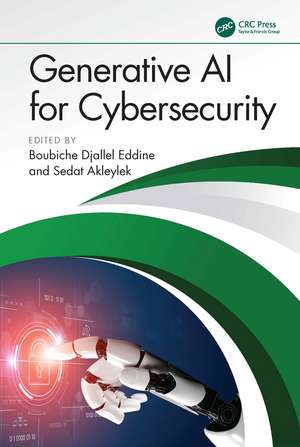
Generative AI for Cybersecurity
Editat de Boubiche Djallel Eddine, Sedat Akleyleken Limba Engleză Hardback – 14 iun 2026
This book provides a balanced and comprehensive examination of this dual-use technology. It highlights how generative models can be leveraged to build resilient, intelligent, and proactive defense mechanisms capable of anticipating and countering emerging cyber risks. At the same time, it critically analyzes the vulnerabilities, ethical dilemmas, and regulatory challenges introduced by the misuse of GenAI. Through diverse perspectives and expert contributions, the book bridges theoretical foundations with real-world applications, demonstrating how GenAI can support adaptive intrusion detection, anomaly analysis, secure autonomous systems, and more transparent and explainable security solutions.
Beyond technical considerations, the book addresses broader societal, geopolitical, and governance implications, including issues of trust, sovereignty, and responsible AI deployment. It offers frameworks, methodologies, and practical insights suitable for researchers, practitioners, students, and policymakers seeking to understand, develop, or regulate GenAI-driven cybersecurity systems.
By examining both the opportunities and the risks, Generative AI for Cybersecurity serves as a timely reference for navigating an era where AI is not only a tool for defense but also a catalyst for new forms of cyber aggression, highlighting the urgent need for innovative, ethical, and resilient approaches to securing the digital world.
Preț: 799.71 lei
Preț vechi: 1147.10 lei
-30%
Puncte Express: 1200
Carte indisponibilă temporar
Doresc să fiu notificat când acest titlu va fi disponibil:
Se trimite...
Specificații
ISBN-13: 9781041077459
ISBN-10: 1041077459
Pagini: 342
Ilustrații: 166
Dimensiuni: 178 x 254 mm
Greutate: 0.79 kg
Ediția:1
Editura: CRC Press
Colecția CRC Press
ISBN-10: 1041077459
Pagini: 342
Ilustrații: 166
Dimensiuni: 178 x 254 mm
Greutate: 0.79 kg
Ediția:1
Editura: CRC Press
Colecția CRC Press
Public țintă
Academic, Postgraduate, and Professional ReferenceCuprins
Part 1: Introduction and Background. Chapter 1 The Rise of Generative AI in Cybersecurity: Balancing Benefits and Risks. Part 2: The Power of Generative AI in Cyber Defense. Chapter 2 Adversarial Intelligence: Leveraging Generative Models for Cyber Defense and Resilience. Chapter 3 Generative AI in Cybersecurity Operations: Advancing Defence and Building Trust. Chapter 4 Generative AI for Indigenous Cyber Defense: Building Sovereign Digital Resilience in the Global South. Part 3: Weaponized Generative AI. Chapter 5 The Dark Side of Generative AI: Threats and Risks. Chapter 6 Generative AI in Offensive Security: Capabilities, Challenges, and Risks. Chapter 7 The Dark Side of Generative AI: Detecting Deep Fakes through Emotion Analysis. Part 4: Proactive Cybersecurity with Generative AI. Chapter 8 Proactive Cybersecurity with Generative AI. Chapter 9 GEPARD: A GenAI-Enabled Proactive Adaptive Resilient Defense Framework for Cybersecurity. Part 5: Case uses of Generative AI in Cybersecurity. Chapter 10 Host-Based Intrusion Detection Systems Developed Using ADFA-LD and AWSCTD Datasets. Chapter 11 An Explainable Intelligence Framework for IoT Anomaly Detection Using Hierarchical Feature Embedding and Latent Space Modelling. Chapter 12 Accurate and Lightweight IoV Intrusion Detection: Correlation-Filtered Ensemble Feature Selection.
Notă biografică
Djallel Eddine Boubiche is a Full Professor at the Higher National School of Renewable Energies, Environment, and Sustainable Development (RE2SD) in Batna, Algeria. He received his Ph.D. in Computer Science from UHLB University, Algeria, in 2013. He has held several academic responsibilities, including serving on the school’s scientific committee, leading the Industrial Networks Engineering & Artificial Intelligence Specialty, and directing the LEREESI Laboratory. His current research focuses on Security, Edge AI, Wireless Communication and the Internet of Things (IoT). Prof. Boubiche has published widely in leading international journals and conferences, including IEEE Access, IEEE Network, IEEE Communications Magazine, Future Generation Computer Systems, Computers in Human Behavior, and other reputable venues. He is actively engaged in the research community, frequently contributing as a program committee member, program chair, and general or co-general chair for various international conferences. He also serves as a guest editor and associate editor for leading indexed journals.
Sedat Akleylek received the B.Sc. degree in mathematics majored in computer science from Ege University, Izmir, Türkiye, in 2004, and the M.Sc. and Ph.D. degrees in cryptography from Middle East Technical University, Ankara, Türkiye, in 2008 and 2010, respectively. He was a Postdoctoral Researcher at the Cryptography and Computer Algebra Group, TU Darmstadt, Germany, between 2014 and 2015. He worked as a Professor at the Department of Computer Engineering, Ondokuz Mayıs University, Samsun, Türkiye till 2022. He has been with the Department of Computer Engineering, Istinye University, Istanbul, Türkiye. He has started to work at the Chair of Security and Theoretical Computer Science, University of Tartu, Tartu, Estonia, since 2022. His research interests include post-quantum cryptography, algorithms and complexity, architectures for computations in finite fields, applied cryptography for cyber security, malware analysis, IoT security, and avionics cyber security. He is a member of the Editorial Board of IEEE Access, Turkish Journal of Electrical Engineering and Computer Sciences, Peerj Computer Science, and International Journal of Information Security Science. He has published more than 100 research papers in international journals, conference proceedings, book chapters and has solved several real-world security and data analytics problems for the industry.
Sedat Akleylek received the B.Sc. degree in mathematics majored in computer science from Ege University, Izmir, Türkiye, in 2004, and the M.Sc. and Ph.D. degrees in cryptography from Middle East Technical University, Ankara, Türkiye, in 2008 and 2010, respectively. He was a Postdoctoral Researcher at the Cryptography and Computer Algebra Group, TU Darmstadt, Germany, between 2014 and 2015. He worked as a Professor at the Department of Computer Engineering, Ondokuz Mayıs University, Samsun, Türkiye till 2022. He has been with the Department of Computer Engineering, Istinye University, Istanbul, Türkiye. He has started to work at the Chair of Security and Theoretical Computer Science, University of Tartu, Tartu, Estonia, since 2022. His research interests include post-quantum cryptography, algorithms and complexity, architectures for computations in finite fields, applied cryptography for cyber security, malware analysis, IoT security, and avionics cyber security. He is a member of the Editorial Board of IEEE Access, Turkish Journal of Electrical Engineering and Computer Sciences, Peerj Computer Science, and International Journal of Information Security Science. He has published more than 100 research papers in international journals, conference proceedings, book chapters and has solved several real-world security and data analytics problems for the industry.
Descriere
Generative AI for Cybersecurity explores how rapidly evolving generative models are reshaping modern digital defense. As organizations become more interconnected and data-driven, traditional cybersecurity measures are increasingly challenged by adaptive, AI-powered threats.