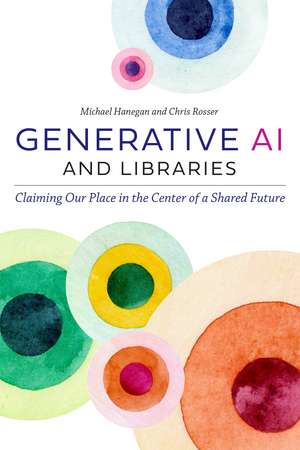
Generative AI and Libraries: Claiming Our Place in the Center of a Shared Future
Autor Michael Hanegan, Chris Rosseren Limba Engleză Paperback – 4 iun 2025
- be introduced to foundational principles and frameworks for navigating the so-called “Age of Intelligence” that provide useful guiderails no matter how AI technology actively evolves;
- delve into the complex ethical considerations of AI, including bias, equity, privacy, misinformation, and the potential impact on human agency and dignity;
- receive guidance related to stakeholder engagement, resource allocation, and the need for continuous learning and adaptation;
- discover practical models for evaluating and implementing AI tools thoughtfully and effectively in ways that align with libraries’ values and mission;
- become familiar with STACKS, an approach for learning, problem solving, and innovation with generative AI;
- explore AI literacy as an expression of metaliteracy using seven frames for instruction and learning; and
- walk away with a sense of how libraries can actively define their essential role as leaders and shapers of the AI landscape, ensuring their continued value and preventing marginalization.
Preț: 445.50 lei
Puncte Express: 668
Carte disponibilă
Livrare economică 04-18 noiembrie
Livrare express 21-27 octombrie pentru 25.31 lei
Livrare prin curier în România Termenul estimat este afișat lângă disponibilitate.
Transport gratuit pentru acest produs Plată online sau ramburs, în funcție de opțiunile comenzii.
Retur gratuit în 14 zile Comandă securizată și suport în română.
Specificații
ISBN-13: 9798892553100
Pagini: 160
Dimensiuni: 152 x 229 x 13 mm
Greutate: 0.23 kg
Editura: American Library Association
Colecția ALA Editions
Pagini: 160
Dimensiuni: 152 x 229 x 13 mm
Greutate: 0.23 kg
Editura: American Library Association
Colecția ALA Editions
Recenzii
"Offers an encouraging perspective on the adoption and future of AI in the field of information literacy. The authors stress the essential role librarians play in guiding users to embrace this technological era. Practitioners will find several elements of the volume particularly useful, including the chapter that details how AI is an expression of metaliteracy in practice ... The authors demonstrate a strong awareness of the diverse roles libraries play in AI adoption and implementation, offering insights that are adaptable to different library environments."
— Journal of Access Services
"Packed full of useful information, charts, figures, and tables on this topic, along with practical information for those who want to lead into this future ... This book is an excellent and positive early guide for AI discussions, directions, and explorations within libraries."
— Public Services Quarterly
”A timely, conceptually robust exploration of how libraries can respond to—and actively shape—the impact of generative AI. Grounding their book in the principles of metaliteracy and the ACRL Framework, the authors outline frameworks for information professionals seeking to develop AI literacy in their communities. The authors strike a balance between promoting AI and acknowledging its pitfalls. While addressing user ethics, equity, and AI’s environmental impact, they also highlight its potential to expand learning and work ... Because this work centers on concepts, frameworks, and instructional models rather than specific tools, it is likely to remain useful despite rapid technological change. Recommended for academic and public libraries engaged in AI literacy programming, policy development, or staff training. School libraries and other settings will also find value in the metaliteracy framing as practical scaffolds for staff and student education."
— Library Journal
— Journal of Access Services
"Packed full of useful information, charts, figures, and tables on this topic, along with practical information for those who want to lead into this future ... This book is an excellent and positive early guide for AI discussions, directions, and explorations within libraries."
— Public Services Quarterly
”A timely, conceptually robust exploration of how libraries can respond to—and actively shape—the impact of generative AI. Grounding their book in the principles of metaliteracy and the ACRL Framework, the authors outline frameworks for information professionals seeking to develop AI literacy in their communities. The authors strike a balance between promoting AI and acknowledging its pitfalls. While addressing user ethics, equity, and AI’s environmental impact, they also highlight its potential to expand learning and work ... Because this work centers on concepts, frameworks, and instructional models rather than specific tools, it is likely to remain useful despite rapid technological change. Recommended for academic and public libraries engaged in AI literacy programming, policy development, or staff training. School libraries and other settings will also find value in the metaliteracy framing as practical scaffolds for staff and student education."
— Library Journal
Notă biografică
Michael Hanegan is the founder and chief research officer of the Center for the Future of Learning and Work. He is an adjunct professor at Rose State College and the University of Central Oklahoma. His research and practice spans K–12 schools, higher education, the library ecosystem, and industry to cultivate and sustain human-centered approaches to the future of learning and work. He lives in Edmond, Oklahoma.
Chris Rosser is First Year and Transfer Experience Librarian and Oklahoma State University. From 2009 to 2024, Chris served as an instructional and Theological Librarian at Oklahoma Christian University. His expertise centers around pedagogy, instructional design, and innovative approaches to learning, including gamification, and AI-empowered learning. His work has been featured at the American Library Association annual conference, American Theological Librarian Association, Oklahoma Association of College and Research Libraries, Transformative Learning Conference, and Christian Scholar’s Conference. He lives in Edmond, Oklahoma.
Chris Rosser is First Year and Transfer Experience Librarian and Oklahoma State University. From 2009 to 2024, Chris served as an instructional and Theological Librarian at Oklahoma Christian University. His expertise centers around pedagogy, instructional design, and innovative approaches to learning, including gamification, and AI-empowered learning. His work has been featured at the American Library Association annual conference, American Theological Librarian Association, Oklahoma Association of College and Research Libraries, Transformative Learning Conference, and Christian Scholar’s Conference. He lives in Edmond, Oklahoma.
Cuprins
Introduction: Libraries Claim the Center
Part I: Foundations of AI in Libraries
Chapter 1: The Future of Learning and Work in Libraries
Chapter 2: The Human-Centered Paradigm
Chapter 3: Essential Concepts and Definitions
Part II: Strategic Implementation of AI in Libraries
Chapter 4: The AI Integration Process
Chapter 5: A Framework for AI Adoption
Chapter 6: The Unseen Cost and Possibilities of AI Integration
Part III: The Future of Libraries in the Age of Intelligence
Chapter 7: Metaliteracy: Exploring the Intersections of AI and the ACRL Framework
Chapter 8: STACKS: An Approach for Learning, Problem-Solving, and Innovation with Generative AI
Conclusion: First Steps for Libraries in the Age of Intelligence
About the Authors
Index
Part I: Foundations of AI in Libraries
Chapter 1: The Future of Learning and Work in Libraries
Chapter 2: The Human-Centered Paradigm
Chapter 3: Essential Concepts and Definitions
Part II: Strategic Implementation of AI in Libraries
Chapter 4: The AI Integration Process
Chapter 5: A Framework for AI Adoption
Chapter 6: The Unseen Cost and Possibilities of AI Integration
Part III: The Future of Libraries in the Age of Intelligence
Chapter 7: Metaliteracy: Exploring the Intersections of AI and the ACRL Framework
Chapter 8: STACKS: An Approach for Learning, Problem-Solving, and Innovation with Generative AI
Conclusion: First Steps for Libraries in the Age of Intelligence
About the Authors
Index
Descriere
Addressing a topic of great concern with both urgency and clarity, this book offers a compelling vision for libraries to claim their central role as trusted stewards of knowledge and architects of a responsible and equitable AI-driven world.