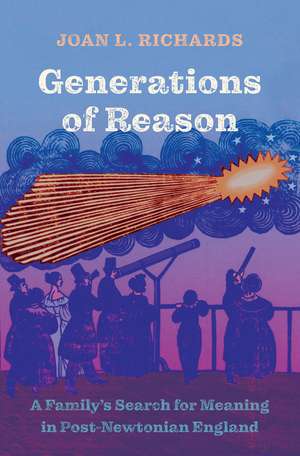
Generations of Reason: A Family’s Search for Meaning in Post-Newtonian England
Autor Joan L. Richardsen Limba Engleză Hardback – 26 oct 2021
Analiza modului în care rațiunea a modelat viața de familie și structurile sociale în Anglia post-newtoniană constituie nucleul acestui volum semnat de Joan L. Richards. Reținem că, spre deosebire de lucrările pur teoretice, Generations of Reason propune o istorie intelectuală intimă, focalizată pe experiența concretă a trei generații de bărbați educați la Cambridge și a femeilor care le-au fost partenere în acest demers al cunoașterii. Autorul reușește să reintegreze științele meditative — teologia, astronomia și logica — în peisajul cultural englez, demonstrând cum angajamentul față de rațiune a influențat nu doar carierele științifice, ci și alegerile etice sau politice ale familiei studiate.
Cititorii familiarizați cu Reason and Authority in the Eighteenth Century de Gerald R. Cragg vor aprecia modul în care Joan L. Richards trece de la analiza abstractă a conceptului de rațiune la aplicarea sa practică în spațiul domestic și academic. În timp ce Cragg se concentrează pe fundamentele filosofice ale Iluminismului, acest volum oferă o perspectivă umanizată, ancorată în documente de arhivă inedite. Această abordare continuă preocupările autoarei din lucrarea sa anterioară, Mathematical Visions: The Pursuit of Geometry in Victorian England, unde a explorat semnificația culturală a geometriei. În volumul de față, ea extinde cadrul de cercetare, oferind o viziune panoramică asupra transformărilor din epoca napoleoniană și zorii erei industriale, fără a pierde din vedere structura fină a gândirii individuale care continuă să ne influențeze percepția asupra lumii moderne.
Preț: 299.68 lei
Carte disponibilă
Livrare economică 18 mai-01 iunie
Livrare express 02-08 mai pentru 47.04 lei
Specificații
ISBN-10: 0300255497
Pagini: 456
Ilustrații: 21 b-w illus.
Dimensiuni: 156 x 235 x 32 mm
Greutate: 0.76 kg
Editura: Yale University Press
Colecția Yale University Press
De ce să citești această carte
Această carte este esențială pentru cercetătorii și studenții interesați de istoria ideilor și sociologia cunoașterii. Cititorul câștigă o înțelegere profundă a modului în care valorile intelectuale pot defini identitatea unei familii de-a lungul a peste un secol. Este un studiu de caz fascinant despre tranziția de la raționalismul clasic la complexitatea epocii victoriene, oferind o perspectivă rară asupra legăturii dintre viața privată și progresul științific.
Despre autor
Joan L. Richards este profesor asociat de istoria matematicii la Universitatea Brown. Expertiza sa se concentrează pe intersecția dintre matematică și cultura britanică, fiind recunoscută pentru lucrarea sa fundamentală despre geometria victoriană. Prin Generations of Reason, ea își demonstrează capacitatea de a sintetiza istoria științei cu biografia intelectuală, menținând un standard academic ridicat și publicând sub egida prestigioasei Yale University Press. Interesele sale academice includ, de asemenea, pedagogia artelor liberale și contextul istoric al dezvoltării disciplinelor logice.
Descriere scurtă
This book recounts the story of three Cambridge-educated Englishmen and the women with whom they chose to share their commitment to reason in all parts of their lives. The reason this family embraced was an essentially human power with the potential to generate true insight into all aspects of the world. In exploring the ways reason permeated three generations of English experience, this book casts new light on key developments in English cultural and political history, from the religious conformism of the eighteenth century through the Napoleonic era into the Industrial Revolution and prosperity of the Victorian age. At the same time, it restores the rich world of the essentially meditative, rational sciences of theology, astronomy, mathematics, and logic to their proper place in the English intellectual landscape. Following the development of their views over the course of an eventful one hundred years of English history illuminates the fine structure of ways reason still operates in our world.
Recenzii
“Joan Richards reveals the struggles of many mathematicians with algebra, symbols, and irrational numbers, all as they debated the power of reason.”—Journal of Modern History
“Through her rich prose, Richards brings to life the struggles of conscience and the resulting choices made by men guided by their devotion and reason, each of whom sought to blaze their own path by wedding their Christian faith with the ultimate symbol of reason: mathematics.”—Courtney A. Hoffman, 1650–1850
“This compelling and wide-ranging family narrative adopts a highly perceptive and novel approach to the transition from the rationalist Enlightenment to the religious, political and mathematical conflicts of Victorian Britain.”—Simon Schaffer, coauthor of Leviathan and the Air-Pump
“This epic masterpiece explores the connections between philosophy, mathematics, spiritualism and faith across successive generations of an utterly extraordinary family. I couldn’t put it down.”—James A. Secord, author of Visions of Science: Books and Readers at the Dawn of the Victorian Age
“This fascinating family saga traces how reason became lived experience in the religion, politics, science, mathematics, spiritualism, and personal tragedy in three generations of an English family. Beautifully written, Generations of Reason vividly evokes how a commitment to living reason unfolded against the backdrop of a century of revolution, reform, and transformation.”—Lorraine Daston, author of Against Nature
“This magnificent book analyses the interlinked lives of three generations of extraordinary thinkers who each grappled with the challenges of integrating their spiritual commitments with powerful and persuasive new ideas about rationality and reason—ideas that increasingly undermined their faith. In a sweeping family saga, Joan Richards’ deep expertise reveals the burning concerns of a tightly knit circle of uniquely interesting men and women as they explored ways of living and believing, moving in different directions through the foundation of Unitarianism to a trust in numbers and mathematical rationality for some and spiritual theosophy for others.”—Janet Browne, author of Charles Darwin: A Biography