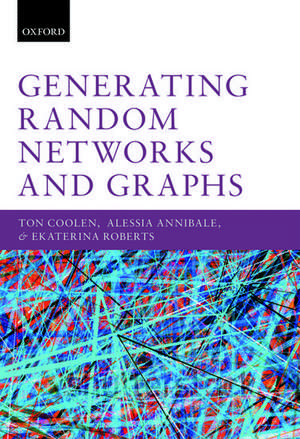
Generating Random Networks and Graphs
Autor Ton Coolen, Alessia Annibale, Ekaterina Robertsen Limba Engleză Hardback – 16 mar 2017
Preț: 537.10 lei
Preț vechi: 679.89 lei
-21%
Puncte Express: 806
Carte tipărită la comandă
Livrare economică 04-09 decembrie
Livrare prin curier în România Termenul estimat este afișat lângă disponibilitate.
Transport gratuit pentru acest produs Plată online sau ramburs, în funcție de opțiunile comenzii.
Retur gratuit în 14 zile Comandă securizată și suport în română.
Specificații
ISBN-13: 9780198709893
ISBN-10: 0198709897
Pagini: 324
Dimensiuni: 179 x 253 x 24 mm
Greutate: 0.79 kg
Editura: OUP OXFORD
Colecția OUP Oxford
Locul publicării:Oxford, United Kingdom
ISBN-10: 0198709897
Pagini: 324
Dimensiuni: 179 x 253 x 24 mm
Greutate: 0.79 kg
Editura: OUP OXFORD
Colecția OUP Oxford
Locul publicării:Oxford, United Kingdom
V-ar putea interesa
-
 Schaum's Outline of Complex Variables, 2edMurray Spiegel-13%Preț: 214.88 lei248.34 lei
 -
 Riemann SurfacesSimon Donaldson-33%Preț: 820.82 lei1219.67 lei
 -
 Quasiconformal Maps and Teichmüller TheoryAlastair Fletcher-30%Preț: 817.83 lei1170.42 lei
 -
 Riemann SurfacesSimon Donaldson-21%Preț: 373.46 lei473.87 lei
 -
 Problems and Solutions for Complex AnalysisRami Shakarchi-15%Preț: 471.95 lei555.23 lei
 -
 Complex AnalysisElias M. Stein-16%Preț: 656.05 lei781.02 lei
 -
 Harmonic Analysis of Operators on Hilbert SpaceBéla Sz Nagy-15%Preț: 539.82 lei635.08 lei
 -
 -18%Preț: 773.31 lei943.07 lei
 -
 Classical and Stochastic Laplacian GrowthBjörn GustafssonPreț: 411.26 lei
 -
 Lectures on Several Complex VariablesPaul M. Gauthier-15%Preț: 542.88 lei638.68 lei
 -
 Preț: 392.46 lei
 -
 -18%Preț: 766.12 lei934.30 lei
 -
 Harmonic Analysis on Exponential Solvable Lie GroupsHidenori Fujiwara-15%Preț: 679.69 lei799.63 lei
 -
 Preț: 404.88 lei
Recenzii
It succeeds to reach a high degree of learning osmosis for the reader; moreover, relative transmission of research experience, to name a few advantages of the volume at hand. The authors succeed in doing many things well, e.g. inventing a lot of suitable paradigms.
This is a magnificent guide through a subject that is deeper, more subtle and much more important for data-based applications than one might suspect, and it fully reflects the authors' technical prowess and teaching abilities. Advanced readers will find much food for thought in these pages.
This is a magnificent guide through a subject that is deeper, more subtle and much more important for data-based applications than one might suspect, and it fully reflects the authors' technical prowess and teaching abilities. Advanced readers will find much food for thought in these pages.
Notă biografică
Ton Coolen received his PhD in Theoretical Physics from the University of Utrecht, followed by postdoctoral work at Utrecht, Nijmegen and Oxford. Since 1995 he has been working at King's College London. During this time he had developed a special interest in multidisciplinary research. This is expressed firstly through applying his expertise in statistical mechanics to problems including medical survival analysis, cellular signalling networks, econophysics and immunology. He also set up the Institute for Mathematical and Molecular Biomedicine in order to bring together colleagues in biology, medicine, physics, computer science and mathematics to work on developing effective quantitative tools for biomedical researchers.Alessia Annibale obtained her undergraduate and Master degrees from the University of Rome "La Sapienza" before moving to the Disordered System and Neural Networks group in King's College London to complete her PhD. She has continued to work as a lecturer in King's College London, with papers published on spin glasses, network dynamics and stochastic processes on finitely connected random graphs. She is a member of the Institute for Mathematical and Molecular Biomedicine, and in recent years has taken a particular interest in applying the mathematical tools of disordered systems to understand the properties of biological networks.Ekaterina Roberts obtained her undergraduate degree from Imperial College, London. After this she worked at the UK's Financial Services Authority, contributing to regulatory policies on how financial institutions should measure and capitalise their credit risk, as well as undertaking direct supervisory oversight of some small banks and insurers. She then joined the Randall Division of Cell and Molecular Biophysics to complete a cross-disciplinary PhD which used statistical mechanics to create tools to analyse random graph ensembles which share topological properties with real molecular networks.