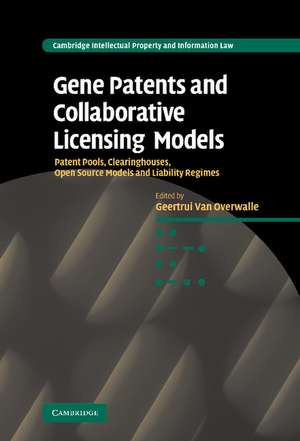
Gene Patents and Collaborative Licensing Models
Editat de Geertrui van Overwalleen Limba Engleză Hardback – 28 iun 2012
Preț: 956.83 lei
Preț vechi: 1112.60 lei
-14%
Puncte Express: 1435
Carte tipărită la comandă
Livrare economică 23 noiembrie-07 decembrie
Livrare prin curier în România Termenul estimat este afișat lângă disponibilitate.
Transport gratuit pentru acest produs Plată online sau ramburs, în funcție de opțiunile comenzii.
Retur gratuit în 14 zile Comandă securizată și suport în română.
Specificații
ISBN-13: 9780521896733
ISBN-10: 0521896738
Pagini: 516
Dimensiuni: 157 x 235 x 32 mm
Greutate: 0.89 kg
Editura: Cambridge University Press
Locul publicării:Cambridge, United Kingdom
ISBN-10: 0521896738
Pagini: 516
Dimensiuni: 157 x 235 x 32 mm
Greutate: 0.89 kg
Editura: Cambridge University Press
Locul publicării:Cambridge, United Kingdom
V-ar putea interesa
-
![Mental Capacity Act 2005 code of practice: [2007 final edition]](https://i1.books-express.ro/bt/9780117037465/mental-capacity-act-2005-code-of-practice-2007-final-edition.jpg) Mental Capacity Act 2005 code of practice: [2007 final edition]Department for Constitutional AffairsPreț: 253.60 lei
Mental Capacity Act 2005 code of practice: [2007 final edition]Department for Constitutional AffairsPreț: 253.60 lei -
 -30%Preț: 479.40 lei684.03 lei
 -
 Who Should We Treat?: Rights, Rationing, and Resources in the NHSChristopher Newdick-25%Preț: 531.07 lei711.01 lei
 -
 Autonomy, Consent and the LawSheila A.M. McLean-15%Preț: 454.61 lei534.84 lei
 -
 -15%Preț: 412.65 lei485.47 lei
 -
 -18%Preț: 822.19 lei1002.67 lei
 -
 -15%Preț: 295.40 lei348.07 lei
 -
 FDA Oversight of Medical Devices: Efforts & DevelopmentsMatthew W Hill-27%Preț: 999.94 lei1362.71 lei
 -
 Abortion Law in the United States & EuropeJean Simpson-27%Preț: 531.97 lei725.45 lei
 -
 Safeguarding Vulnerable Adults and the LawMichael Mandelstam-24%Preț: 261.57 lei344.98 lei
 -
 Essential Mental Health LawAnthony MadenPreț: 201.47 lei
Cuprins
Part I. Patent Pools: 1. Patent pooling for gene-based diagnostic testing: conceptual framework Birgit Verbeure; 2. Case 1. The MPEG LA® licensing model. What problem does it solve in biopharma and genetics? Lawrence A. Horn; 3. Case 2. IP fragmentation and patent pools: the SARS case Carmen E. Correa; 4. Critical analysis of patent pools Jorge A. Goldstein; Part II. Clearing Houses: 5. Clearinghouse mechanisms in genetic diagnostics: conceptual framework Esther van Zimmeren; 6. Case 3. The global biodiversity information facility. An example of an information clearinghouse James L. Edwards; 7. Case 4. BirchBob: an example of a technology exchange clearing house Esther van Zimmeren and Dirk Avau; 8. Case 5. The public intellectual property resource for agriculture. A standard license public sector clearinghouse for agricultural IP Alan B. Bennett and Sara Boettiger; 9. Case 6. The science commons material transfer agreement project. A standard license clearing house? Thinh Nguyen; 10. Case 7. The collective management of copyright and neighbouring rights. An example of a royalty collection clearing house Jan Corbet; 11. Comment on the conceptual framework for a clearing house mechanism Michael Spence; Part III. Open Source: 12. Open source genetics: a conceptual framework Janet Hope; 13. Case 8. CAMBIA's biological open source initiative (BiOS) Nele Berthels; 14. Case 9. Diversity Arrays Technology Pty Ltd.: applying the open source philosophy in agriculture Andrzej Kilian; 15. Critical commentary on 'open source' in the life sciences Arti K. Rai; 16. Several kinds of 'should': the ethics of open source in life sciences innovation Antony Taubman; Part IV. Liability Regimes: 17. Pathways across the valley of death: novel intellectual property strategies for accelerated drug discovery Arti K. Rai, Jerome H. Reichman, Paul F. Uhlir and Colin Crossman; 18. Case 10. The international treaty on plant genetic resources for food and agriculture: the standard material transfer agreement as implementation of a limited compensatory liability regime Victoria Henson-Apollonio; 19. Critical analysis of property rules, liability rules and molecular futures: bargaining in the shadow of the cathedral Dan L. Burk; Part V. Different Perspectives: 20. Gene patents: from discovery to invention. A geneticist's view Gert Matthijs and Gert-Jan Van Ommen; 21. 'Patent Tsunami' in the field of genetic diagnostics. A patent practitioner's view Jacques Warcoin; 22. Gene patents and clearing models. Some comments from a competition law perspective Hanns Ullrich; 23. Access to genetic patents and clearinghouse model. An economic perspective Reiko Aoki; 24. The role of law, institutions and governance in facilitating access to the scientific research commons. A philosopher's perspective Tom Dedeurwaerdere; Part VI. Concluding Thoughts: 25. Of thickets, blocks and gaps: designing tools to resolve obstacles in the gene patents landscape Geertrui van Overwalle.
Recenzii
"Van Overwalle has done an excellent job in creating a compilation that offers diverse perspectives on the feasibility and desirability of translating successful licensing schemes from other industries (electronics, software, entertainment) to biotechnology."
-J. Jonas Anderson,The IP Law Book Review
-J. Jonas Anderson,The IP Law Book Review
Descriere
An examination of legal measures which might be used to solve the problem of fragmentation of patents in genetics.