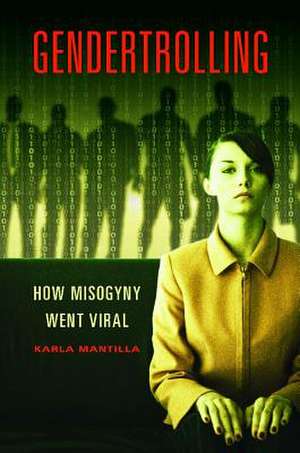
Gendertrolling: How Misogyny Went Viral
Autor Karla Mantillaen Limba Engleză Hardback – 31 aug 2015
Designed to educate the general public on a popular and brutal form of harassment against women, Gendertrolling: How Misogyny Went Viral provides key insight into this Internet phenomenon. The book not only differentiates this violent form of trolling from others but also discusses the legal parameters surrounding the issue, such as privacy, anonymity, and free speech online as well as offering legal and policy recommendations for improving the climate for women online.
The analysis of social media and legal aspects of the book make it highly suitable as a reliable source to many modern classes. Additionally, increased awareness among the general and scholarly public of the phenomenon of gendertrolling would help galvanize widespread support for laws, policies, new online content provider protocols, and positive social pressure.
Preț: 386.52 lei
Preț vechi: 464.76 lei
-17%
Puncte Express: 580
Carte tipărită la comandă
Livrare economică 23 noiembrie-07 decembrie
Livrare prin curier în România Termenul estimat este afișat lângă disponibilitate.
Transport gratuit de la 400.00 lei Plată online sau ramburs, în funcție de opțiunile comenzii.
Retur gratuit în 14 zile Comandă securizată și suport în română.
Specificații
ISBN-13: 9781440833175
ISBN-10: 1440833176
Pagini: 280
Dimensiuni: 162 x 236 x 24 mm
Greutate: 0.61 kg
Editura: Bloomsbury Publishing
Colecția Praeger
Locul publicării:New York, United States
ISBN-10: 1440833176
Pagini: 280
Dimensiuni: 162 x 236 x 24 mm
Greutate: 0.61 kg
Editura: Bloomsbury Publishing
Colecția Praeger
Locul publicării:New York, United States
V-ar putea interesa
-
 Rape and the Legal ProcessJennifer Temkin-28%Preț: 448.46 lei623.85 lei
 -
 Scars Across HumanityElaine StorkeyPreț: 93.33 lei
 -
 Resolving Sexual AbuseYvonne M. DolanPreț: 279.83 lei
 -
 Even from a Broken WebBob BertolinoPreț: 218.99 lei
 -
 Preț: 480.37 lei
 -
 How Long Does It Hurt?Cynthia L MatherPreț: 128.59 lei
 -
 SlutwalkK. MendesPreț: 175.27 lei
 -
 -23%Preț: 39.24 lei51.22 lei
 -
 -27%Preț: 1026.55 lei1397.76 lei
 -
 Ma, Jackser's Dyin AloneMartha Long-18%Preț: 65.41 lei79.76 lei
Cuprins
Acknowledgments
PART I: GENDERTROLLING AND ITS EFFECTS
Chapter 1: Introduction
Chapter 2: Characteristics of Gendertrolling
Chapter 3: Responses to Gendertrolling Campaigns
Chapter 4: Fighting Back
PART II: GENDERTROLLING IN HISTORICAL AND SOCIAL CONTEXT
Chapter 5: Gendertrolling: It's Not about the Internet
Chapter 6: The Power of Naming
Chapter 7: Cultural Defense Mechanisms as Backlash
Chapter 8: Gendertrolling: Cultural Defense Mechanisms at Work
Chapter 9: Recommendations for Change
Epilogue
Notes
Index
PART I: GENDERTROLLING AND ITS EFFECTS
Chapter 1: Introduction
Chapter 2: Characteristics of Gendertrolling
Chapter 3: Responses to Gendertrolling Campaigns
Chapter 4: Fighting Back
PART II: GENDERTROLLING IN HISTORICAL AND SOCIAL CONTEXT
Chapter 5: Gendertrolling: It's Not about the Internet
Chapter 6: The Power of Naming
Chapter 7: Cultural Defense Mechanisms as Backlash
Chapter 8: Gendertrolling: Cultural Defense Mechanisms at Work
Chapter 9: Recommendations for Change
Epilogue
Notes
Index
Recenzii
Mantilla's work is valuable . . . for gathering firsthand voices of gendertrolling victims about their experiences, reactions, and attempts to fight back. Furthermore, the author successfully contextualizes gendertrolling in the history of misogyny. By doing so, she persuasively argues that gendertrolling is not unique to digital experiences but is a new form of misogyny and abuse against women. She lists various recommendations for legal protections and strategies to fight against gendertrolling and generate solutions. Summing Up: Recommended. All levels/libraries.
The contemporary issues addressed in the book are relevant to undergraduate and graduate instructors seeking to offer guidance in new media, prejudice, and the ethics of unrestricted 'free speech' in Internet environments. Each chapter can be taught independently, allowing for text-based questions and discussion in a small graduate-level seminar or a large undergraduate lecture. . . . Mantilla's book has utility beyond the classroom settingbecause it contributes to a larger cultural conversation concerning the regulation of online sexist speech.
The contemporary issues addressed in the book are relevant to undergraduate and graduate instructors seeking to offer guidance in new media, prejudice, and the ethics of unrestricted 'free speech' in Internet environments. Each chapter can be taught independently, allowing for text-based questions and discussion in a small graduate-level seminar or a large undergraduate lecture. . . . Mantilla's book has utility beyond the classroom settingbecause it contributes to a larger cultural conversation concerning the regulation of online sexist speech.