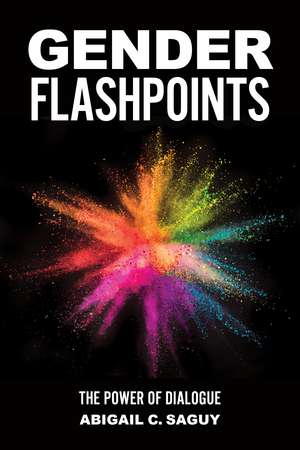
Gender Flashpoints: The Power of Dialogue
Autor Abigail C. Saguyen Limba Engleză Paperback – 8 iun 2026 – vârsta ani
Saguy interviews activists across the full political spectrum about a wide range of contemporary debates over gender to better understand points of contention as well as surprising areas of agreement. She finds that at the crux of many of these debates are disputes about the goals of gender-related advocacy, the strategies to achieve these goals, and whose rights are being advocated for. For example, when discussing pregnancy-related policy issues, there is disagreement as to whether the term “pregnant person” or “pregnant woman” should be used. While some believe “pregnant person” affirms the existence of nonbinary people and trans men, others believe it erases women. These differences often appear to be simply about language, but they are, in fact, disagreements on worldviews, identities, and legitimacy.
One of the conflicts Saguy dives into is the issue of gender-neutral restrooms. She finds when interviewing different activists about what they thought of the topic, they initially repeated the familiar, mainstream polarized discourse. LGBTQ+ activists and mainstream feminists emphasized the importance of restroom access, especially for transgender and gender-nonconforming people. Conservatives and gender-critical feminists emphasized women’s and girls’ vulnerability and need for privacy and safety in public restrooms. Across the political spectrum, activists spoke about how those on the “other side” were unwilling to engage in productive dialogue. However, Saguy also finds that activists on both sides recognized the complexity of the issue and agreed on the need for public bathrooms that provided everyone with greater safety and privacy. Activists across the spectrum showed enthusiasm for desegregated public restrooms that include an open space for sinks and mirrors—along with toilets with European style, fully enclosed floor-to-ceiling doors. Saguy advocates for engaging in dialogue about charged issues, such as gender-neutral bathrooms, in order to help identify workable solutions to seemingly intractable social problems.
Gender Flashpoints is a fascinating and comprehensive view of the deeply personal and divisive topic of gender that offers hope for finding common ground and a path forward.
Preț: 201.93 lei
Puncte Express: 303
Carte disponibilă
Livrare economică 09-23 noiembrie
Livrare prin curier în România Termenul estimat este afișat lângă disponibilitate.
Transport gratuit de la 400.00 lei Plată online sau ramburs, în funcție de opțiunile comenzii.
Retur gratuit în 14 zile Comandă securizată și suport în română.
Specificații
ISBN-13: 9780871548511
ISBN-10: 0871548518
Pagini: 200
Dimensiuni: 152 x 229 x 18 mm
Greutate: 0.36 kg
Editura: Russell Sage Foundation
Colecția Russell Sage Foundation
ISBN-10: 0871548518
Pagini: 200
Dimensiuni: 152 x 229 x 18 mm
Greutate: 0.36 kg
Editura: Russell Sage Foundation
Colecția Russell Sage Foundation
Recenzii
“Gender Flashpoints represents a vital contribution to understanding gender as both a major axis of social inequality and a central aspect of personal identity. Through a wide-ranging analysis of what we know about gender—coupled with original research on the activists who are shaping current debates—Abigail Saguy does a masterful job of shining light and lowering the heat on this important but increasingly contentious subject. Her fair-minded insights accomplish the remarkable feat of addressing the variety of issues that have divided scholars and political activists alike while also remaining above the fray. By providing a road map for thinking about the diverse points of disagreement, she has given us a brave book that is a gift to researchers, teachers, and students at all levels.” —KATHLEEN GERSON, professor of sociology and Collegiate Professor of Arts and Science, New York University
“Americans have been talking past each other on hot-button gender questions for decades, barely stopping to consider what each other is saying. Gender Flashpoints is a crucial gift: it lays out the terrain, the fissures, the assumptions, and the conflicts that these debates presume. People on all sides of sex and gender debates will find this guide essential.”—ANDREW PERRIN, SNF-Agora Professor of Sociology, Johns Hopkins University
“Gender Flashpoints is a terrific book that should be required reading for scholars and students of sex and gender no matter the discipline. It provides a thick, nonjudgmental description of how different individuals and groups within and outside of feminism think about sex and gender. The book is novel and brave in this respect but also in its normative contribution: Abigail Saguy identifies both the collisions and the points of agreement that can provide the basis for rigorous dialogue and potential resolution.”— DORIANE LAMBELET COLEMAN, Thomas L. Perkins Distinguished Professor of Law, Duke University School of Law
“Americans have been talking past each other on hot-button gender questions for decades, barely stopping to consider what each other is saying. Gender Flashpoints is a crucial gift: it lays out the terrain, the fissures, the assumptions, and the conflicts that these debates presume. People on all sides of sex and gender debates will find this guide essential.”—ANDREW PERRIN, SNF-Agora Professor of Sociology, Johns Hopkins University
“Gender Flashpoints is a terrific book that should be required reading for scholars and students of sex and gender no matter the discipline. It provides a thick, nonjudgmental description of how different individuals and groups within and outside of feminism think about sex and gender. The book is novel and brave in this respect but also in its normative contribution: Abigail Saguy identifies both the collisions and the points of agreement that can provide the basis for rigorous dialogue and potential resolution.”— DORIANE LAMBELET COLEMAN, Thomas L. Perkins Distinguished Professor of Law, Duke University School of Law
Notă biografică
ABIGAIL C. SAGUY is a professor of sociology, University of California, Los Angeles
Textul de pe ultima copertă
Americans are deeply divided about gender. Like other issues in the U.S., debates about gender are extremely polarized and can spark intense anger and conflict. These “gender flashpoints” include gender identity, gender and parenting, gender-neutral restrooms, the use of identifying pronouns, and participation in women’s sports. Even the term gender itself has become contested. In this divisive social context, advocates on both sides have reduced complex issues to all-or-nothing propositions. Many people are confused about these topics, embarrassed about what they do not know, or afraid that they will be called a bigot if they say the “wrong thing.” In Gender Flashpoints, sociologist Abigail C. Saguy gets to the root of these major disagreements about gender.
Saguy interviews activists across the full political spectrum about a wide range of contemporary debates over gender to better understand points of contention as well as surprising areas of agreement. She finds that at the crux of many of these debates are disputes about the goals of gender-related advocacy, the strategies to achieve these goals, and whose rights are being advocated for. For example, when discussing pregnancy-related policy issues, there is disagreement as to whether the term “pregnant person” or “pregnant woman” should be used. While some believe “pregnant person” affirms the existence of nonbinary people and trans men, others believe it erases women. These differences often appear to be simply about language, but they are, in fact, disagreements on worldviews, identities, and legitimacy.
One of the conflicts Saguy dives into is the issue of gender-neutral restrooms. She finds when interviewing different activists about what they thought of the topic, they initially repeated the familiar, mainstream polarized discourse. LGBTQ+ activists and mainstream feminists emphasized the importance of restroom access, especially for transgender and gender-nonconforming people. Conservatives and gender-critical feminists emphasized women’s and girls’ vulnerability and need for privacy and safety in public restrooms. Across the political spectrum, activists spoke about how those on the “other side” were unwilling to engage in productive dialogue. However, Saguy also finds that activists on both sides recognized the complexity of the issue and agreed on the need for public bathrooms that provided everyone with greater safety and privacy. Activists across the spectrum showed enthusiasm for desegregated public restrooms that include an open space for sinks and mirrors—along with toilets with European style, fully enclosed floor-to-ceiling doors. Saguy advocates for engaging in dialogue about charged issues, such as gender-neutral bathrooms, in order to help identify workable solutions to seemingly intractable social problems.
Gender Flashpoints is a fascinating and comprehensive view of the deeply personal and divisive topic of gender that offers hope for finding common ground and a path forward.
Saguy interviews activists across the full political spectrum about a wide range of contemporary debates over gender to better understand points of contention as well as surprising areas of agreement. She finds that at the crux of many of these debates are disputes about the goals of gender-related advocacy, the strategies to achieve these goals, and whose rights are being advocated for. For example, when discussing pregnancy-related policy issues, there is disagreement as to whether the term “pregnant person” or “pregnant woman” should be used. While some believe “pregnant person” affirms the existence of nonbinary people and trans men, others believe it erases women. These differences often appear to be simply about language, but they are, in fact, disagreements on worldviews, identities, and legitimacy.
One of the conflicts Saguy dives into is the issue of gender-neutral restrooms. She finds when interviewing different activists about what they thought of the topic, they initially repeated the familiar, mainstream polarized discourse. LGBTQ+ activists and mainstream feminists emphasized the importance of restroom access, especially for transgender and gender-nonconforming people. Conservatives and gender-critical feminists emphasized women’s and girls’ vulnerability and need for privacy and safety in public restrooms. Across the political spectrum, activists spoke about how those on the “other side” were unwilling to engage in productive dialogue. However, Saguy also finds that activists on both sides recognized the complexity of the issue and agreed on the need for public bathrooms that provided everyone with greater safety and privacy. Activists across the spectrum showed enthusiasm for desegregated public restrooms that include an open space for sinks and mirrors—along with toilets with European style, fully enclosed floor-to-ceiling doors. Saguy advocates for engaging in dialogue about charged issues, such as gender-neutral bathrooms, in order to help identify workable solutions to seemingly intractable social problems.
Gender Flashpoints is a fascinating and comprehensive view of the deeply personal and divisive topic of gender that offers hope for finding common ground and a path forward.